



 Chat with AI
Exam 13: Urban Patterns

Exam 1: Basic Concepts112 Questions
Exam 2: Population and Health102 Questions
Exam 3: Migration104 Questions
Exam 4: Folk and Popular Culture111 Questions
Exam 5: Languages123 Questions
Exam 6: Religions118 Questions
Exam 7: Ethnicities113 Questions
Exam 8: Political Geography128 Questions
Exam 9: Development99 Questions
Exam 10: Food and Agriculture132 Questions
Exam 11: Industry and Manufacturing118 Questions
Exam 12: Services and Settlements117 Questions
Exam 13: Urban Patterns113 Questions
Select questions type


In the early 1900s most people in the world lived in rural communities.
(True/False)
4.8/5  (81)
(81) Public housing comprises a large percentage of housing in Britain but only a small percentage in the United States.
(True/False)
4.8/5 (71)
(71)  -According to this map of the St. Louis area, the
Sometimes geographers, public officials, and market analysts are so involved with questions of "how" to enact changes that we don't pause enough to ask "why" or "whether we should" aid specific types of developments in a city or neighborhood. In actuality, controversies abound over urban transitions, gentrification, and plans involving new construction. Go online to search for recent media coverage of controversial changes in your city or community, and ask professors and fellow students about the ethical dimensions of those changes. What changes have most residents been concerned about? What alternative plans have been proposed?
(Essay)
4.8/5 (62)
(62) Compared to the United Kingdom, the amount of sprawl in the United States is
(Multiple Choice)
4.8/5 (77)
(77) The supply of land for new housing is more severely restricted outside European cities than U.S. cities.
(True/False)
4.8/5 (80)
(80) People in the United States are attracted to suburbs in part because suburbs are characterized by
(Multiple Choice)
4.8/5 (77)
(77) 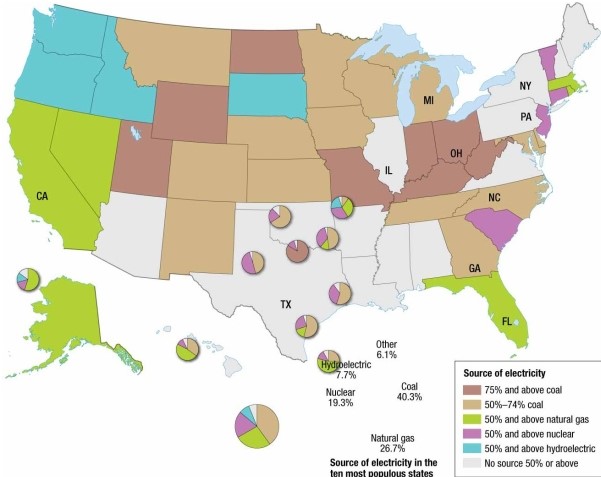 -Looking at this map of U.S. electrical sources, what are the major sources of energy today in the U.S. Southwest? What energy alternatives can you propose for the Southwest? Assuming that your energy alternatives could be fully implemented in the next few years, what energy options would then become available to other regions of the country as well?
 (Essay)
4.9/5 (77)
(77) The areas on the periphery of cities in less developed countries are sometimes known as
(Multiple Choice)
4.7/5 (75)
(75) Envision a radical new plan of your own for using existing automobile technologies most effectively, to positively impact human lives, city planning, and other societal concerns. How would your plan solve or ameliorate some of the problems raised in this chapter?
(Essay)
5.0/5 (79)
(79) Many of the poor on the periphery of cities in less developed countries live in areas known as
(Multiple Choice)
4.7/5 (83)
(83) What activity tends to locate on the street-level floor of a skyscraper in a typical North American CBD?
(Multiple Choice)
4.9/5 (85)
(85) 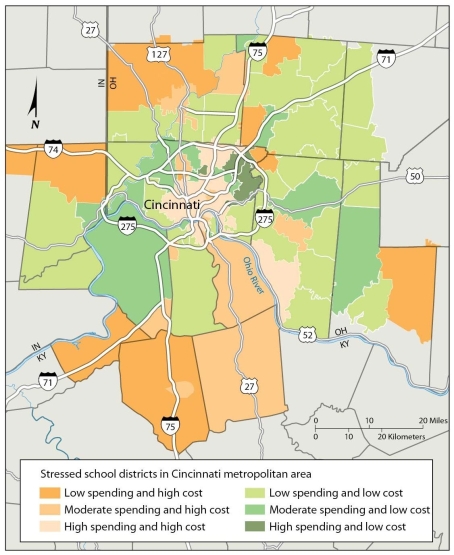 -Analyze this map of stressed school districts. Imagine that you have been given the power to redesign the city's school system, as well as any other urban patterns that correlate to the school system, specifically to relieve those stressed schools-as if this were a "war on poor education" for which massive amounts of national, state, and local resources were made available. What would you do to relieve these school districts? How radical would your plan be, compared to the status quo?
 (Essay)
4.9/5 (80)
(80) The process that includes subdividing a house from single-family owner occupancy to multiple occupancy, is
(Multiple Choice)
4.9/5 (80)
(80) Chicago is a good location in which to develop urban models because it is located
(Multiple Choice)
4.8/5 (75)
(75) In general, higher status families in the United States are more likely to live farther away from a city center while lower status people tend to live closer to the city center.
(True/False)
4.8/5 (76)
(76) The strongest criticism of suburbs argued that historically,
(Multiple Choice)
4.8/5 (77)
(77) According to the concentric zone model, a city develops in a series of
(Multiple Choice)
4.8/5 (73)
(73) 
Filters
- Essay(0)
- Multiple Choice(0)
- Short Answer(0)
- True False(0)
- Matching(0)