



 Chat with AI
Exam 13: Urban Patterns


What is the zone in transition, and what are some of the social problems found there?

 (82)
 Answered by Examlex AI Copilot
The "zone in transition" is a term used in urban sociology and refers to an area within a city that surrounds the central business district (CBD). This concept was first introduced by sociologists Ernest Burgess in 1925 as part of his concentric zone model, which sought to explain urban social structures and their relation to space. The zone in transition is typically characterized by a state of flux, where residential properties are being encroached upon by commercial and industrial interests.
This area is often one of the first to experience the effects of urban expansion and change. It usually features a mix of uses, including light manufacturing, warehouses, small businesses, and residential buildings, many of which may be in a state of disrepair due to the pressures of potential redevelopment. The population in the zone in transition is often diverse, including immigrants, lower-income families, and other marginalized groups who may be attracted by the relatively lower rents and central location.
Some of the social problems commonly found in the zone in transition include:
1. Housing issues: Substandard housing and overcrowding are prevalent, as the area may contain older buildings that are not well-maintained. Landlords may neglect properties because of the anticipated redevelopment, leading to unsafe living conditions.
2. Poverty: Economic hardship is common among residents, as the area may not offer many well-paying jobs, and the cost of living in the city can be high.
3. Crime: Higher crime rates are often reported in these areas, possibly due to a combination of poverty, lack of social cohesion, and inadequate policing.
4. Social disorganization: The rapid turnover of residents and businesses can lead to a lack of stable community networks and social institutions, which in turn can exacerbate crime and delinquency.
5. Health problems: Residents may face health issues related to pollution from nearby industrial activities, limited access to healthcare services, and stress from living in an environment with high noise levels and poor air quality.
6. Educational challenges: Schools in the zone in transition may be under-resourced and overcrowded, leading to lower educational outcomes for children in the area.
7. Gentrification: As the area becomes more attractive to developers and higher-income residents, the original inhabitants may be displaced due to rising rents and property values, leading to a loss of community and cultural displacement.
Urban planners and policymakers often focus on zones in transition when considering urban renewal projects, affordable housing initiatives, and community development programs to address these social problems and improve the quality of life for residents.
Public transit is more extensive in Western European cities than in the United States primarily because
(64)  Verified
B
Given our concerns about the underclass, homelessness, ethnic and racial segregation, and other problems in society today, invent a set of ethical guidelines that you believe that geographers should follow in their work. Be as specific as possible, and use evidence from the textbook to reinforce the ethical frameworks that you create.
(81) Answered by Examlex AI CopilotAs geographers, it is important for us to approach our work with a strong ethical framework in order to address the concerns of the underclass, homelessness, ethnic and racial segregation, and other societal problems. In order to do so, I propose the following set of ethical guidelines for geographers to follow in their work:
1. Respect for Human Dignity: Geographers should always prioritize the respect and dignity of all individuals, especially those who are marginalized or vulnerable. This means actively working to understand and address the root causes of issues such as homelessness and racial segregation, and advocating for policies and solutions that prioritize the well-being of these communities.
2. Social Justice and Equity: Geographers should strive to promote social justice and equity in their work, particularly in relation to issues of poverty, inequality, and discrimination. This may involve conducting research that highlights the disparities in access to resources and opportunities, and advocating for policies that aim to address these disparities.
3. Community Engagement and Empowerment: Geographers should actively engage with and involve the communities they study in their research and decision-making processes. This means seeking input and collaboration from community members, and working to empower these communities to advocate for their own needs and interests.
4. Ethical Research Practices: Geographers should adhere to ethical research practices, including obtaining informed consent from research participants, protecting their privacy and confidentiality, and ensuring that their research does not cause harm to the communities they study.
5. Environmental Sustainability: Geographers should also consider the ethical implications of their work on the environment, and strive to promote sustainable and environmentally-friendly practices in their research and advocacy efforts.
These ethical guidelines are supported by evidence from the textbook, which emphasizes the importance of understanding and addressing social and environmental issues from a holistic and ethical perspective. By following these guidelines, geographers can contribute to the creation of a more just and equitable society for all.
The density gradient in American and European cities is becoming flatter.
(84) A process by which banks designate an area within which they refuse to lend money for improvements is
(71) 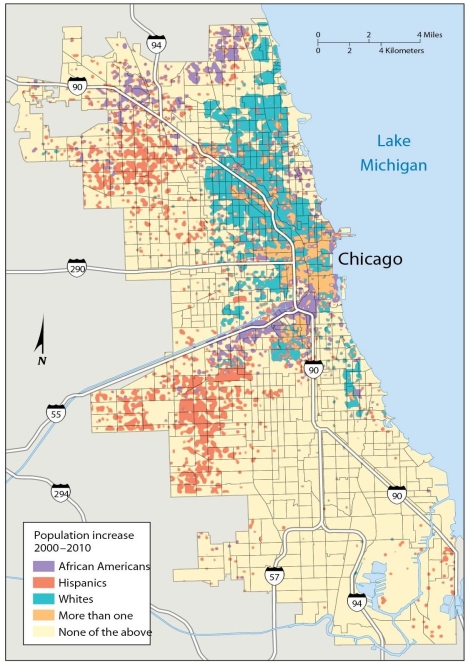 -This map of Chicago indicates that virtually no whites live in the predominantly Hispanic and African American neighborhoods.
 (65) Imagine that all of the skyscrapers in Chicago higher than 20 storeys would have to be demolished for a combination of reasons involving safety, public health, and legal concerns, and that no additional tall skyscrapers were allowed to be built in Illinois. Assuming that people would still want to live and work in Chicago, how would the urban landscape and economy of the city change as a result?
(88) Public housing accounts for approximately 30% of all dwellings in the United States, whereas in the United Kingdom it is as high as 11%.
(85) What model of urban development does your present city or town most closely resemble? In what ways do some specific parts of it also resemble the other urban models?
(68) Most urban residents in the United States live in central cities rather than suburbs.
(86) During the process of ________, the owner may abandon the property because the rents that can be collected are less than the costs involved in upkeep.
(78) About ________ of the homeless people in the United States are single men, and the remainder are women and children.
(74) Under certain conditions, according to U.S. law when a family is forced by a city to relocate,
(77) Large numbers of employees of suburban businesses may suffer hardships because they do not
(85) 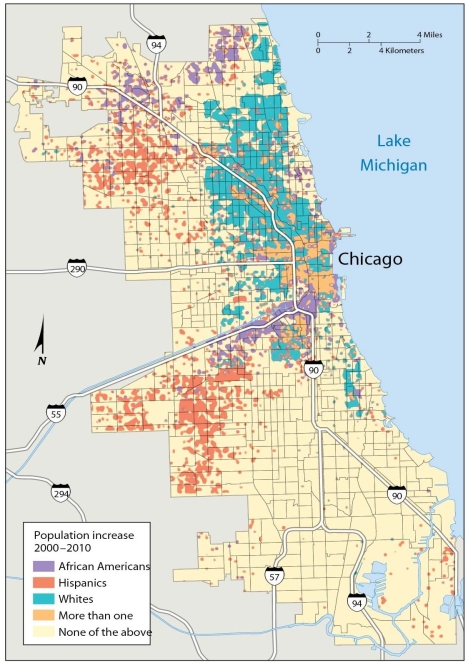 -This map of Chicago indicates that the African American population has increased in some neighborhoods of the city.
 (78) Retail activities which tend to concentrate in the CBD include those which have
(81) Detroit is trying to figure out how to shut down and close off ________ because the city cannot afford to pay for street lights, garbage pickup, and police protection for the entire 360 square kilometers (139 square miles).
(81) The U.S. government estimated in 2011 that the number of homeless people on any given night was about
(73) 
Filters
- Essay(0)
- Multiple Choice(0)
- Short Answer(0)
- True False(0)
- Matching(0)