



 Chat with AI
Exam 26: Fiscal Policy

Exam 1: The Central Idea156 Questions
Exam 2: Observing and Explaining the Economy143 Questions
Exam 3: The Supply and Demand Model166 Questions
Exam 4: Subtleties of the Supply and Demand Model176 Questions
Exam 5: The Demand Curve and the Behavior of Consumers176 Questions
Exam 6: The Supply Curve and the Behavior of Firms179 Questions
Exam 7: The Efficiency of Markets163 Questions
Exam 8: Costs and the Changes at Firms Over Time191 Questions
Exam 9: The Rise and Fall of Industries139 Questions
Exam 10: Monopoly184 Questions
Exam 11: Product Differentiation, Monopolistic Competition, and Oligopoly169 Questions
Exam 12: Antitrust Policy and Regulation152 Questions
Exam 13: Labor Markets179 Questions
Exam 14: Taxes, Transfers, and Income Distribution179 Questions
Exam 15: Public Goods, Externalities, and Government Behavior197 Questions
Exam 16: Capital and Financial Markets188 Questions
Exam 17: Macroeconomics: the Big Picture159 Questions
Exam 18: Measuring the Production, Income, and Spending of Nations177 Questions
Exam 19: The Spending Allocation Model166 Questions
Exam 20: Unemployment and Employment212 Questions
Exam 21: Productivity and Economic Growth162 Questions
Exam 22: Money and Inflation153 Questions
Exam 23: The Nature and Causes of Economic Fluctuations185 Questions
Exam 24: The Economic Fluctuations Model205 Questions
Exam 25: Using the Economic Fluctuations Model176 Questions
Exam 26: Fiscal Policy138 Questions
Exam 27: Monetary Policy180 Questions
Exam 28: Economic Growth Around the World157 Questions
Exam 29: International Trade242 Questions
Exam 30: International Finance125 Questions
Select questions type


Suppose the economy is initially in equilibrium, and real and potential GDP are equal. Now, suppose export orders increase. Under these circumstances, which of the following statements is true?
(Multiple Choice)
4.9/5  (78)
(78) The size of the budget surplus depends on the state of the economy.
(True/False)
4.8/5 (78)
(78) What are the arguments used by the proponents of discretionary fiscal policy?
(Essay)
4.8/5 (75)
(75) The structural budget surplus is the size of the budget surplus when
(Multiple Choice)
4.7/5 (83)
(83) Which of the following is not an instrument of fiscal policy?
(Multiple Choice)
4.9/5 (64)
(64) All four of the major fiscal interventions implemented in the 2000's decade have been blamed for worsening the long-term budget situation of the United States.
(True/False)
5.0/5 (67)
(67) Which of the following would cause the AD curve to shift to the left?
(Multiple Choice)
4.7/5 (63)
(63) The year 2001 was the ____ consecutive year the U.S. federal government had been running a budget ____.
(Multiple Choice)
4.8/5 (83)
(83) Suppose the government surplus is currently .5 percent of real GDP and the structural surplus is 1.5 percent.

(Essay)
4.9/5 (79)
(79) The table below shows the relationship between the deficit and real GDP. Draw a diagram depicting this relationship. Assume potential GDP is $6,900 billion. 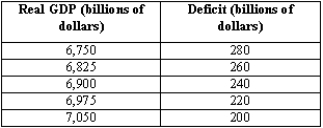

(Essay)
4.8/5 (79)
(79) The 2008 and 2009 major fiscal stimulus bills were motivated by the serious economic recession that hit the United States in 2008, and can be classified as "countercyclical."
(True/False)
4.8/5 (77)
(77) In which of the following years was the debt to GDP ratio the lowest?
(Multiple Choice)
4.9/5 (81)
(81) Which of the following is true about the projected U.S. federal tax revenues and expenditures for 2017?
(Multiple Choice)
4.9/5 (88)
(88) 
Filters
- Essay(0)
- Multiple Choice(0)
- Short Answer(0)
- True False(0)
- Matching(0)