



 Chat with AI
Exam 26: Fiscal Policy

Exam 1: The Central Idea156 Questions
Exam 2: Observing and Explaining the Economy143 Questions
Exam 3: The Supply and Demand Model166 Questions
Exam 4: Subtleties of the Supply and Demand Model176 Questions
Exam 5: The Demand Curve and the Behavior of Consumers176 Questions
Exam 6: The Supply Curve and the Behavior of Firms179 Questions
Exam 7: The Efficiency of Markets163 Questions
Exam 8: Costs and the Changes at Firms Over Time191 Questions
Exam 9: The Rise and Fall of Industries139 Questions
Exam 10: Monopoly184 Questions
Exam 11: Product Differentiation, Monopolistic Competition, and Oligopoly169 Questions
Exam 12: Antitrust Policy and Regulation152 Questions
Exam 13: Labor Markets179 Questions
Exam 14: Taxes, Transfers, and Income Distribution179 Questions
Exam 15: Public Goods, Externalities, and Government Behavior197 Questions
Exam 16: Capital and Financial Markets188 Questions
Exam 17: Macroeconomics: the Big Picture159 Questions
Exam 18: Measuring the Production, Income, and Spending of Nations177 Questions
Exam 19: The Spending Allocation Model166 Questions
Exam 20: Unemployment and Employment212 Questions
Exam 21: Productivity and Economic Growth162 Questions
Exam 22: Money and Inflation153 Questions
Exam 23: The Nature and Causes of Economic Fluctuations185 Questions
Exam 24: The Economic Fluctuations Model205 Questions
Exam 25: Using the Economic Fluctuations Model176 Questions
Exam 26: Fiscal Policy138 Questions
Exam 27: Monetary Policy180 Questions
Exam 28: Economic Growth Around the World157 Questions
Exam 29: International Trade242 Questions
Exam 30: International Finance125 Questions
Select questions type


Why is discretionary fiscal policy considered risky or somewhat uncertain?
(Essay)
4.7/5  (82)
(82) Which of the following Nobel laureate economists is against the use of discretionary fiscal policy?
(Multiple Choice)
4.7/5 (88)
(88) The U.S. federal budget for 2017 projects higher expenditures than tax revenues.
(True/False)
4.9/5 (82)
(82) The Jobs and Growth Tax Relief Reconciliation Act (JGTRRA) of 2003 was implemented amidst concerns about the slow recovery of the economy following the 2001 recession.
(True/False)
4.8/5 (78)
(78) The recent use of discretionary fiscal policy was facilitated by
(Multiple Choice)
4.8/5 (89)
(89) The major summary document describing U.S. federal fiscal policy is the
(Multiple Choice)
4.7/5 (82)
(82) Suppose a recession occurs unexpectedly in December one year. Explain why the actual budget will differ from the predicted budget.
(Essay)
4.9/5 (86)
(86) If a federal budget in which expenditures exceed revenue is enacted, the federal government will
(Multiple Choice)
4.8/5 (78)
(78) 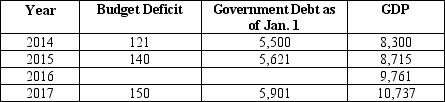

Which of the following is not an argument for the use of rules over discretion?
(Multiple Choice)
4.8/5 (73)
(73) About half of the U.S. budget consists of social security, Medicare, and Medicaid. Which of the following is not true about these important expenditures?
(Multiple Choice)
4.7/5 (70)
(70) By law, Congress and the president must approve the budget by the beginning of the fiscal year.
(True/False)
4.8/5 (77)
(77) Which of the following types of taxes have been growing rapidly as a share of federal government revenues?
(Multiple Choice)
4.8/5 (79)
(79) Suppose you have the following data on projected and actual figures for the U.S. budget for 2001 (in billions of dollars): 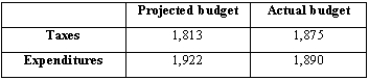

(Essay)
4.7/5 (78)
(78) 
Filters
- Essay(0)
- Multiple Choice(0)
- Short Answer(0)
- True False(0)
- Matching(0)