



 Chat with AI
Exam 26: Fiscal Policy

Exam 1: The Central Idea156 Questions
Exam 2: Observing and Explaining the Economy143 Questions
Exam 3: The Supply and Demand Model166 Questions
Exam 4: Subtleties of the Supply and Demand Model176 Questions
Exam 5: The Demand Curve and the Behavior of Consumers176 Questions
Exam 6: The Supply Curve and the Behavior of Firms179 Questions
Exam 7: The Efficiency of Markets163 Questions
Exam 8: Costs and the Changes at Firms Over Time191 Questions
Exam 9: The Rise and Fall of Industries139 Questions
Exam 10: Monopoly184 Questions
Exam 11: Product Differentiation, Monopolistic Competition, and Oligopoly169 Questions
Exam 12: Antitrust Policy and Regulation152 Questions
Exam 13: Labor Markets179 Questions
Exam 14: Taxes, Transfers, and Income Distribution179 Questions
Exam 15: Public Goods, Externalities, and Government Behavior197 Questions
Exam 16: Capital and Financial Markets188 Questions
Exam 17: Macroeconomics: the Big Picture159 Questions
Exam 18: Measuring the Production, Income, and Spending of Nations177 Questions
Exam 19: The Spending Allocation Model166 Questions
Exam 20: Unemployment and Employment212 Questions
Exam 21: Productivity and Economic Growth162 Questions
Exam 22: Money and Inflation153 Questions
Exam 23: The Nature and Causes of Economic Fluctuations185 Questions
Exam 24: The Economic Fluctuations Model205 Questions
Exam 25: Using the Economic Fluctuations Model176 Questions
Exam 26: Fiscal Policy138 Questions
Exam 27: Monetary Policy180 Questions
Exam 28: Economic Growth Around the World157 Questions
Exam 29: International Trade242 Questions
Exam 30: International Finance125 Questions
Select questions type


The stimulus package of 2009 is a good example of a countercyclical fiscal policy, a $789 billion package of government spending increases and tax cuts that aims to help the U.S. economy recover from a deep recession by increasing real GDP and moving the economy closer to potential output.
(True/False)
4.9/5  (82)
(82) Social security is the biggest spending item in the U.S. 2017 federal budget, followed by defense.
(True/False)
4.9/5 (66)
(66) The federal deficit is the total amount of outstanding loans that the U.S. federal government owes.
(True/False)
4.8/5 (78)
(78) Which of the following types of taxes are not used by the federal government to raise revenue?
(Multiple Choice)
4.9/5 (80)
(80) At any one time, there can be discussions in Congress about only one year's budget.
(True/False)
4.8/5 (95)
(95) The Jobs and Growth Tax Relief Reconciliation Act (JGTRRA) of 2003 accelerated the tax cuts introduced in the 2001 plan, increased tax rates on capital gains and dividends, and introduced a child tax credit for parents.
(True/False)
4.8/5 (73)
(73) Most government expenditures are for purchases of new goods and services.
(True/False)
4.9/5 (89)
(89) Which of the following is the largest component of federal government expenditures?
(Multiple Choice)
5.0/5 (85)
(85) 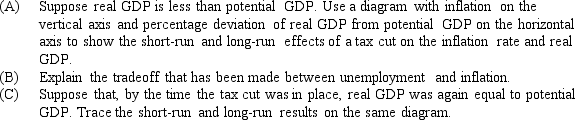
In using countercyclical policy during a recession, the government faces a tradeoff between reducing unemployment now and reducing inflation in the long run. Please explain.
(Essay)
4.9/5 (86)
(86) Increasing government purchases can contribute to higher inflation.
(True/False)
4.9/5 (73)
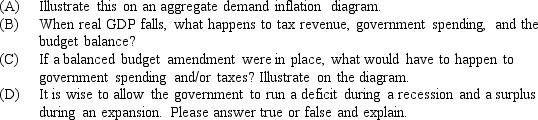
(73) Suppose that the economy is in a recession as a result of a fall in investment spending and real GDP is below potential GDP.
(Essay)
4.9/5 (77)
(77) 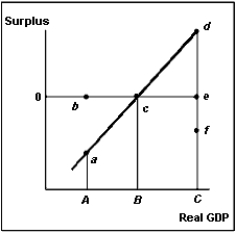
For a hypothetical economy in 2010, the deficit was $300 billion, the national debt was $3,800 billion, and the average interest rate on the federal debt was 6.0 percent. The amount of interest payments made that year was
(Multiple Choice)
4.9/5 (72)
(72) Why is there an inverse relationship between real GDP and the budget deficit?
(Essay)
4.8/5 (78)
(78) Suppose the economy is initially in equilibrium at point A in the figure below. A decrease in investment expenditures causes the AD curve to shift back to AD2. Under these circumstances, which of the following statements is true? 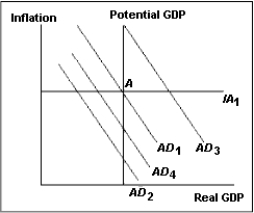
(Multiple Choice)
4.8/5 (77)
(77) 
Filters
- Essay(0)
- Multiple Choice(0)
- Short Answer(0)
- True False(0)
- Matching(0)