



 Chat with AI
Exam 26: Fiscal Policy

Exam 1: The Central Idea156 Questions
Exam 2: Observing and Explaining the Economy143 Questions
Exam 3: The Supply and Demand Model166 Questions
Exam 4: Subtleties of the Supply and Demand Model176 Questions
Exam 5: The Demand Curve and the Behavior of Consumers176 Questions
Exam 6: The Supply Curve and the Behavior of Firms179 Questions
Exam 7: The Efficiency of Markets163 Questions
Exam 8: Costs and the Changes at Firms Over Time191 Questions
Exam 9: The Rise and Fall of Industries139 Questions
Exam 10: Monopoly184 Questions
Exam 11: Product Differentiation, Monopolistic Competition, and Oligopoly169 Questions
Exam 12: Antitrust Policy and Regulation152 Questions
Exam 13: Labor Markets179 Questions
Exam 14: Taxes, Transfers, and Income Distribution179 Questions
Exam 15: Public Goods, Externalities, and Government Behavior197 Questions
Exam 16: Capital and Financial Markets188 Questions
Exam 17: Macroeconomics: the Big Picture159 Questions
Exam 18: Measuring the Production, Income, and Spending of Nations177 Questions
Exam 19: The Spending Allocation Model166 Questions
Exam 20: Unemployment and Employment212 Questions
Exam 21: Productivity and Economic Growth162 Questions
Exam 22: Money and Inflation153 Questions
Exam 23: The Nature and Causes of Economic Fluctuations185 Questions
Exam 24: The Economic Fluctuations Model205 Questions
Exam 25: Using the Economic Fluctuations Model176 Questions
Exam 26: Fiscal Policy138 Questions
Exam 27: Monetary Policy180 Questions
Exam 28: Economic Growth Around the World157 Questions
Exam 29: International Trade242 Questions
Exam 30: International Finance125 Questions
Select questions type


There is an inverse relationship between the budget deficit and real GDP because
(Multiple Choice)
4.9/5  (80)
(80) The largest share of expenditures by state and local governments is for
(Multiple Choice)
4.7/5 (79)
(79) What are the three classes of federal expenditures? Of these, what is the largest?
(Essay)
4.9/5 (84)
(84) 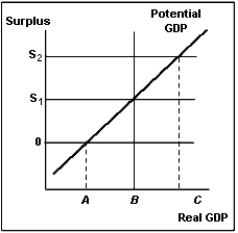 -If real GDP equals C in Exhibit 26-1,
Budget deficits have occurred every year for the past three decades.
(True/False)
4.8/5 (70)
(70) Interest rate payments are what the federal government pays every year on its debt. Total interest payments equal the interest rate multiplied by the amount of government debt outstanding.
(True/False)
4.9/5 (80)
(80) Which of the following is true about the relationship between the federal budget deficit and the federal debt?
(Multiple Choice)
4.7/5 (80)
(80) There were federal budget surpluses between 1998 and 2001 because income grew very rapidly as the economy expanded during that time period.
(True/False)
4.9/5 (80)
(80) What is the difference between a structural surplus and a cyclical surplus?
(Essay)
4.9/5 (81)
(81) Which of the following would cause the AD curve to shift to the right?
(Multiple Choice)
4.9/5 (89)
(89) Suppose that real GDP has been above potential GDP for some period of time. The government is considering a reduction in spending, and the Federal Reserve is trying to determine what is likely to happen to inflation. Trace out two possible scenarios that could occur as a result of decreased government spending. Be sure to comment on the long-run inflation level in each case.
(Essay)
4.9/5 (78)
(78) Name two reasons why the actual budget may differ from the budget enacted at the start of the fiscal year.
(Essay)
4.9/5 (83)
(83) Suppose, for a hypothetical economy, potential GDP equals $9,200 billion. If real GDP equals $9,400 billion, then according to the table below, the cyclical surplus equals 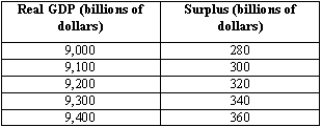 A)$320 billion.
B)$40 billion.
C)-$40 billion.
D)$20 billion.
E)$360 billion.
A)$320 billion.
B)$40 billion.
C)-$40 billion.
D)$20 billion.
E)$360 billion.
(Essay)
4.9/5 (91)
(91) In practice, discretionary changes in fiscal policy have offset booms and recessions.
(True/False)
4.8/5 (79)
(79) The Economic Growth and Tax Reconciliation Act of 2001 is a recent example of discretionary fiscal policy.
(True/False)
4.8/5 (90)
(90) 
Filters
- Essay(0)
- Multiple Choice(0)
- Short Answer(0)
- True False(0)
- Matching(0)