



 Chat with AI
Exam 26: Fiscal Policy

Exam 1: The Central Idea156 Questions
Exam 2: Observing and Explaining the Economy143 Questions
Exam 3: The Supply and Demand Model166 Questions
Exam 4: Subtleties of the Supply and Demand Model176 Questions
Exam 5: The Demand Curve and the Behavior of Consumers176 Questions
Exam 6: The Supply Curve and the Behavior of Firms179 Questions
Exam 7: The Efficiency of Markets163 Questions
Exam 8: Costs and the Changes at Firms Over Time191 Questions
Exam 9: The Rise and Fall of Industries139 Questions
Exam 10: Monopoly184 Questions
Exam 11: Product Differentiation, Monopolistic Competition, and Oligopoly169 Questions
Exam 12: Antitrust Policy and Regulation152 Questions
Exam 13: Labor Markets179 Questions
Exam 14: Taxes, Transfers, and Income Distribution179 Questions
Exam 15: Public Goods, Externalities, and Government Behavior197 Questions
Exam 16: Capital and Financial Markets188 Questions
Exam 17: Macroeconomics: the Big Picture159 Questions
Exam 18: Measuring the Production, Income, and Spending of Nations177 Questions
Exam 19: The Spending Allocation Model166 Questions
Exam 20: Unemployment and Employment212 Questions
Exam 21: Productivity and Economic Growth162 Questions
Exam 22: Money and Inflation153 Questions
Exam 23: The Nature and Causes of Economic Fluctuations185 Questions
Exam 24: The Economic Fluctuations Model205 Questions
Exam 25: Using the Economic Fluctuations Model176 Questions
Exam 26: Fiscal Policy138 Questions
Exam 27: Monetary Policy180 Questions
Exam 28: Economic Growth Around the World157 Questions
Exam 29: International Trade242 Questions
Exam 30: International Finance125 Questions
Select questions type


When using discretionary fiscal policy to counter a fluctuation in the economy, policymakers should
(Multiple Choice)
5.0/5  (82)
(82) The president can change only a small part of the budget each year.
(True/False)
5.0/5 (95)
(95) Policy rules tend to have the economy running a budget deficit during a recession and a budget surplus during an expansion.
(True/False)
4.9/5 (75)
(75) In which of the following years was the debt to GDP ratio the highest?
(Multiple Choice)
4.8/5 (70)
(70) Suppose the budget deficit for a hypothetical economy fell from $107 billion in 2016 to $40 billion in 2017.

(Essay)
4.9/5 (76)
(76) Social security, Medicare, and Medicaid are expected to grow very rapidly in the coming years.
(True/False)
4.8/5 (69)
(69) In practice, automatic fiscal policy has helped stabilize the economy.
(True/False)
4.8/5 (76)
(76) The stimulus package of 2009 was widely accepted by economists as an appropriate response to the crisis at hand. Supporters of the plan included fiscally conservative economists Robert Barro and Eugene Fama.
(True/False)
4.7/5 (78)
(78) Suppose a government has $4,000 billion of debt. This year, real GDP is $8,000 billion, the tax rate is 30 percent, and government spending is $2,000 billion. Which of the following is true?
(Multiple Choice)
4.7/5 (79)
(79) Early each year, the president of the United States issues an economic report, which contains the economic forecast for the year. This report is prepared by which of the following?
(Multiple Choice)
4.8/5 (82)
(82) The fact that taxes and government spending change whenever the state of the economy changes results in
(Multiple Choice)
4.9/5 (83)
(83) Early each year, the president of the United States issues an economic report, which contains the economic forecast for the year and is prepared by the CIa.
(True/False)
4.8/5 (78)
(78) Exhibit 26-1 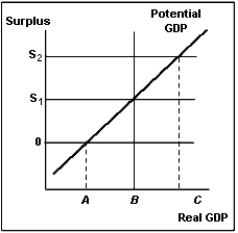 -According to Exhibit 26-1, when real GDP equals potential GDP,
 (Multiple Choice)
4.8/5 (86)
(86) President Bill Clinton's 1994 Economic Report presented the case for "shifting federal spending priorities from consumption to investment," a key fiscal policy principle of his administration.
(True/False)
4.8/5 (70)
(70) The total amount of outstanding loans owed by the federal government is known as
(Multiple Choice)
4.8/5 (87)
(87) Since ____, the U.S. federal government has been running a budget deficit.
(Multiple Choice)
4.8/5 (76)
(76) 
Filters
- Essay(0)
- Multiple Choice(0)
- Short Answer(0)
- True False(0)
- Matching(0)