



 Chat with AI
Exam 33: Muscle and Movement

Exam 1: Introduction81 Questions
Exam 2: The Chemistry and Energy of Life87 Questions
Exam 3: Nucleic Acids, Proteins, and Enzymes118 Questions
Exam 4: Cells: the Working Units of Life115 Questions
Exam 5: Cell Membranes and Signaling95 Questions
Exam 6: Pathways That Harvest and Store Chemical Energy130 Questions
Exam 7: The Cell Cycle and Cell Division119 Questions
Exam 8: Inheritance, Genes, and Chromosomes80 Questions
Exam 9: DNA and Its Role in Heredity94 Questions
Exam 10: From Dna to Protein: Gene Expression80 Questions
Exam 11: Regulation of Gene Expression94 Questions
Exam 12: Genomes78 Questions
Exam 13: Biotechnology83 Questions
Exam 14: Genes, Development, and Evolution94 Questions
Exam 15: Processes of Evolution83 Questions
Exam 16: Reconstructing and Using Phylogenies76 Questions
Exam 17: Speciation80 Questions
Exam 18: The History of Life on Earth82 Questions
Exam 19: Bacteria, Archaea, and Viruses100 Questions
Exam 20: The Origin and Diversification of Eukaryotes96 Questions
Exam 21: The Evolution of Plants130 Questions
Exam 22: The Evolution and Diversity of Fungi103 Questions
Exam 23: Animal Origins and Diversity136 Questions
Exam 24: The Plant Body90 Questions
Exam 25: Plant Nutrition and Transport129 Questions
Exam 26: Plant Growth and Development85 Questions
Exam 27: Reproduction of Flowering Plants85 Questions
Exam 28: Plants in the Environment85 Questions
Exam 29: Fundamentals of Animal Function86 Questions
Exam 30: Nutrition and Digestion81 Questions
Exam 31: Breathing83 Questions
Exam 32: Circulation80 Questions
Exam 33: Muscle and Movement75 Questions
Exam 34: Neurons, Sense Organs, and Nervous Systems171 Questions
Exam 35: Nervous and Endocrine Control94 Questions
Exam 36: Water and Salts: Excretion85 Questions
Exam 37: Animal Reproduction84 Questions
Exam 38: Animal Development104 Questions
Exam 39: Immunology: Animal Defense Systems91 Questions
Exam 40: Animal Behavior83 Questions
Exam 41: The Distribution of Earths Ecological Systems82 Questions
Exam 42: Populations78 Questions
Exam 43: Ecological and Evolutionary Consequences of Interactions Within and Among Species114 Questions
Exam 44: Ecological Communities121 Questions
Exam 45: The Global Ecosystem127 Questions
Select questions type


Smooth muscle differs from both cardiac and skeletal muscle in that
(Multiple Choice)
4.7/5  (83)
(83) The figure below shows an electron micrograph of a portion of one insect flight muscle cell.Identify the structures labeled A and B. 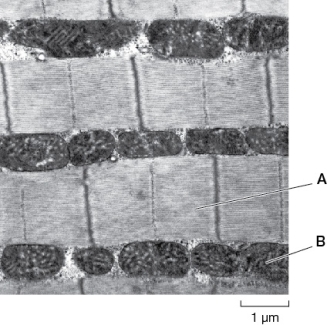
(Multiple Choice)
4.8/5 (75)
(75) Compared to the legs of sedentary people,the legs of cross-country skiers and long-distance runners are likely to have
(Multiple Choice)
4.9/5 (92)
(92) Bricklayers occasionally need to carry stacks of bricks from their truck to the work site;this is a heavy load,but it is only carried a short distance.An examination of the muscles used to perform this work would show that they
(Multiple Choice)
4.9/5 (87)
(87) A chemical compound has been used as a rodent poison for many years although scientists do not know specifically how it causes death.Recently the compound was shown to bind to the dihydropyridine (DHP)receptor.What would be the best question to ask next in continued research about the mechanism of this compound?
(Multiple Choice)
4.8/5 (82)
(82) Regarding skeletal,smooth,and cardiac muscle cells,which structure(s)is/are present in all three types?
(Multiple Choice)
4.8/5 (60)
(60) Student 1 states that butterflies have exoskeletons,while student 2 states that before metamorphosis,butterflies exist in caterpillar form and have no skeleton.Which student is correct?
(Multiple Choice)
4.9/5 (76)
(76) Which statement about fast-twitch and slow-twitch fibers is false?
(Multiple Choice)
4.7/5 (82)
(82) Refer to the figure below.Which statement accurately describes the H zone and I bands of a sarcomere? 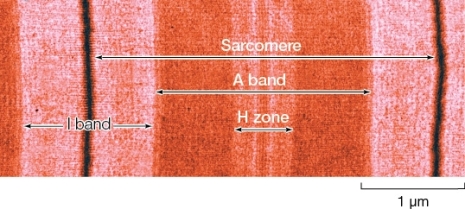
(Multiple Choice)
4.8/5 (71)
(71) Which two animals have different types of skeletal systems?
(Multiple Choice)
4.9/5 (85)
(85) A biologist is looking at human muscle fibers under the microscope.Which criterion should the biologist use to distinguish between skeletal and cardiac muscle fibers?
(Multiple Choice)
4.8/5 (85)
(85) Which remains constant as a skeletal muscle relaxes following contraction?
(Multiple Choice)
4.8/5 (73)
(73) Starting with the arrival of an action potential at the neuromuscular junction,which is the correct order of events?
(Multiple Choice)
4.8/5 (75)
(75) If the slow-twitch muscle fibers of a marathon runner,weight lifter,and triathlon competitor (5K run,1K swim,10K bicycle ride)were compared,which would represent the correct order of the percentage of slow-twitch muscle fibers observed in their bodies (from the athlete with the highest percentage to the athlete with the lowest)?
(Multiple Choice)
4.9/5 (86)
(86) 
Filters
- Essay(0)
- Multiple Choice(0)
- Short Answer(0)
- True False(0)
- Matching(0)