



 Chat with AI
Exam 7: Global Markets in Action

Exam 1: What Is Economics479 Questions
Exam 2: The Economic Problem439 Questions
Exam 3: Demand and Supply515 Questions
Exam 4: Elasticity533 Questions
Exam 5: Efficiency and Equity449 Questions
Exam 6: Government Actions in Markets410 Questions
Exam 7: Global Markets in Action200 Questions
Exam 8: Utility and Demand364 Questions
Exam 9: Possibilities, Preferences, and Choices464 Questions
Exam 10: Organizing Production385 Questions
Exam 11: Output and Costs494 Questions
Exam 12: Perfect Competition487 Questions
Exam 13: Monopoly606 Questions
Exam 14: Monopolistic Competition320 Questions
Exam 15: Oligopoly280 Questions
Exam 16: Public Choices and Public Goods356 Questions
Exam 17: Externalities and the Environment284 Questions
Exam 18: Markets for Factors of Production382 Questions
Exam 19: Economic Inequality354 Questions
Exam 20: Uncertainty and Information233 Questions
Exam 21: Extension A: Review11 Questions
Exam 22: Extension B: Review25 Questions
Exam 23: Extension C: Review14 Questions
Exam 24: Extension D: Review38 Questions
Exam 25: Extension E: Review11 Questions
Exam 26: Extension F: Review18 Questions
Select questions type


Prior to international trade, the price of good X is lower in country A than in country B. This means that we know that
(Multiple Choice)
4.8/5  (93)
(93) Average tariff levels in the United States in the last decade are
(Multiple Choice)
4.9/5 (86)
(86) Currently, the United States has an import quota on the amount of sugar that is allowed to be imported into the United States. What would happen to the price of sugar in the United States if the import quota was removed? What would happen to U.S. consumption and U.S. production of sugar?
(Essay)
5.0/5 (84)
(84) When a group lobbies for the prevention of free trade, the most likely reason is
(Multiple Choice)
4.8/5 (85)
(85) A country specializes in the production of goods for which it has a comparative advantage, so
(Multiple Choice)
4.8/5 (88)
(88) 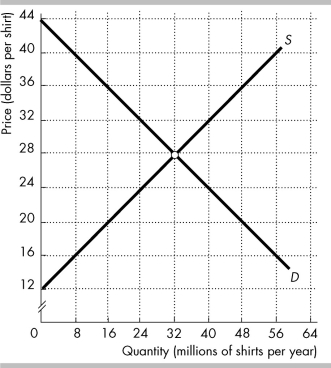 The figure shows the market for shirts in the United States, where D is the U.S demand curve and S is the U.S. supply curve. The world price is $20 per shirt. The United States imposes a tariff on imported shirts, $4 per shirt.
-In the figure above, the U.S. government's revenue from the tariff is ________.
The figure shows the market for shirts in the United States, where D is the U.S demand curve and S is the U.S. supply curve. The world price is $20 per shirt. The United States imposes a tariff on imported shirts, $4 per shirt.
-In the figure above, the U.S. government's revenue from the tariff is ________. (Multiple Choice)
4.7/5 (81)
(81) How does a tariff affect the government's revenue? How does an import quota affect the government's revenue?
(Essay)
4.9/5 (81)
(81) 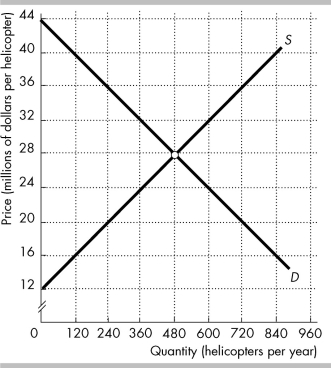 The figure shows the market for helicopters in the United States, where D is the domestic demand curve and S is the domestic supply curve. The United States trades helicopters with the rest of the world at a price of $36 million per helicopter.
-In the figure above, with international trade ________ helicopters per year are produced in the United States.
The figure shows the market for helicopters in the United States, where D is the domestic demand curve and S is the domestic supply curve. The United States trades helicopters with the rest of the world at a price of $36 million per helicopter.
-In the figure above, with international trade ________ helicopters per year are produced in the United States. (Multiple Choice)
4.8/5 (81)
(81) Almost all economists support protectionist policies because protection
(Multiple Choice)
4.9/5 (80)
(80) Which of the following reasons explains why rich countries persistently restrict textile imports from poor countries?
(Multiple Choice)
4.8/5 (78)
(78) 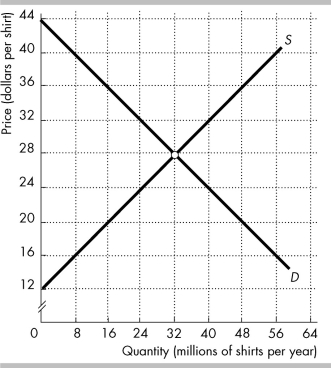 The figure shows the market for shirts in the United States, where D is the domestic demand curve and S is the domestic supply curve. The world price is $20 per shirt.
-In the figure above, with international trade ________ million shirts per year are produced in the United States.
The figure shows the market for shirts in the United States, where D is the domestic demand curve and S is the domestic supply curve. The world price is $20 per shirt.
-In the figure above, with international trade ________ million shirts per year are produced in the United States. (Multiple Choice)
4.8/5 (80)
(80) Over the past 70 years, the United States has reduced its average tariff rate so today it is less than 5 percent.
(True/False)
4.9/5 (82)
(82) In 2006, European Union tariff on imported bananas from Latin America was €176 a ton. Suppose 2.5 million tons of bananas were imported in 2006 but then the tariff decreased to €152 a ton in 2007 and as a result, 3 million tons were imported in 2007. What is the tariff revenue in 2007?
(Multiple Choice)
4.8/5 (77)
(77) Trade war occurs when, after a tariff is imposed, other countries retaliate with their own tariff.
(True/False)
4.8/5 (92)
(92) When the United States imposes a tariff on a good, the amount of the ________ in U.S. consumer surplus is ________ the amount of the ________ in U.S. producer surplus .
(Multiple Choice)
4.9/5 (85)
(85) When a foreign firm sells its exports at a lower price than its cost of production, the firm is
(Multiple Choice)
4.8/5 (90)
(90) 
Filters
- Essay(0)
- Multiple Choice(0)
- Short Answer(0)
- True False(0)
- Matching(0)