



 Chat with AI
Exam 7: Global Markets in Action

Exam 1: What Is Economics479 Questions
Exam 2: The Economic Problem439 Questions
Exam 3: Demand and Supply515 Questions
Exam 4: Elasticity533 Questions
Exam 5: Efficiency and Equity449 Questions
Exam 6: Government Actions in Markets410 Questions
Exam 7: Global Markets in Action200 Questions
Exam 8: Utility and Demand364 Questions
Exam 9: Possibilities, Preferences, and Choices464 Questions
Exam 10: Organizing Production385 Questions
Exam 11: Output and Costs494 Questions
Exam 12: Perfect Competition487 Questions
Exam 13: Monopoly606 Questions
Exam 14: Monopolistic Competition320 Questions
Exam 15: Oligopoly280 Questions
Exam 16: Public Choices and Public Goods356 Questions
Exam 17: Externalities and the Environment284 Questions
Exam 18: Markets for Factors of Production382 Questions
Exam 19: Economic Inequality354 Questions
Exam 20: Uncertainty and Information233 Questions
Exam 21: Extension A: Review11 Questions
Exam 22: Extension B: Review25 Questions
Exam 23: Extension C: Review14 Questions
Exam 24: Extension D: Review38 Questions
Exam 25: Extension E: Review11 Questions
Exam 26: Extension F: Review18 Questions
Select questions type


In developing countries, there is more reliance on ________ as opposed to ________ for government revenue.
(Multiple Choice)
4.7/5  (94)
(94) Currently Belize, a country in Central America, has a small coffee industry but does not export any coffee. Suppose the government of Belize, in order to protect the new coffee industry to enable it to grow into a mature industry that can compete in world markets, places a tariff on the importation of coffee. What is the argument that has been used to support the tariff on coffee?
(Multiple Choice)
4.8/5 (86)
(86) During the first 6 months of 2008, the European Union (EU) initiated an anti-dumping case against China for imports of taper candles. What is dumping?
(Multiple Choice)
4.8/5 (89)
(89) Give a brief description of the history of tariffs in the United States.
(Essay)
4.8/5 (80)
(80) Usually the imposition of trade barriers affecting a particular good benefits ________ people domestically, each of whom gains a ________.
(Multiple Choice)
4.7/5 (95)
(95) 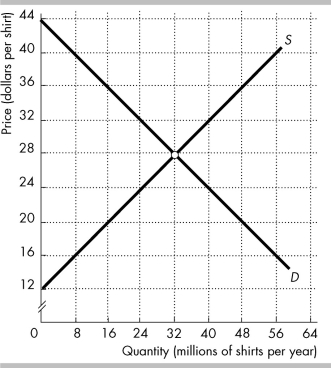 The figure shows the market for shirts in the United States, where D is the domestic demand curve and S is the domestic supply curve. The world price is $20 per shirt.
-In the figure above, with international trade American consumers buy ________ million shirts per year.
The figure shows the market for shirts in the United States, where D is the domestic demand curve and S is the domestic supply curve. The world price is $20 per shirt.
-In the figure above, with international trade American consumers buy ________ million shirts per year. (Multiple Choice)
4.8/5 (86)
(86) Which of the statements about the gains from international trade is correct?
(Multiple Choice)
4.9/5 (78)
(78) The United States imports cars from Japan. If the United States imposes a tariff on cars imported from Japan,
(Multiple Choice)
4.8/5 (81)
(81) An import quota restricts ________ and is designed to protect domestic ________.
(Multiple Choice)
4.9/5 (75)
(75) A tariff is imposed on a good. The tariff will ________ the domestic quantity supplied, ________ the domestic quantity demanded, and ________ price in the home country.
(Multiple Choice)
4.9/5 (89)
(89) Based on the table below, at what world price would the country import the good? 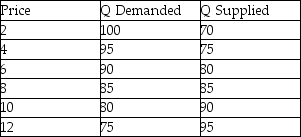
(Multiple Choice)
4.8/5 (74)
(74) During the first 6 months of 2008, the United States imported more than 1.6 billion pounds of coffee. Suppose the United States is considering placing trade restrictions on the importation of coffee. What would be a potential consequence of such a trade restriction?
(Multiple Choice)
4.9/5 (76)
(76) 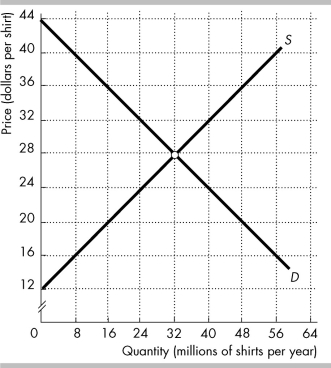 The figure shows the market for shirts in the United States, where D is the U.S demand curve and S is the U.S. supply curve. The world price is $20 per shirt. The United States imposes a tariff on imported shirts, $4 per shirt.
-In the figure above, the deadweight loss from the tariff is ________.
The figure shows the market for shirts in the United States, where D is the U.S demand curve and S is the U.S. supply curve. The world price is $20 per shirt. The United States imposes a tariff on imported shirts, $4 per shirt.
-In the figure above, the deadweight loss from the tariff is ________. (Multiple Choice)
4.9/5 (83)
(83) Most economists would agree that "saving jobs" is a valid reason for restricting trade.
(True/False)
4.7/5 (73)
(73) During the first 6 months of 2008, the United States imported from Africa, Asia, and Latin America more than 1.6 billion pounds of coffee and did not export any coffee. How is the gain from imports distributed between consumers and domestic producers?
(Multiple Choice)
4.9/5 (98)
(98) Compared to the situation before international trade, after the United States exports a good production in the United States ________ and consumption in the United States ________.
(Multiple Choice)
4.7/5 (76)
(76) The figure shows the market for shirts in the United States, where D is the U.S demand curve and S is the U.S. supply curve. The world price is $20 per shirt. The United States imposes a tariff on imported shirts, $4 per shirt.
-In the figure above, U.S. consumers' ________ from the tariff is ________.
The figure shows the market for shirts in the United States, where D is the U.S demand curve and S is the U.S. supply curve. The world price is $20 per shirt. The United States imposes a tariff on imported shirts, $4 per shirt.
-In the figure above, U.S. consumers' ________ from the tariff is ________. (Multiple Choice)
4.8/5 (76)
(76) 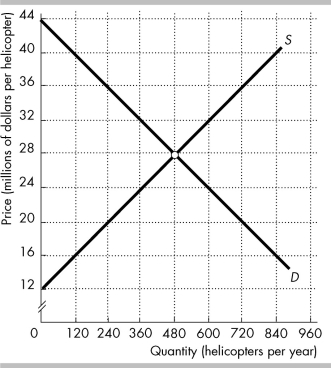 The figure shows the market for helicopters in the United States, where D is the domestic demand curve and S is the domestic supply curve. The United States trades helicopters with the rest of the world at a price of $36 million per helicopter.
-In the figure above, international trade ________ total surplus in the United States by ________.
The figure shows the market for helicopters in the United States, where D is the domestic demand curve and S is the domestic supply curve. The United States trades helicopters with the rest of the world at a price of $36 million per helicopter.
-In the figure above, international trade ________ total surplus in the United States by ________. (Multiple Choice)
4.7/5 (88)
(88) 
Filters
- Essay(0)
- Multiple Choice(0)
- Short Answer(0)
- True False(0)
- Matching(0)