



 Chat with AI
Exam 7: Global Markets in Action

Exam 1: What Is Economics479 Questions
Exam 2: The Economic Problem439 Questions
Exam 3: Demand and Supply515 Questions
Exam 4: Elasticity533 Questions
Exam 5: Efficiency and Equity449 Questions
Exam 6: Government Actions in Markets410 Questions
Exam 7: Global Markets in Action200 Questions
Exam 8: Utility and Demand364 Questions
Exam 9: Possibilities, Preferences, and Choices464 Questions
Exam 10: Organizing Production385 Questions
Exam 11: Output and Costs494 Questions
Exam 12: Perfect Competition487 Questions
Exam 13: Monopoly606 Questions
Exam 14: Monopolistic Competition320 Questions
Exam 15: Oligopoly280 Questions
Exam 16: Public Choices and Public Goods356 Questions
Exam 17: Externalities and the Environment284 Questions
Exam 18: Markets for Factors of Production382 Questions
Exam 19: Economic Inequality354 Questions
Exam 20: Uncertainty and Information233 Questions
Exam 21: Extension A: Review11 Questions
Exam 22: Extension B: Review25 Questions
Exam 23: Extension C: Review14 Questions
Exam 24: Extension D: Review38 Questions
Exam 25: Extension E: Review11 Questions
Exam 26: Extension F: Review18 Questions
Select questions type


Selling a product in a foreign nation at a price less than its cost of production is called
(Multiple Choice)
4.7/5  (67)
(67) If the United States imposes a tariff on imported cars, the
(Multiple Choice)
4.9/5 (87)
(87) The United States has a comparative advantage and specialize in the production of airplanes. Compared to the situation with no trade, which of the following will occur?
(Multiple Choice)
4.9/5 (65)
(65) If a country imposes a tariff on an imported good, the tariff ________ the price in the importing country and ________ the quantity of imports.
(Multiple Choice)
4.9/5 (78)
(78) When the principle of comparative advantage is used to guide trade, then a country specializes in producing only
(Multiple Choice)
4.9/5 (70)
(70) As a result of an increase in tariffs, imports decrease and government revenue increases.
(True/False)
4.8/5 (82)
(82) A country opens up to trade and becomes an importer of a sugar. In the sugar market, consumer surplus will ________, producer surplus will ________, and total surplus will ________.
(Multiple Choice)
4.7/5 (63)
(63) 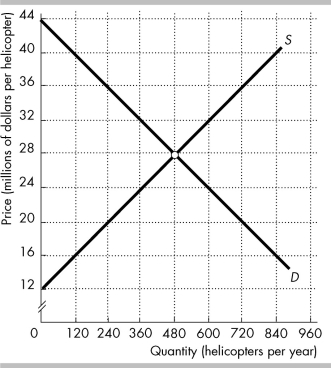 The figure shows the market for helicopters in the United States, where D is the domestic demand curve and S is the domestic supply curve. The United States trades helicopters with the rest of the world at a price of $36 million per helicopter.
-In the figure above, with international trade U.S. companies buy ________ helicopters per year.
The figure shows the market for helicopters in the United States, where D is the domestic demand curve and S is the domestic supply curve. The United States trades helicopters with the rest of the world at a price of $36 million per helicopter.
-In the figure above, with international trade U.S. companies buy ________ helicopters per year. (Multiple Choice)
4.9/5 (74)
(74) When a rich nation buys a product made in a poor nation, in the poor nation the demand for labor ________ and the wage rate ________.
(Multiple Choice)
5.0/5 (79)
(79) Japan imposes a tariff on imported rice. In Japan, surplus will be redistributed from
(Multiple Choice)
4.9/5 (71)
(71) 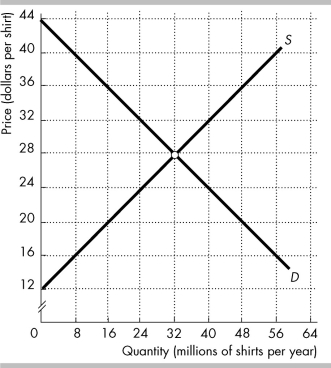 The figure shows the market for shirts in the United States, where D is the U.S demand curve and S is the U.S. supply curve. The world price is $20 per shirt. The United States imposes a tariff on imported shirts, $4 per shirt.
-In the figure above, the tariff ________ the domestic production of shirts in the United States by ________ per year.
The figure shows the market for shirts in the United States, where D is the U.S demand curve and S is the U.S. supply curve. The world price is $20 per shirt. The United States imposes a tariff on imported shirts, $4 per shirt.
-In the figure above, the tariff ________ the domestic production of shirts in the United States by ________ per year. (Multiple Choice)
4.8/5 (76)
(76) In 2006, European Union tariff on imported bananas from Latin America was €176 a ton. Suppose 2.5 million tons of bananas were imported in 2006 but then the tariff decreased to €152 a ton in 2007 and as a result, 3 million tons were imported in 2007. What is the change in tariff revenue between 2006 and 2007?
(Multiple Choice)
4.8/5 (79)
(79) The figure shows the market for shirts in the United States, where D is the U.S demand curve and S is the U.S. supply curve. The world price is $20 per shirt. The United States imposes a tariff on imported shirts, $4 per shirt.
-In the figure above, U.S. producers' ________ from the tariff is ________.
The figure shows the market for shirts in the United States, where D is the U.S demand curve and S is the U.S. supply curve. The world price is $20 per shirt. The United States imposes a tariff on imported shirts, $4 per shirt.
-In the figure above, U.S. producers' ________ from the tariff is ________. (Multiple Choice)
4.8/5 (73)
(73) A country opens up to trade and exports computer chips. In the computer chip market, surplus has been redistributed from
(Multiple Choice)
4.9/5 (69)
(69) During the first 6 months of 2008, the United States imported from Africa, Asia, and Latin America more than 1.6 billion pounds of coffee and did not export any coffee. Based on this, we know definitively that
(Multiple Choice)
4.9/5 (91)
(91) In poorer countries, free trade ________ the demand for labor in these countries and ________ the wages paid in these countries.
(Multiple Choice)
4.9/5 (82)
(82) 
Filters
- Essay(0)
- Multiple Choice(0)
- Short Answer(0)
- True False(0)
- Matching(0)