



 Chat with AI
Exam 7: Global Markets in Action

Exam 1: What Is Economics479 Questions
Exam 2: The Economic Problem439 Questions
Exam 3: Demand and Supply515 Questions
Exam 4: Elasticity533 Questions
Exam 5: Efficiency and Equity449 Questions
Exam 6: Government Actions in Markets410 Questions
Exam 7: Global Markets in Action200 Questions
Exam 8: Utility and Demand364 Questions
Exam 9: Possibilities, Preferences, and Choices464 Questions
Exam 10: Organizing Production385 Questions
Exam 11: Output and Costs494 Questions
Exam 12: Perfect Competition487 Questions
Exam 13: Monopoly606 Questions
Exam 14: Monopolistic Competition320 Questions
Exam 15: Oligopoly280 Questions
Exam 16: Public Choices and Public Goods356 Questions
Exam 17: Externalities and the Environment284 Questions
Exam 18: Markets for Factors of Production382 Questions
Exam 19: Economic Inequality354 Questions
Exam 20: Uncertainty and Information233 Questions
Exam 21: Extension A: Review11 Questions
Exam 22: Extension B: Review25 Questions
Exam 23: Extension C: Review14 Questions
Exam 24: Extension D: Review38 Questions
Exam 25: Extension E: Review11 Questions
Exam 26: Extension F: Review18 Questions
Select questions type


When the United States exports a good, U.S. consumer surplus ________ and U.S. total surplus ________.
(Multiple Choice)
4.9/5  (85)
(85) Suppose sugar is exported from a nation. In the sugar market who does NOT benefit from the exports?
(Multiple Choice)
4.8/5 (73)
(73) During 2005-2006 Europe imported more than $70 million worth of U.S. long-grain rice. Who gains from this trade?
(Multiple Choice)
4.9/5 (80)
(80) Tariffs ________ the domestic price of the good and import quotas ________ the domestic price of the good.
(Multiple Choice)
4.8/5 (83)
(83) Agriculture Secretary Ed Schafer today announced that Chile's Livestock and Agricultural Service approved the U.S. inspection, control and certification systems for poultry, allowing these products to enter the Chilean market effective immediately. What is NOT an effect of this change in Chilean policy on the Chilean poultry market?
(Multiple Choice)
4.9/5 (78)
(78) 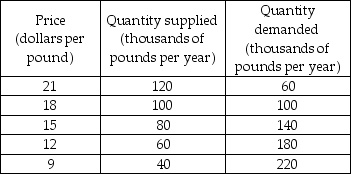 -The United States imports cheese from a variety of countries. The table above gives the domestic supply of, and demand for, cheese in the United States. The world price of cheese is $12 per pound, and trade is unrestricted.
a) How many pounds of cheese are consumed in the United States?
b) How many pounds of cheese are produced in the United States?
c) How many pounds of cheese are imported into the United States?
If a $3 per pound tariff is imposed,
d) How many pounds of cheese are consumed in the United States?
e) How many pounds of cheese are produced in the United States?
f) How many pounds of cheese are imported into the United States?
g) How much will the U.S. government collect in tariff revenue?
h) Who benefits from the tariff? Who loses?
-The United States imports cheese from a variety of countries. The table above gives the domestic supply of, and demand for, cheese in the United States. The world price of cheese is $12 per pound, and trade is unrestricted.
a) How many pounds of cheese are consumed in the United States?
b) How many pounds of cheese are produced in the United States?
c) How many pounds of cheese are imported into the United States?
If a $3 per pound tariff is imposed,
d) How many pounds of cheese are consumed in the United States?
e) How many pounds of cheese are produced in the United States?
f) How many pounds of cheese are imported into the United States?
g) How much will the U.S. government collect in tariff revenue?
h) Who benefits from the tariff? Who loses? (Essay)
4.7/5 (83)
(83)  The figure shows the market for shirts in the United States, where D is the domestic demand curve and S is the domestic supply curve. The world price is $20 per shirt.
-In the figure above, international trade ________ consumer surplus in the United States by ________.
The figure shows the market for shirts in the United States, where D is the domestic demand curve and S is the domestic supply curve. The world price is $20 per shirt.
-In the figure above, international trade ________ consumer surplus in the United States by ________. (Multiple Choice)
4.9/5 (73)
(73) If the United States imposes a tariff on imported steel, the tariff will
(Multiple Choice)
5.0/5 (85)
(85) Explain how governments restrict international trade and who benefits as well as who loses from the restrictions.
(Essay)
4.9/5 (80)
(80) 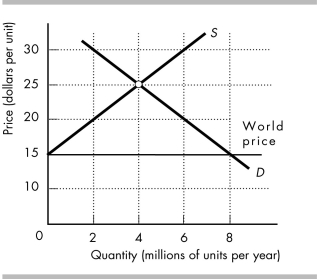 -The above figure shows the domestic supply of and domestic demand for an imported good. The world price is $15 per unit.
a) At the world price of $15 per unit, what is the domestic consumption and domestic production?
b) At the world price of $15 per unit, what is the quantity imported?
c) If the government imposes a tariff of $5 per unit, what is the domestic consumption and domestic production?
d) With the $5 per unit tariff, what is the quantity imported?
e) How much revenue does the government collect with a tariff of $5 per unit?
-The above figure shows the domestic supply of and domestic demand for an imported good. The world price is $15 per unit.
a) At the world price of $15 per unit, what is the domestic consumption and domestic production?
b) At the world price of $15 per unit, what is the quantity imported?
c) If the government imposes a tariff of $5 per unit, what is the domestic consumption and domestic production?
d) With the $5 per unit tariff, what is the quantity imported?
e) How much revenue does the government collect with a tariff of $5 per unit? (Essay)
5.0/5 (77)
(77) Which of the following is a reason why only limited attempts are made to compensate those who lose from free international trade?
(Multiple Choice)
4.8/5 (75)
(75) Which of the following are TRUE regarding the argument that trade barriers protect U.S. workers from cheap foreign labor? I. Low-wage foreigners are just as productive as U.S. workers.
II) U.S. workers have a comparative advantage in low-wage jobs.
(Multiple Choice)
5.0/5 (63)
(63) The gains from trade that are possible when two countries have different opportunity costs for wheat and coffee are realized when
(Multiple Choice)
4.8/5 (79)
(79) Tariffs and import quotas both decrease the amount of a good consumed and raise the price paid by domestic residents for the good.
(True/False)
4.9/5 (72)
(72) Japan was accused of dumping in the steel industry within the United States when it
(Multiple Choice)
4.9/5 (73)
(73) Which of the following statements concerning tariffs is NOT true?
(Multiple Choice)
4.8/5 (82)
(82) 
Filters
- Essay(0)
- Multiple Choice(0)
- Short Answer(0)
- True False(0)
- Matching(0)