



 Chat with AI
Exam 7: Global Markets in Action

Exam 1: What Is Economics479 Questions
Exam 2: The Economic Problem439 Questions
Exam 3: Demand and Supply515 Questions
Exam 4: Elasticity533 Questions
Exam 5: Efficiency and Equity449 Questions
Exam 6: Government Actions in Markets410 Questions
Exam 7: Global Markets in Action200 Questions
Exam 8: Utility and Demand364 Questions
Exam 9: Possibilities, Preferences, and Choices464 Questions
Exam 10: Organizing Production385 Questions
Exam 11: Output and Costs494 Questions
Exam 12: Perfect Competition487 Questions
Exam 13: Monopoly606 Questions
Exam 14: Monopolistic Competition320 Questions
Exam 15: Oligopoly280 Questions
Exam 16: Public Choices and Public Goods356 Questions
Exam 17: Externalities and the Environment284 Questions
Exam 18: Markets for Factors of Production382 Questions
Exam 19: Economic Inequality354 Questions
Exam 20: Uncertainty and Information233 Questions
Exam 21: Extension A: Review11 Questions
Exam 22: Extension B: Review25 Questions
Exam 23: Extension C: Review14 Questions
Exam 24: Extension D: Review38 Questions
Exam 25: Extension E: Review11 Questions
Exam 26: Extension F: Review18 Questions
Select questions type


If a government imposes a quota on imports of a popular doll, the price of the doll in the country will ________ and the quantity purchased in the country will ________.
(Multiple Choice)
4.9/5  (86)
(86) When the United States imposes an import quota on a good, the amount of the ________ in U.S. consumer surplus is ________ the amount of the ________ in U.S. producer surplus.
(Multiple Choice)
5.0/5 (69)
(69) Based on the table below, at what world price would the country export the good? 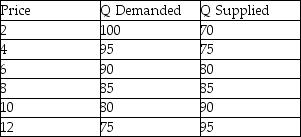
(Multiple Choice)
4.7/5 (79)
(79) During 2005-2006 Europe imported more than $70 million worth of U.S. long-grain rice. In 2006, the European Union threatened to restrict imports of long-grain rice because traces of genetically modified rice were found mixed in to commercial supplies. What would NOT be an effect in the European rice market if U.S. imports were banned?
(Multiple Choice)
4.8/5 (81)
(81) It is possible for the United States to compete against cheap foreign labor because expensive domestic workers
(Multiple Choice)
4.7/5 (78)
(78) Between August 2007 and July 2008, Brazil exported more than 3.5 billion pounds of coffee to the rest of the world. This fact means that
(Multiple Choice)
4.8/5 (81)
(81) The (false) idea that an industry should be protected because of learning-by-doing until it is large enough to compete successfully in world markets is the ________ argument for protection.
(Multiple Choice)
4.7/5 (72)
(72) Discuss reasons why we see trade restrictions. Are any of these reasons valid?
(Essay)
4.7/5 (79)
(79) The average tariff rate imposed by the United States on imported goods
(Multiple Choice)
4.7/5 (80)
(80) U.S. producer surplus ________ when the United States imports a good and U.S. producer surplus ________ when the United States exports a good.
(Multiple Choice)
4.7/5 (76)
(76) In 2006, the European Union (EU) threatened to ban imports of long-grain rice because traces of genetically modified rice were found mixed in to commercial supplies. Instead of a ban, suppose the EU placed a tariff on the import of long-grain rice. Which of the following would be an outcome of this tariff?
(Multiple Choice)
4.8/5 (73)
(73) How does a tariff affect the domestic price of the import, the domestic consumption, the domestic production, and the quantity imported?
(Essay)
4.7/5 (85)
(85) Which of the following is an explanation for the existence of trade restrictions?
(Multiple Choice)
4.8/5 (73)
(73) If the United States imposes a tariff on $1 per imported shirt, the tariff will
(Multiple Choice)
4.8/5 (70)
(70) Compared to the situation before international trade, after the United States imports a good production in the United States ________ and consumption in the United States ________.
(Multiple Choice)
4.9/5 (91)
(91) 
Filters
- Essay(0)
- Multiple Choice(0)
- Short Answer(0)
- True False(0)
- Matching(0)