



 Chat with AI
Exam 17: Work, Heat, and the First Law of Thermodynamics

Exam 1: Concepts of Motion52 Questions
Exam 2: Kinematics in One Dimension59 Questions
Exam 3: Vectors and Coordinate Systems33 Questions
Exam 4: Kinematics in Two Dimensions50 Questions
Exam 5: Force and Motion31 Questions
Exam 6: Dynamics I: Motion Along a Line46 Questions
Exam 7: Newtons Third Law43 Questions
Exam 8: Dynamics Ii: Motion in a Plane20 Questions
Exam 9: Impulse and Momentum20 Questions
Exam 10: Energy43 Questions
Exam 11: Work100 Questions
Exam 12: Rotation of a Rigid Body113 Questions
Exam 13: Newtons Theory of Gravity50 Questions
Exam 14: Oscillations49 Questions
Exam 15: Fluids and Elasticity72 Questions
Exam 16: A Macroscopic Description of Matter29 Questions
Exam 17: Work, Heat, and the First Law of Thermodynamics98 Questions
Exam 18: The Micromacro Connection39 Questions
Exam 19: Heat Engines and Refrigerators50 Questions
Exam 20: Traveling Waves49 Questions
Exam 21: Superpositions64 Questions
Exam 22: Wave Optics51 Questions
Exam 23: Ray Optics63 Questions
Exam 24: Optical Instruments49 Questions
Exam 25: Electric Charges and Forces26 Questions
Exam 26: The Electric Field32 Questions
Exam 27: Gausss Law41 Questions
Exam 28: The Electric Potential40 Questions
Exam 29: Potential and Field57 Questions
Exam 30: Current and Resistance32 Questions
Exam 31: Fundamentals of Circuits68 Questions
Exam 32: The Magnetic Field87 Questions
Exam 33: Electromagnetic Induction66 Questions
Exam 34: Electromagnetic Fields and Waves52 Questions
Exam 35: Ac Circuits46 Questions
Exam 36: Relativity49 Questions
Exam 37: The Foundations of Modern Physics8 Questions
Exam 38: Quantization54 Questions
Exam 39: Wave Functions and Uncertainty18 Questions
Exam 40: One-Dimensional Quantum Mechanics32 Questions
Exam 41: Atomic Physics39 Questions
Exam 42: Nuclear Physics65 Questions
Select questions type


A cylinder contains 1.2 moles of ideal gas, initially at a temperature of 116°C. The cylinder is provided with a frictionless piston, which maintains a constant pressure of 6.4 x 10⁵ Pa on the gas. The gas is cooled until its temperature has decreased to 27°C For the gas  and the ideal gas constant
 (a) Find the work done by (or on) the gas during this process. Is the work done by or on the gas?
(b) What is the change in the internal (thermal) energy of the gas during this process?
(c) How much heat is transferred to (or from) the gas during this process? Does this heat flow into or out of the gas?
and the ideal gas constant
(a) Find the work done by (or on) the gas during this process. Is the work done by or on the gas?
(b) What is the change in the internal (thermal) energy of the gas during this process?
(c) How much heat is transferred to (or from) the gas during this process? Does this heat flow into or out of the gas? (Essay)
4.8/5  (74)
(74) Two metal rods, one silver and the other copper, are both attached to a steam chamber as shown in the figure, with a temperature of 100°C, at one end, and an ice water bath, with a temperature of 0°C, at the other. The rods are 5.0 cm long and have a square cross-section, 2.0 cm on a side. When steady state has been reached, how much heat flows through the two rods in 1.0 min? The thermal conductivity of silver is 417 W/(m∙K), and that of copper is 395 W/(m∙K). No heat is exchanged between the rods and the surroundings, except at their ends. 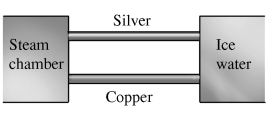
(Multiple Choice)
5.0/5 (91)
(91) What is the net power that a person loses through radiation if her surface area is 1.20 m2, if her emissivity is 0.895, if her skin temperature is 300 K, and if she is in a room that is at a temperature of 17°C? The Stefan-Boltzmann constant is 5.670 × 10⁻⁸ W/m2 · K4.
(Multiple Choice)
4.9/5 (79)
(79) A heat conducting rod, 0.90 m long, is made of an aluminum section that is 0.10 m long, and a copper section that is 0.80 m long. Both sections have cross-sectional areas of 0.00040 m2. The aluminum end is maintained at a temperature of 40°C and the copper end is at 150°. The thermal conductivity of aluminum is 205 W/m∙K and of copper is 385 W/m∙K. Steady state has been reached, and no heat is lost through the well-insulated sides of the rod. The temperature of the aluminum-copper junction in the rod is closest to
(Multiple Choice)
4.9/5 (81)
(81) What is the steady state rate of heat flow through a pane of glass that is 40.0 cm by 30.0 cm with a thickness of 4.00 mm when the outside temperature of the glass is -10.0°C and its inside temperature is 25.0°C? The thermal conductivity of glass is 0.105 W/(m∙K), the specific heat of glass is 0.180 cal/(g∙°C), and 1 cal = 4.190 J.
(Multiple Choice)
4.9/5 (74)
(74) An ideal gas with γ = 1.30 occupies 7.0 L at 300 K and 200 kPa pressure. It is compressed adiabatically to 1/7 of its original volume, then cooled at constant volume to 300 K, and finally allowed to expand isothermally to 7.0 L. How much work does the gas do during this process? The ideal gas constant is R = 8.314 J/mol ∙ K = 0.0821 L ∙ atm/mol ∙ K.
(Multiple Choice)
5.0/5 (89)
(89) A quantity of ideal gas requires 800 kJ to raise the temperature of the gas by 10.0 K when the gas is maintained at constant volume. The same quantity of gas requires 900 kJ to raise the temperature of the gas by 10.0 K when the gas is maintained at constant pressure. What is the adiabatic constant γ for this gas?
(Multiple Choice)
4.9/5 (77)
(77) 
A concrete wall of a cold storage room measures 3.0 m high, 5.0 m wide, and 20 cm thick. The room temperature is maintained at -10°C and the outside temperature is 20°C The inside wall is to be covered by a layer of wood in order to reduce the rate of heat loss through the wall BY 90 percent. The thermal conductivities of concrete and wood are 0.80 W/m·K and 0.040 W/m·K, respectively. Under steady state conditions, the thickness of the layer of wood required is closest to
(Multiple Choice)
4.8/5 (82)
(82) A substance has a melting point of 20°C and a heat of fusion of 3.5 × 10⁴ J/kg. The boiling point is 150°C and the heat of vaporization is 7.0 × 10⁴ J/kg at a pressure of 1.0 atm. The specific heats for the solid, liquid, and gaseous phases are 600 J/(kg∙K), 1000 J/(kg∙K), and 400 J/(kg∙K), respectively. The quantity of heat given up by 0.50 kg of the substance when it is cooled from 170°C to 88°C, at a pressure of 1.0 atmosphere, is closest to
(Multiple Choice)
4.9/5 (78)
(78) A copper cylinder with a mass of 125 g and temperature of 345°C is cooled by dropping it into a glass beaker containing 565 g of water initially at 20.0°C. The mass of the beaker is 50.0 g and the specific heat of the glass is 840 J/kg∙K. What is the final equilibrium temperature of the system, assuming the cooling takes place very quickly, so that no energy is lost to the air? The specific heat of copper is 385 J/kg∙K and that of water is 4190 J/kg∙K.
(Short Answer)
4.9/5 (71)
(71) The pV diagram shown is for 7.50 moles of an ideal diatomic gas taken through a cycle from a to b to c. The ideal gas constant is R = 8.314 J/mol ∙ K. 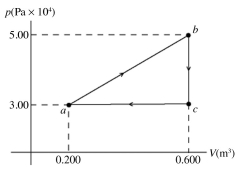 (a) What is the highest temperature reached by the gas during the cycle?
(b) What net work does the gas do during the cycle?
(c) How much heat is exchanged with the gas during part bc of the cycle? Does it enter or leave the gas?
(d) What is the change in the internal (thermal) energy of the gas during part bc of the cycle?
(e) What is the change in the internal (thermal) energy of the gas during the entire cycle?
(a) What is the highest temperature reached by the gas during the cycle?
(b) What net work does the gas do during the cycle?
(c) How much heat is exchanged with the gas during part bc of the cycle? Does it enter or leave the gas?
(d) What is the change in the internal (thermal) energy of the gas during part bc of the cycle?
(e) What is the change in the internal (thermal) energy of the gas during the entire cycle? (Essay)
4.9/5 (75)
(75) The filament in a light bulb has a diameter of 0.050 mm and an emissivity of 1.0. The temperature of the filament is 3000°C. What should be the length of the filament so it will radiate 60 W of power? The Stefan-Boltzmann constant is 5.670 × 10⁻⁸ W/m2 · K4.
(Multiple Choice)
5.0/5 (76)
(76) A person pours 330 g of water at 45°C into an 855-g aluminum container with an initial temperature of 10°C. The specific heat of aluminum is 900 J/(kg∙K) and that of water is 4190 J/(kg∙K). What is the final temperature of the system, assuming no heat is exchanged with the surroundings?
(Multiple Choice)
4.8/5 (73)
(73) A fixed amount of ideal gas goes through a process abc. In state a, the temperature of the gas is 152°C, its pressure is 1.25 atm, and it occupies a volume of 0.250 m3. It then undergoes an isothermal expansion to state b that doubles its volume, followed by an isobaric compression back to its original volume at state c. (Hint: First show this process on a pV diagram.) The ideal gas constant is 8.314 J/mol ∙ K, and 1.00 atm = 1.01 × 10⁵ Pa.
(a) How many moles does this gas contain?
(b) What is the change in the internal energy of the gas between states a and b?
(c) What is the net work done on (or by) this gas during the entire process?
(d) What is the temperature of the gas in state c?
(Essay)
5.0/5 (85)
(85) A blacksmith is flattening a steel plate that measures 10 cm × 15 cm × 1 mm. He has heated the plate to 900 K. If the emissivity of the plate is 0.75, what is the total rate at which it radiates energy? The Stefan-Boltzmann constant is 5.670 × 10⁻⁸ W/m2 · K4. Ignore any heat it receives from the surroundings.
(Multiple Choice)
4.8/5 (78)
(78) Two experimental runs are performed to determine the calorimetric properties of an alcohol that has a melting point of -10°C. In the first run, a 200-g cube of frozen alcohol, at the melting point, is added to 300 g of water at 20°C in a styrofoam container. When thermal equilibrium is reached, the alcohol-water solution is at a temperature of 5.0°C. In the second run, an identical cube of alcohol is added to 500 g of water at 20°C and the temperature at thermal equilibrium is 10°C. The specific heat of water is 4190 J/kg·K. Assume that no heat is exchanged with the styrofoam container and with the surroundings. The specific heat of the alcohol is closest to
(Multiple Choice)
4.8/5 (74)
(74) 
Filters
- Essay(0)
- Multiple Choice(0)
- Short Answer(0)
- True False(0)
- Matching(0)