



 Chat with AI
Exam 25: Electric Charges and Forces

Exam 1: Concepts of Motion52 Questions
Exam 2: Kinematics in One Dimension59 Questions
Exam 3: Vectors and Coordinate Systems33 Questions
Exam 4: Kinematics in Two Dimensions50 Questions
Exam 5: Force and Motion31 Questions
Exam 6: Dynamics I: Motion Along a Line46 Questions
Exam 7: Newtons Third Law43 Questions
Exam 8: Dynamics Ii: Motion in a Plane20 Questions
Exam 9: Impulse and Momentum20 Questions
Exam 10: Energy43 Questions
Exam 11: Work100 Questions
Exam 12: Rotation of a Rigid Body113 Questions
Exam 13: Newtons Theory of Gravity50 Questions
Exam 14: Oscillations49 Questions
Exam 15: Fluids and Elasticity72 Questions
Exam 16: A Macroscopic Description of Matter29 Questions
Exam 17: Work, Heat, and the First Law of Thermodynamics98 Questions
Exam 18: The Micromacro Connection39 Questions
Exam 19: Heat Engines and Refrigerators50 Questions
Exam 20: Traveling Waves49 Questions
Exam 21: Superpositions64 Questions
Exam 22: Wave Optics51 Questions
Exam 23: Ray Optics63 Questions
Exam 24: Optical Instruments49 Questions
Exam 25: Electric Charges and Forces26 Questions
Exam 26: The Electric Field32 Questions
Exam 27: Gausss Law41 Questions
Exam 28: The Electric Potential40 Questions
Exam 29: Potential and Field57 Questions
Exam 30: Current and Resistance32 Questions
Exam 31: Fundamentals of Circuits68 Questions
Exam 32: The Magnetic Field87 Questions
Exam 33: Electromagnetic Induction66 Questions
Exam 34: Electromagnetic Fields and Waves52 Questions
Exam 35: Ac Circuits46 Questions
Exam 36: Relativity49 Questions
Exam 37: The Foundations of Modern Physics8 Questions
Exam 38: Quantization54 Questions
Exam 39: Wave Functions and Uncertainty18 Questions
Exam 40: One-Dimensional Quantum Mechanics32 Questions
Exam 41: Atomic Physics39 Questions
Exam 42: Nuclear Physics65 Questions
Select questions type


A 1.0-C point charge is 15 m from a second point charge, and the electric force on one of them due to the other is 1.0 N. What is the magnitude of the second charge? (k = 1/4πε0 = 8.99 × 10⁹ N ∙ m2/C2)

Free
(Multiple Choice)
4.9/5  (74)
(74) Correct Answer: Verified
E
A small sphere with a mass of 441 g is moving upward along the vertical +y-axis when it encounters an electric field of 5.00 N/C  . If, due to this field, the sphere suddenly acquires a horizontal acceleration of 13.0 m/s2
 , what is the charge that it carries?
. If, due to this field, the sphere suddenly acquires a horizontal acceleration of 13.0 m/s2
, what is the charge that it carries?Free
(Multiple Choice)
4.8/5 (77)
(77) Correct Answer:Verified
VerifiedA
One very small uniformly charged plastic ball is located directly above another such charge in a test tube as shown in the figure. The balls are in equilibrium a distance d apart. If the charge on each ball is doubled, the distance between the balls in the test tube would become 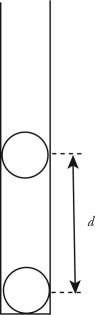
Free
(Multiple Choice)
4.8/5 (72)
(72) Correct Answer:Verified
VerifiedB
A small glass bead has been charged to 8.0 nC. What is the magnitude of the electric field 2.0 cm from the center of the bead? (k = 1/4πε0 = 8.99 × 10⁹ N ∙ m2/C2)
(Multiple Choice)
4.9/5 (82)
(82) What is the minimum magnitude of an electric field that balances the weight of a plastic sphere of mass 6.4 g that has been charged to -3.0 nC?
(Multiple Choice)
4.8/5 (82)
(82) The point charge at the bottom of the figure is Q = +17 nC, and the curve is a circular arc. What is the magnitude of the force on the charge Q due to the other point charges shown? (k = 1/4πε0 = 8.99 × 10⁹ N ∙ m2/C2) 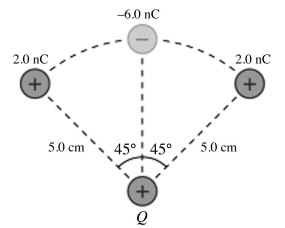
(Multiple Choice)
4.8/5 (81)
(81) The figure shows two tiny 5.0-g spheres suspended from two very thin 1.0-m-long threads. The spheres repel each other after being charged to +91 nC and hang at rest as shown. What is the angle θ? (k = 1/4πε0 = 8.99 × 10⁹ N ∙ m2/C2) 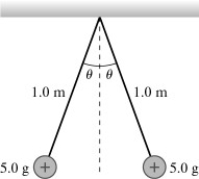
(Multiple Choice)
4.8/5 (68)
(68) In the figure, charge q1 = 3.1 × 10⁻⁶ C is placed at the origin and charge q2 = -8.7 × 10⁻⁶ C is placed on the x-axis, at x = -0.20 m. Where along the x-axis can a third charge Q = -8.3 µC be placed such that the resultant force on this third charge is zero? 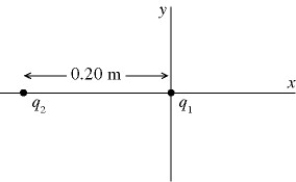
(Short Answer)
4.8/5 (94)
(94) A piece of plastic has a net charge of +2.00 μC. How many more protons than electrons does this piece of plastic have? (e = 1.60 × 10⁻¹⁹ C)
(Multiple Choice)
4.9/5 (97)
(97) Two identical small charged spheres are a certain distance apart, and each one initially experiences an electrostatic force of magnitude F due to the other. With time, charge gradually leaks off of both spheres. When each of the spheres has lost half its initial charge, the magnitude of the electrostatic force will be
(Multiple Choice)
4.8/5 (80)
(80) A +7.00 μC point charge and -9.00 μC point charge are placed along the x-axis at x = 0.000 cm and x = 40.0 cm, respectively. Where must a third charge, q, be placed along the x-axis so that it does not experience any net electric force due to the other two charges?
(Multiple Choice)
4.7/5 (80)
(80) A metal sphere of radius 10 cm carries a charge of +2.0 μC uniformly distributed over its surface. What is the magnitude of the electric field due to this sphere at a point 5.0 cm outside the sphere's surface? (k = 1/4πε0 = 8.99 × 10⁹ N ∙ m2/C2)
(Multiple Choice)
4.9/5 (72)
(72) Charge Q1 = 6.0 nC is at (0.30 m, 0), charge Q2 = -1.0 nC is at (0, 0.10 m), and charge Q3 = 5.0 nC is at (0, 0). What are the magnitude and direction of the net electrostatic force on the 5.0-nC charge due to the other charges? (k = 1/4πε0 = 8.99 × 10⁹ N ∙ m2/C2)
(Essay)
4.8/5 (72)
(72) Two identical small conducting spheres are separated by 0.60 m. The spheres carry different amounts of charge and each sphere experiences an attractive electric force of 10.8N. The total charge on the two spheres is -24 μC. The two spheres are now connected by a slender conducting wire, which is then removed. The electric force on each sphere is closest to
(Multiple Choice)
4.8/5 (80)
(80) When two point charges are a distance d part, the electric force that each one feels from the other has magnitude F. In order to make this force twice as strong, the distance would have to be changed to
(Multiple Choice)
4.9/5 (63)
(63) In the figure Q = 5.8 nC and all other quantities are accurate to 2 significant figures. What is the magnitude of the force on the charge Q? (k = 1/4πε0 = 8.99 × 10⁹ N ∙ m2/C2) 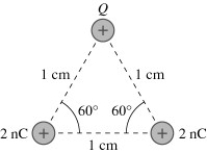
(Multiple Choice)
4.7/5 (80)
(80) In the figure, all the charges are point charges and the charge in the middle is Q = -3.1 nC. For what charge q1 will charge q2 be in static equilibrium? 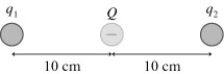
(Multiple Choice)
4.8/5 (91)
(91) When two point charges are 2.0 cm apart, each one experiences a 1.0-N electric force due to the other charge. If they are moved to a new separation of 8.0 cm, the electric force on each of them is closest to
(Multiple Choice)
4.9/5 (83)
(83) In the figure, a small spherical insulator of mass 6.00 × 10⁻² kg and charge +0.400 μC is hung by a thin wire of negligible mass. A charge of -0.220 μC is held 0.290 m away from the sphere and directly to the right of it, so the wire makes an angle θ with the vertical, as shown. What is the angle θ? (k = 1/4πε0 = 8.99 × 10⁹ N ∙ m2/C2) 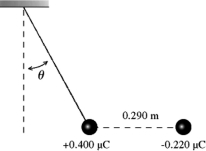
(Multiple Choice)
4.9/5 (77)
(77) A point charge Q is located a short distance from a point charge 3Q, and no other charges are present. If the electrical force on Q is F, what is the electrical force on 3Q?
(Multiple Choice)
4.9/5 (84)
(84) 
Filters
- Essay(0)
- Multiple Choice(0)
- Short Answer(0)
- True False(0)
- Matching(0)