



 Chat with AI
Exam 17: Work, Heat, and the First Law of Thermodynamics

Exam 1: Concepts of Motion52 Questions
Exam 2: Kinematics in One Dimension59 Questions
Exam 3: Vectors and Coordinate Systems33 Questions
Exam 4: Kinematics in Two Dimensions50 Questions
Exam 5: Force and Motion31 Questions
Exam 6: Dynamics I: Motion Along a Line46 Questions
Exam 7: Newtons Third Law43 Questions
Exam 8: Dynamics Ii: Motion in a Plane20 Questions
Exam 9: Impulse and Momentum20 Questions
Exam 10: Energy43 Questions
Exam 11: Work100 Questions
Exam 12: Rotation of a Rigid Body113 Questions
Exam 13: Newtons Theory of Gravity50 Questions
Exam 14: Oscillations49 Questions
Exam 15: Fluids and Elasticity72 Questions
Exam 16: A Macroscopic Description of Matter29 Questions
Exam 17: Work, Heat, and the First Law of Thermodynamics98 Questions
Exam 18: The Micromacro Connection39 Questions
Exam 19: Heat Engines and Refrigerators50 Questions
Exam 20: Traveling Waves49 Questions
Exam 21: Superpositions64 Questions
Exam 22: Wave Optics51 Questions
Exam 23: Ray Optics63 Questions
Exam 24: Optical Instruments49 Questions
Exam 25: Electric Charges and Forces26 Questions
Exam 26: The Electric Field32 Questions
Exam 27: Gausss Law41 Questions
Exam 28: The Electric Potential40 Questions
Exam 29: Potential and Field57 Questions
Exam 30: Current and Resistance32 Questions
Exam 31: Fundamentals of Circuits68 Questions
Exam 32: The Magnetic Field87 Questions
Exam 33: Electromagnetic Induction66 Questions
Exam 34: Electromagnetic Fields and Waves52 Questions
Exam 35: Ac Circuits46 Questions
Exam 36: Relativity49 Questions
Exam 37: The Foundations of Modern Physics8 Questions
Exam 38: Quantization54 Questions
Exam 39: Wave Functions and Uncertainty18 Questions
Exam 40: One-Dimensional Quantum Mechanics32 Questions
Exam 41: Atomic Physics39 Questions
Exam 42: Nuclear Physics65 Questions
Select questions type


A person makes ice tea by adding ice to 1.8 kg of hot tea, initially at 80°C. How many kilograms of ice, initially at 0.00°C, are required to bring the mixture to 10°C? The heat of fusion of ice is 334 kJ/kg, and we can assume that tea has essentially the same thermal properties as water, so its specific heat is 4190 J/(kg∙K).
(Multiple Choice)
4.8/5  (82)
(82) A solid concrete wall 4.0 m by 2.4 m and 30 cm thick, with a thermal conductivity of 1.3 W/(m∙K), separates a basement at 18°C from the ground outside at 6°C. Under steady state conditions, how much heat flows through the wall in one hour?
(Multiple Choice)
4.8/5 (80)
(80) The gas in a perfectly insulated system does work at a rate of 13 W. At what rate is the internal (thermal) energy of the gas changing?
(Multiple Choice)
4.8/5 (82)
(82) An ideal monatomic gas cools from 455.0 K to 405.0 K at constant volume as 831 J of energy is removed from it. How many moles of gas are in the sample? The ideal gas constant is R = 8.314 J/mol ∙ K.
(Multiple Choice)
4.8/5 (67)
(67) When a fixed amount of ideal gas goes through an isobaric expansion
(Multiple Choice)
5.0/5 (73)
(73) Under steady state conditions, a piece of wood 350 mm by 350 mm and 15 mm thick conducts heat through its thickness and loses no appreciable heat through its well-insulated sides. The rate of heat flow is measured to be 14.0 W when the temperature difference across its thickness is 28 C°. Determine the thermal conductivity of this wood.
(Multiple Choice)
4.7/5 (74)
(74) A cylinder contains 23 moles of an ideal gas at a temperature of 300 K. The gas is compressed at constant pressure until the final volume equals 0.43 times the initial volume. The molar heat capacity at constant volume of the gas is 24.0 J/mol · K and the ideal gas constant is R = 8.314 J/mol ∙ K. The heat absorbed by the gas is closest to
(Multiple Choice)
4.9/5 (74)
(74) A cylinder contains 24.0 moles of an ideal gas at a temperature of 300 K. The gas is compressed at constant pressure until the final volume equals 0.63 times the initial volume. The molar heat capacity at constant volume of the gas is 24.0 J/mol · K and the ideal gas constant is R = 8.314 J/mol ∙ K. The change in the internal (thermal) energy of the gas is closest to
(Multiple Choice)
4.8/5 (85)
(85) It is necessary to determine the specific heat of an unknown object. The mass of the object is measured to be 199.0 g. It is determined experimentally that it takes 16.0 J to raise the temperature 10.0°C. Find the specific heat of the object.
(Multiple Choice)
4.9/5 (67)
(67) A cylindrical bar that us well insulated around its sides connects hot and cold reservoirs and conducts heat at a rate of 10.0 J/s under steady state conditions. If all of its linear dimensions (diameter and length) are reduced by half, the rate at which it will now conduct heat between the same reservoirs is closest to
(Multiple Choice)
4.9/5 (80)
(80) A compression, at a constant pressure of 190 kPa, is performed on 5.0 moles of an ideal monatomic gas. The compression reduces the volume of the gas from 0.19 m3 to 0.12 m3. The ideal gas constant is R = 8.314 J/mol ∙ K. The work done by the gas is closest to
(Multiple Choice)
4.8/5 (75)
(75) A steel container, equipped with a piston, contains 21 mol of an ideal gas at 465 K. The container is compressed isothermally to 90% of its original volume. How much work is done on the gas? The ideal gas constant is R = 8.314 J/mol ∙ K.
(Multiple Choice)
4.9/5 (75)
(75) How many grams of ice at -13°C must be added to 711 grams of water that is initially at a temperature of 87°C to produce water at a final temperature of 10.0°C? Assume that no heat is lost to the surroundings and that the container has negligible mass. The specific heat of liquid water is 4190 J/kg·C° and of ice is 2050 J/kg·C°. For water the normal melting point is 0.00°C and the heat of fusion is 334 × 103 J/kg. The normal boiling point is 100°C and the heat of vaporization is 2.26 × 10⁶ J/kg.
(Short Answer)
4.9/5 (73)
(73) During an adiabatic process, an ideal gas does 25 J of work. What is the change in the internal (thermal) energy of the gas during this process?
(Multiple Choice)
4.9/5 (78)
(78) If 2.0 g of water at 0.00°C is to be vaporized, how much heat must be added to it? The specific heat of water is 1.0 cal/g∙K, its heat of fusion is 80 cal/g, and its heat of vaporization is 539 cal/g.
(Multiple Choice)
4.9/5 (81)
(81) Heat is added to a pure substance in a closed container at a constant rate. The figure shows a graph of the temperature of the substance as a function of time. If Lf = latent heat of fusion and Lv = latent heat of vaporization, what is the value of the ratio Lv / Lf for this substance? 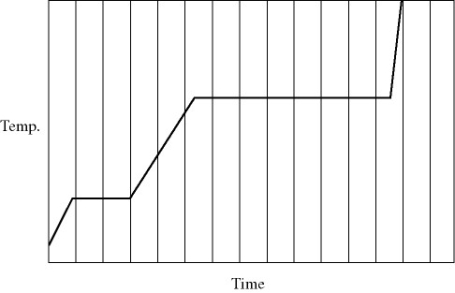
(Multiple Choice)
4.7/5 (80)
(80) The figure (not to scale) shows a pV diagram for 1.8 g of helium gas (He) that undergoes the process 1 → 2 → 3. Find the value of V3. The ideal gas constant is R = 8.314 J/mol ∙ K = 0.0821 L ∙ atm/mol ∙ K, and the atomic weight of helium is 4.0 g/mol. 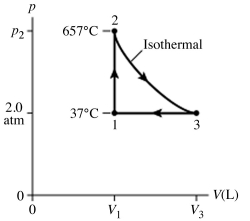
(Multiple Choice)
4.8/5 (88)
(88) A monatomic ideal gas undergoes an isothermal expansion at 300 K, as the volume increased from 0.020 m3 to 0.040 m3. The final pressure is 120 kPa. The ideal gas constant is R = 8.314 J/mol ∙ K. The heat transfer to the gas is closest to
(Multiple Choice)
4.7/5 (88)
(88) If we use 67 W of power to heat 148 g of water, how long will it take to raise the temperature of the water from 15°C to 25°C? The specific heat of water is 4190 J/kg•K.
(Multiple Choice)
4.8/5 (66)
(66) 
Filters
- Essay(0)
- Multiple Choice(0)
- Short Answer(0)
- True False(0)
- Matching(0)