



 Chat with AI
Exam 17: Work, Heat, and the First Law of Thermodynamics

Exam 1: Concepts of Motion52 Questions
Exam 2: Kinematics in One Dimension59 Questions
Exam 3: Vectors and Coordinate Systems33 Questions
Exam 4: Kinematics in Two Dimensions50 Questions
Exam 5: Force and Motion31 Questions
Exam 6: Dynamics I: Motion Along a Line46 Questions
Exam 7: Newtons Third Law43 Questions
Exam 8: Dynamics Ii: Motion in a Plane20 Questions
Exam 9: Impulse and Momentum20 Questions
Exam 10: Energy43 Questions
Exam 11: Work100 Questions
Exam 12: Rotation of a Rigid Body113 Questions
Exam 13: Newtons Theory of Gravity50 Questions
Exam 14: Oscillations49 Questions
Exam 15: Fluids and Elasticity72 Questions
Exam 16: A Macroscopic Description of Matter29 Questions
Exam 17: Work, Heat, and the First Law of Thermodynamics98 Questions
Exam 18: The Micromacro Connection39 Questions
Exam 19: Heat Engines and Refrigerators50 Questions
Exam 20: Traveling Waves49 Questions
Exam 21: Superpositions64 Questions
Exam 22: Wave Optics51 Questions
Exam 23: Ray Optics63 Questions
Exam 24: Optical Instruments49 Questions
Exam 25: Electric Charges and Forces26 Questions
Exam 26: The Electric Field32 Questions
Exam 27: Gausss Law41 Questions
Exam 28: The Electric Potential40 Questions
Exam 29: Potential and Field57 Questions
Exam 30: Current and Resistance32 Questions
Exam 31: Fundamentals of Circuits68 Questions
Exam 32: The Magnetic Field87 Questions
Exam 33: Electromagnetic Induction66 Questions
Exam 34: Electromagnetic Fields and Waves52 Questions
Exam 35: Ac Circuits46 Questions
Exam 36: Relativity49 Questions
Exam 37: The Foundations of Modern Physics8 Questions
Exam 38: Quantization54 Questions
Exam 39: Wave Functions and Uncertainty18 Questions
Exam 40: One-Dimensional Quantum Mechanics32 Questions
Exam 41: Atomic Physics39 Questions
Exam 42: Nuclear Physics65 Questions
Select questions type


A container with rigid walls is filled with 4 mol of air with CV = 2.5R. How much does the internal (thermal) energy change if the temperature of the air rises from 16°C to 437°C? The ideal gas constant is R = 8.314 J/mol ∙ K.
(Multiple Choice)
4.9/5  (82)
(82) When a fixed amount of ideal gas goes through an adiabatic expansion
(Multiple Choice)
4.8/5 (74)
(74) An ideal gas with γ = 1.67 is initially at 0°C in a volume of 10.0 L at a pressure of 1.00 atm. It is then expanded adiabatically to a volume of 10.4 L. What is the final temperature of the gas?
(Multiple Choice)
4.8/5 (80)
(80) A spherical object 25.0 cm in diameter having an emissivity of 0.800 is held at a temperature of 275°C by an internal heater. This object is embedded in a very large vat of water at 100.0°C and atmospheric pressure. At what maximum rate (in g/min) is the water evaporating in the vat due to the radiated heat it receives from the object? You can ignore any heat radiated by the water. The latent heat of fusion for water is 33,400 J/kg, its latent heat of vaporization is 2.26 × 10⁶ J/kg, and the Stefan-Boltzmann constant is 5.670 × 10⁻⁸ W/m2 · K4.
(Short Answer)
4.9/5 (88)
(88) In an isochoric process, the internal (thermal) energy of an ideal gas decreases by 50 J. How much work does the gas do during this process?
(Multiple Choice)
4.9/5 (81)
(81) During an isothermal process, 5.0 J of heat is removed from an ideal gas. What is the change in internal (thermal) energy of the gas?
(Multiple Choice)
4.8/5 (91)
(91) An ideal gas is allowed to expand slowly at constant temperature to twice its original volume. During the expansion, the gas absorbs 200 kJ of heat.
(a) What is the change in the internal (thermal) energy of the gas during the expansion?
(b) How much work does the gas do during the expansion?
(Essay)
4.8/5 (87)
(87) The figure shows a pV diagram for 8.3 g of nitrogen gas (N2) in a sealed container. The temperature T1 of the gas in state 1 is 79°C. What are (a) the pressure p1 of the gas in state 1 and (b) the temperature T2 of the gas in state 2? The ideal gas constant is R = 8.314 J/mol ∙ K = 0.0821 L ∙ atm/mol ∙ K, and the ATOMIC weight of nitrogen is 14 g/mol. 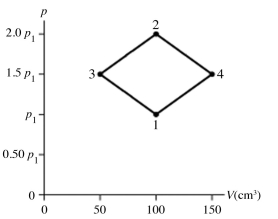
(Multiple Choice)
4.8/5 (84)
(84) A certain amount of ideal monatomic gas is maintained at constant volume as it is cooled from 455K to 405 K. This feat is accomplished by removing 400 J of heat from the gas. How much work is done by the gas during this process? The ideal gas constant is R = 8.314 J/mol ∙ K.
(Multiple Choice)
4.8/5 (81)
(81) A solid metal sphere is 15.0 cm in diameter and has surface of uniform color. When its surface is at 112°C, you measure that it radiates energy at a rate of 71.3 W. What is the emissivity of the surface of this object? Any heat that enters the sphere from the outside environment is negligible. The Stefan-Boltzmann constant is 5.670 × 10⁻⁸ W/m2 · K4.
(Short Answer)
4.9/5 (75)
(75) 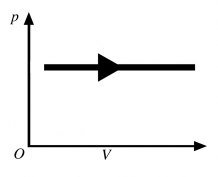
A thermally isolated system is made up of a hot piece of aluminum and a cold piece of copper; the aluminum and the copper are in thermal contact. The specific heat of aluminum is more than double that of copper. Which object experiences the greater temperature change during the time the system takes to reach thermal equilibrium?
(Multiple Choice)
4.9/5 (79)
(79) The figure shows a pV diagram for 0.0066 mol of gas that undergoes the process 1 → 2 → 3. What is the pressure p2. The ideal gas constant is R = 8.314 J/mol ∙ K = 0.0821 L ∙ atm/mol ∙ K. 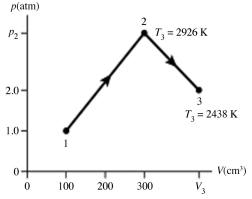
(Multiple Choice)
4.7/5 (90)
(90) In a thermodynamic process involving 7.8 moles of an ideal gas, the gas is at an initial temperature of 24°C and has an initial volume of 0.040 m3. The gas expands adiabatically to a volume of 0.080 m3. For this gas, CV = 12.27 J/mol · K, and the ideal gas constant is R = 8.314 J/mol ∙ K. Calculate the work done by the gas during this expansion.
(Short Answer)
4.9/5 (78)
(78) When a fixed amount of ideal gas goes through an isochoric process
(Multiple Choice)
4.9/5 (76)
(76) When a fixed amount of ideal gas goes through an isothermal expansion
(Multiple Choice)
4.8/5 (89)
(89) An ideal gas increases in temperature from 22°C to 42°C by two different processes. In one process, the temperature increases at constant volume, and in the other process the temperature increases at constant pressure. Which of the following statements about this gas are correct? (There may be more than one correct choice.)
(Multiple Choice)
4.9/5 (61)
(61) The temperature of an ideal gas in a sealed 0.40 m3 container is reduced from 400 K to 270 K. The final pressure of the gas is 30 kPA. The molar heat capacity at constant volume of the gas is 28.0 J/mol · K. The work done by the gas is closest to
(Multiple Choice)
4.8/5 (87)
(87) How much work is done by 3.00 mol of ideal gas when it triples its volume at a constant temperature of 127°C? The ideal gas constant is R = 8.314 J/mol ∙ K.
(Multiple Choice)
4.8/5 (81)
(81) 
Filters
- Essay(0)
- Multiple Choice(0)
- Short Answer(0)
- True False(0)
- Matching(0)