



 Chat with AI
Exam 17: Work, Heat, and the First Law of Thermodynamics

Exam 1: Concepts of Motion52 Questions
Exam 2: Kinematics in One Dimension59 Questions
Exam 3: Vectors and Coordinate Systems33 Questions
Exam 4: Kinematics in Two Dimensions50 Questions
Exam 5: Force and Motion31 Questions
Exam 6: Dynamics I: Motion Along a Line46 Questions
Exam 7: Newtons Third Law43 Questions
Exam 8: Dynamics Ii: Motion in a Plane20 Questions
Exam 9: Impulse and Momentum20 Questions
Exam 10: Energy43 Questions
Exam 11: Work100 Questions
Exam 12: Rotation of a Rigid Body113 Questions
Exam 13: Newtons Theory of Gravity50 Questions
Exam 14: Oscillations49 Questions
Exam 15: Fluids and Elasticity72 Questions
Exam 16: A Macroscopic Description of Matter29 Questions
Exam 17: Work, Heat, and the First Law of Thermodynamics98 Questions
Exam 18: The Micromacro Connection39 Questions
Exam 19: Heat Engines and Refrigerators50 Questions
Exam 20: Traveling Waves49 Questions
Exam 21: Superpositions64 Questions
Exam 22: Wave Optics51 Questions
Exam 23: Ray Optics63 Questions
Exam 24: Optical Instruments49 Questions
Exam 25: Electric Charges and Forces26 Questions
Exam 26: The Electric Field32 Questions
Exam 27: Gausss Law41 Questions
Exam 28: The Electric Potential40 Questions
Exam 29: Potential and Field57 Questions
Exam 30: Current and Resistance32 Questions
Exam 31: Fundamentals of Circuits68 Questions
Exam 32: The Magnetic Field87 Questions
Exam 33: Electromagnetic Induction66 Questions
Exam 34: Electromagnetic Fields and Waves52 Questions
Exam 35: Ac Circuits46 Questions
Exam 36: Relativity49 Questions
Exam 37: The Foundations of Modern Physics8 Questions
Exam 38: Quantization54 Questions
Exam 39: Wave Functions and Uncertainty18 Questions
Exam 40: One-Dimensional Quantum Mechanics32 Questions
Exam 41: Atomic Physics39 Questions
Exam 42: Nuclear Physics65 Questions
Select questions type


The figure shows a pV diagram for 4.3 g of oxygen gas (O2) in a sealed container. The temperature T1 of the gas in state 1 is 21°C. What are the temperatures T3 and T4 of the gas in states 3 and 4? The ideal gas constant is R = 8.314 J/mol ∙ K = 0.0821 L ∙ atm/mol ∙ K, and the ATOMIC weight of oxygen is 16 g/mol. 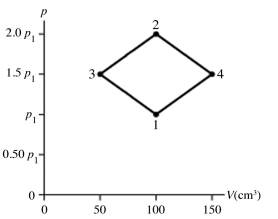
(Multiple Choice)
4.8/5  (69)
(69) When an ideal gas increases in volume at constant pressure, the average kinetic energy of the gas molecules
(Multiple Choice)
4.8/5 (72)
(72) 3.0 moles of an ideal gas with a molar heat capacity at constant volume of 4.9 cal/(mol∙K) and a molar heat capacity at constant pressure of 6.9 cal/(mol∙K) starts at 300 K and is heated at constant pressure to 320 K, then cooled at constant volume to its original temperature. How much heat flows into the gas during this two-step process?
(Multiple Choice)
4.7/5 (74)
(74) The figure shows the pV diagram for a certain thermodynamic process. In this process, 1500 J of heat flows into a system, and at the same time the system expands against a constant external pressure of 9.00 x 10⁴ Pa. If the volume of the system increases from 0.020 m3 to 0.050 m3, calculate the change in internal (thermal) energy of the system. If the internal (thermal) energy change is nonzero, be sure to indicate whether this energy change is positive or negative. 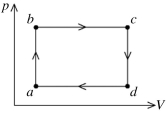
(Short Answer)
4.8/5 (90)
(90) A substance has a melting point of 20°C and a heat of fusion of 3.9 x 10⁴ J/kg. The boiling point is 150°C and the heat of vaporization is 7.8 x 10⁴ J/kg at a pressure of 1.0 atm. The specific heats for the solid, liquid, and gaseous phases are 600 J/(kg∙K), 1000 J/(kg∙K), and 400 J/(kg∙K), respectively. The quantity of heat required to raise the temperature of 3.80 kg of the substance from -61°C to 128°C, at a pressure of 1.0 atm, is closest to
(Multiple Choice)
4.7/5 (92)
(92) The walls of an ice chest are made of 2.00-mm-thick insulation having a thermal conductivity 0.00300 W/m∙K. The total surface area of the ice chest is 1.20 m2. If 4.00 kg of ice at 0.00°C are placed in the chest and the temperature of the outside surface of the chest is 20.0°C, how long does it take the ice to melt under steady state conditions? The latent heat of fusion of water is 79.6 cal/g = 334 kJ/kg.
(Multiple Choice)
4.8/5 (81)
(81) The temperature of an ideal gas in a sealed 0.40-m3 rigid container is reduced from 350 K to 270 K. The final pressure of the gas is 60 kPA. The molar heat capacity at constant volume of the gas is 28.0 J/mol · K. The heat absorbed by the gas is closest to
(Multiple Choice)
4.8/5 (80)
(80) An ideal gas in a balloon is kept in thermal equilibrium with its constant-temperature surroundings. How much work is done by the gas if the outside pressure is slowly reduced, allowing the balloon to expand to 6.0 times its original size? The balloon initially has a pressure of 645.0 Pa and a volume of 0.10 m3. The ideal gas constant is R = 8.314 J/mol ∙ K.
(Multiple Choice)
4.9/5 (76)
(76) In an isochoric process, the internal (thermal) energy of an ideal gas decreases by 50 J. How much heat is exchanged with the gas during this process?
(Multiple Choice)
4.9/5 (86)
(86) A rod, with sides insulated to prevent heat loss, has one end immersed in boiling water 100°C and the other end in a water-ice mixture at 0.00°C. The rod has uniform cross-sectional area of 4.04 cm2 and length of 91 cm. Under steady state conditions, the heat conducted by the rod melts the ice at a rate of 1.0 g every 34 seconds. What is the thermal conductivity of the rod? (The heat of fusion of water is 
(Short Answer)
4.9/5 (72)
(72) Two experimental runs are performed to determine the calorimetric properties of an alcohol that has a melting point of -10°C. In the first run, a 200-g cube of frozen alcohol, at the melting point, is added to 300 g of water at 20°C in a styrofoam container. When thermal equilibrium is reached, the alcohol-water solution is at a temperature of 5.0°C. In the second run, an identical cube of alcohol is added to 500 g of water at 20°C and the temperature at thermal equilibrium is 10°C. The specific heat of water is 4190 J/kg·K. Assume that no heat is exchanged with the styrofoam container and with the surroundings. The heat of fusion of the alcohol is closest to
(Multiple Choice)
4.8/5 (83)
(83) A heat conducting rod, 1.40 m long, is made of an aluminum section that is 0.50 m long and a copper section that is 0.90 m long. Both sections have cross-sectional areas of of 0.00040 m2. The aluminum end and the copper end are maintained at temperatures of 40°C and 280°C, respectively. The thermal conductivity of aluminum is 205 W/m∙K of copper is 385 W/m∙K. The rate at which heat is conducted in the rod is closest to
(Multiple Choice)
4.9/5 (90)
(90) A 648-g empty iron kettle is put on a stove. How much heat. in joules. must it absorb to raise its temperature from 15.0°C to 37.0°C? (The specific heat for iron is 113 cal/kg•C°, 1 cal = 4.190 J)
(Multiple Choice)
4.9/5 (76)
(76) An expansion process on an ideal diatomic gas has a linear path between the initial and final states on a pV diagram. The initial pressure is 300 kPa, the initial volume is 0.020 m3, and the initial temperature is 390 K. The final pressure is 160kPa and the final temperature is 310 K. The change in the internal (thermal) energy of the gas is closest to
(Multiple Choice)
4.9/5 (85)
(85) An ideal gas initially at 300 K and occupying a volume of 20 L is adiabatically compressed. If its final temperature is 400 K and γ = 1.30, what is its final volume?
(Multiple Choice)
4.8/5 (93)
(93) It is a well-known fact that water has a higher specific heat than iron. Now, consider equal masses of water and iron that are initially in thermal equilibrium. The same amount of heat, 30 calories, is added to each one. Which statement is true?
(Multiple Choice)
4.8/5 (73)
(73) An adiabatic compression is performed on an ideal gas. The final pressure is equal to 0.560 times the initial pressure and the final volume equals 1.50 times the initial volume. What is the adiabatic constant for the gas?
(Multiple Choice)
4.9/5 (69)
(69) An 80-g aluminum calorimeter contains 380 g of water at an equilibrium temperature of 20°C. A 120-g piece of metal, initially at 352°C, is added to the calorimeter. The final temperature at equilibrium is 32°C. Assume there is no external heat exchange. The specific heats of aluminum and water are 910 J/kg·K and 4190 J/kg·K, respectively. The specific heat of the metal is closest to
(Multiple Choice)
4.9/5 (81)
(81) During an adiabatic process, 20 moles of a monatomic ideal gas undergo a temperature change from 450 K to 320 K starting from an initial pressure is 400 kPa. The ideal gas constant is R = 8.314 J/mol ∙ K.
(a) What is the final volume of the gas?
(b) How much heat does the gas exchange during this process?
(c) What is the change in the internal (thermal) energy of the gas during this process?
(Essay)
4.9/5 (71)
(71) An ideal gas is compressed in a well-insulated chamber using a well-insulated piston. This process is
(Multiple Choice)
4.9/5 (78)
(78) 
Filters
- Essay(0)
- Multiple Choice(0)
- Short Answer(0)
- True False(0)
- Matching(0)