



 Chat with AI
Exam 12: Perfect Competition and the Supply Curve

Exam 1: First Principles199 Questions
Exam 2: Economic Models: Trade-Offs and Trade299 Questions
Exam 4: Consumer and Producer Surplus229 Questions
Exam 3: Supply and Demand265 Questions
Exam 5: Price Controls and Quotas: Meddling With Markets216 Questions
Exam 6: Elasticity226 Questions
Exam 7: Taxes286 Questions
Exam 8: International Trade260 Questions
Exam 9: Decision Making by Individuals and Firms186 Questions
Exam 10: The Rational Consumer182 Questions
Exam 11: Behind the Supply Curve: Inputs and Costs317 Questions
Exam 12: Perfect Competition and the Supply Curve341 Questions
Exam 13: Monopoly317 Questions
Exam 14: Oligopoly271 Questions
Exam 15: Monopolistic Competition and Product Differentiation245 Questions
Exam 16: Externalities193 Questions
Exam 17: Public Goods and Common Resources208 Questions
Exam 18: The Economics of the Welfare State126 Questions
Exam 19: Factor Markets and the Distribution of Income316 Questions
Exam 20: Uncertainty, Risk, and Private Information192 Questions
Exam 21: Graphs in Economics60 Questions
Exam 22: Consumer Preferences and Consumer Choice135 Questions
Select questions type


A competitive firm operating in the short run is maximizing profits and just breaking even.Its costs include a monthly state license fee of $100 that must be paid for as long as the firm operates.If the license fee is raised to $150,what should the firm do to maximize profits in the short run?
(Multiple Choice)
4.8/5  (78)
(78) Zoe,the owner of Zoe's Bakery,determines that,at her optimal level of production in the short run,P < ATC and P > AVC.In the short run,Zoe should:
(Multiple Choice)
4.8/5 (74)
(74) In the short run,a perfectly competitive firm produces output and earns ZERO economic profit if:
(Multiple Choice)
4.8/5 (87)
(87) In a perfectly competitive industry,the market demand curve is usually:
(Multiple Choice)
4.7/5 (76)
(76) If the long-run market supply curve for a perfectly competitive market is horizontal,then this industry exhibits _____ costs.
(Multiple Choice)
4.9/5 (75)
(75) Use the following to answer question: 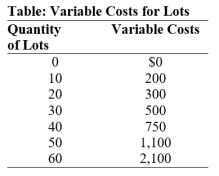 -(Table: Variable Costs for Lots)Use Table: Variable Costs for Lots.During the winter,Alexa runs a snow-clearing service in a perfectly competitive industry.Assume that costs are constant in each interval;so,for example,the marginal cost of clearing each of the lots from 1 through 10 is $20.Also assume that she can only plow the quantities of the lots given in the table (and not numbers in between).Her only fixed cost is $1,000 for a snowplow.Her variable costs include fuel,her time,and hot coffee.If the price per cleared lot is $14,how many lots should Alexa clear?
 (Multiple Choice)
4.8/5 (93)
(93) Use the following to answer question:  -(Figure: A Perfectly Competitive Firm in the Short Run)Use Figure: A Perfectly Competitive Firm in the Short Run.If the market price is G,the firm's total cost of producing its most profitable level of output is:
 (Multiple Choice)
4.9/5 (89)
(89) If the price is greater than the average variable cost and less than the average total cost at the profit-maximizing quantity of output in the short run,a perfectly competitive firm will:
(Multiple Choice)
4.8/5 (84)
(84) Use the following to answer question:  -(Table: Variable Costs for Lawns)Use Table: Variable Costs for Lawns.During the summer,Alex runs a lawn-mowing service,and lawn-mowing is a perfectly competitive industry.Assume that costs are constant in each interval;so,for example,the marginal cost of mowing each of the lawns from 1 through 10 is $10.Also assume that he can only mow the quantities of lawn given in the table (and not numbers in between).His only fixed cost is $1,000 for the mower.His variable costs include fuel,his time,and mower parts.If the price for mowing a lawn is $60,how much is Alex's total revenue at the profit-maximizing output?
 (Multiple Choice)
4.8/5 (73)
(73) For a firm producing at any level of output GREATER than the most profitable one,a reduction in output decreases total revenue _____ total cost.
(Multiple Choice)
4.8/5 (78)
(78) Assume that in the short run a perfectly competitive firm does not produce output and has economic losses.This occurs at the quantity where MR = MC and:
(Multiple Choice)
4.8/5 (75)
(75) Use the following to answer question: 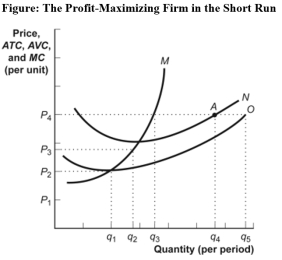 -(Figure: The Profit-Maximizing Firm in the Short Run)Use Figure: The Profit-Maximizing Firm.O is the _____ curve.
 (Multiple Choice)
4.9/5 (81)
(81) Use the following to answer question:
-(Table: Variable Costs for Lawns)Use Table: Variable Costs for Lawns.During the summer,Alex runs a lawn-mowing service,and lawn-mowing is a perfectly competitive industry.Assume that costs are constant in each interval;so,for example,the marginal cost of mowing each of the lawns from 1 through 10 is $10.Also assume that he can only mow the quantities of lawn given in the table (and not numbers in between).His only fixed cost is $1,000 for the mower.His variable costs include fuel,his time,and mower parts.If the price for mowing a lawn is $70,how much is Alex's total cost at the profit-maximizing output?
-(Table: Variable Costs for Lawns)Use Table: Variable Costs for Lawns.During the summer,Alex runs a lawn-mowing service,and lawn-mowing is a perfectly competitive industry.Assume that costs are constant in each interval;so,for example,the marginal cost of mowing each of the lawns from 1 through 10 is $10.Also assume that he can only mow the quantities of lawn given in the table (and not numbers in between).His only fixed cost is $1,000 for the mower.His variable costs include fuel,his time,and mower parts.If the price for mowing a lawn is $70,how much is Alex's total cost at the profit-maximizing output? (Multiple Choice)
4.9/5 (69)
(69) If a perfectly competitive firm decreases production from 11 units to 10 units and the market price is $20 per unit,total revenue for 10 units is:
(Multiple Choice)
4.9/5 (71)
(71) In the short run,if a perfectly competitive firm chooses to produce,then its profits are maximized by producing the quantity of output where marginal cost equals marginal revenue.
(True/False)
4.8/5 (67)
(67) If some firms in a perfectly competitive industry are earning positive economic profits,then in the long run,the:
(Multiple Choice)
4.8/5 (64)
(64) Use the following to answer question:  -(Figure: Marginal Decision Rule)Use Figure: The Marginal Decision Rule.Given the market price P1,B is the _____ curve.
 (Multiple Choice)
4.8/5 (78)
(78) 
Filters
- Essay(0)
- Multiple Choice(0)
- Short Answer(0)
- True False(0)
- Matching(0)