



 Chat with AI
Exam 13: Nuclear Magnetic Resonance Spectroscopy

Exam 1: Structure and Bonding127 Questions
Exam 2: Acids and Bases; Functional Groups136 Questions
Exam 3: Structure and Stereochemistry of Alkanes134 Questions
Exam 4: The Study of Chemical Reactions128 Questions
Exam 5: Stereochemistry132 Questions
Exam 6: Alkyl Halides; Nucleophilic Substitution137 Questions
Exam 7: Structure and Synthesis of Alkenes; Elimination131 Questions
Exam 8: Reactions of Alkenes134 Questions
Exam 10: Structure and Synthesis of Alcohols136 Questions
Exam 11: Reactions of Alcohols125 Questions
Exam 12: Infrared Spectroscopy and Mass Spectrometry121 Questions
Exam 13: Nuclear Magnetic Resonance Spectroscopy130 Questions
Exam 14: Ethers, Epoxides, and Thioethers127 Questions
Exam 15: Conjugated Systems, Orbital Symmetry, and Ultraviolet Spectroscopy130 Questions
Exam 16: Aromatic Compounds128 Questions
Exam 17: Reactions of Aromatic Compounds129 Questions
Exam 18: Ketones and Aldehydes131 Questions
Exam 19: Amines127 Questions
Exam 20: Carboxylic Acids125 Questions
Exam 21: Carboxylic Acid Derivatives130 Questions
Exam 22: Condensations and Alpha Substitutions of Carboxyl Compounds127 Questions
Exam 23: Carbohydrates and Nucleic Acids126 Questions
Exam 24: Amino Acids, Peptides, and Proteins127 Questions
Exam 25: Lipids127 Questions
Exam 26: Synthetic Polymers128 Questions
Select questions type


Which of the following functional groups has the most deshielded proton and would be predicted to show an NMR signal that is the farthest downfield?
(Multiple Choice)
4.9/5  (74)
(74) What compound exhibits three singlets in its proton spin decoupled 13C NMR spectrum?
(Multiple Choice)
4.8/5 (81)
(81) Given that compound X has a molecular formula of C6H10O2, gave three peaks in its 13C NMR spectrum (14, 63 and 158 ppm) and two peaks in its 1H NMR spectrum (1.4, triplet and 4.3 ppm, quartet), provide a structure for compound X.
(Essay)
4.8/5 (94)
(94) The protons labeled Ha in the structure below generally show up as a triplet, even through there are three neighboring protons. The coupling constant is approximately 7 Hz. What does this suggest about the size of the coupling constant for the aldehydic proton? 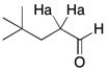
(Essay)
4.9/5 (85)
(85) What is the relationships between Ha and Hb in the following structure? 
(Multiple Choice)
4.8/5 (79)
(79) If a molecule contains 4 elements of unsaturation and signals in the 1H NMR spectrum between δ 7.0 and 8.0 ppm, what structural group is likely to be present?
(Multiple Choice)
4.8/5 (68)
(68) Predict the number of signals expected (disregarding splitting) in the 1H NMR spectrum of the compound shown below. 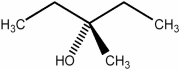
(Short Answer)
4.9/5 (79)
(79) Deduce the identity of the following compound from the spectral data given.
C7H10O2: 1H NMR, δ 1.16 (3H, singlet), 2.21 (2H, singlet); 13C NMR, δ 216.25 (singlet), 52.57 (singlet), 34.51 (triplet), 20.22 (quartet) (ppm)
(Short Answer)
4.8/5 (77)
(77) What multiplicities are observed for the signals in the off-resonance decoupled 13C spectrum of 2-chloropropene?
(Multiple Choice)
4.8/5 (83)
(83) What are the relative integrations for the 1H NMR signals for the following compound? 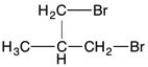
(Multiple Choice)
4.9/5 (84)
(84) 
Filters
- Essay(0)
- Multiple Choice(0)
- Short Answer(0)
- True False(0)
- Matching(0)