



 Chat with AI
Exam 13: Nuclear Magnetic Resonance Spectroscopy

Exam 1: Structure and Bonding127 Questions
Exam 2: Acids and Bases; Functional Groups136 Questions
Exam 3: Structure and Stereochemistry of Alkanes134 Questions
Exam 4: The Study of Chemical Reactions128 Questions
Exam 5: Stereochemistry132 Questions
Exam 6: Alkyl Halides; Nucleophilic Substitution137 Questions
Exam 7: Structure and Synthesis of Alkenes; Elimination131 Questions
Exam 8: Reactions of Alkenes134 Questions
Exam 10: Structure and Synthesis of Alcohols136 Questions
Exam 11: Reactions of Alcohols125 Questions
Exam 12: Infrared Spectroscopy and Mass Spectrometry121 Questions
Exam 13: Nuclear Magnetic Resonance Spectroscopy130 Questions
Exam 14: Ethers, Epoxides, and Thioethers127 Questions
Exam 15: Conjugated Systems, Orbital Symmetry, and Ultraviolet Spectroscopy130 Questions
Exam 16: Aromatic Compounds128 Questions
Exam 17: Reactions of Aromatic Compounds129 Questions
Exam 18: Ketones and Aldehydes131 Questions
Exam 19: Amines127 Questions
Exam 20: Carboxylic Acids125 Questions
Exam 21: Carboxylic Acid Derivatives130 Questions
Exam 22: Condensations and Alpha Substitutions of Carboxyl Compounds127 Questions
Exam 23: Carbohydrates and Nucleic Acids126 Questions
Exam 24: Amino Acids, Peptides, and Proteins127 Questions
Exam 25: Lipids127 Questions
Exam 26: Synthetic Polymers128 Questions
Select questions type


Predict the number of distinct quartets expected in the off-resonance decoupled  spectrum of the compound shown below.
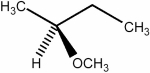
spectrum of the compound shown below. (Short Answer)
4.8/5  (79)
(79) Deduce the identity of the compound whose molecular formula is C4H8O3 from the spectral data provided: IR (cm-1): 2800-3300 (broad), 2950, 1750; 13C NMR (δ): 17.7 (q), 65.4 (q), 72.3 (d), 210.8 (s) (ppm)
(Essay)
4.8/5 (76)
(76) The protons marked Ha and Hb in the molecule below are ________. 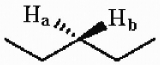
(Multiple Choice)
4.8/5 (81)
(81) How many peaks appear in the proton spin decoupled 13C NMR spectrum of the compound below? 
(Short Answer)
4.8/5 (66)
(66) Predict the number of signals expected, their splitting, and their relative area in the 1H NMR spectrum of 2-methylpropane (isobutane).
(Essay)
4.8/5 (80)
(80) Deduce the identity of the following compound from the spectral data given.
C4H8O2: 1H NMR, δ 1.23 (3H, triplet), 2.00 (3H, singlet), 4.02 (2H, quartet) (ppm); IR, 2980, 
(Essay)
4.7/5 (73)
(73) Deduce the identity of the following compound from the spectral data given.
C9H10O2: 13C NMR, δ 18.06 (quartet), 45.40 (doublet), 127.32 (doublet), 127.55 (doublet), 128.61 (doublet), 139.70 (singlet) (ppm), 180.98 (singlet); IR, broad 3500-2800, 
(Short Answer)
4.9/5 (74)
(74) Deduce the identity of the following compound from the 1H NMR data given.
C6H8O4: δ 3.9 (6H, singlet), 6.1 (2H, singlet) (ppm)
(Essay)
4.9/5 (71)
(71) Which of the following reasons best explains why aromatic protons have a larger chemical shift than protons one carbon removed from a halogen?
(Multiple Choice)
4.9/5 (70)
(70) How many peaks appear in the proton spin decoupled 13 C NMR spectrum of the compound below? 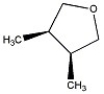
(Multiple Choice)
4.8/5 (88)
(88) The energy difference between the allowed spin states for an 1H nucleus is ________ the strength of the external magnetic field in which it is placed.
(Multiple Choice)
4.8/5 (67)
(67) Deduce the identity of the following compound from the 1H NMR data given.
C5H10O: δ 1.1 (6H, doublet), 2.2 (3H, singlet), 2.5 (1H, septet) (ppm)
(Essay)
4.9/5 (78)
(78) Predict the number of signals expected in the proton spin decoupled 13C spectrum of 3-hexanone, CH3CH2COCH2CH2CH3.
(Short Answer)
4.9/5 (69)
(69) Which compound generates positive peaks for the carbonyl in both its DEPT-90 and DEPT-135 spectra?
(Multiple Choice)
4.7/5 (88)
(88) What compound exhibits only two signals in its 1H NMR spectrum, a triplet and a quintet?
(Multiple Choice)
4.7/5 (72)
(72) What multiplicities are observed in the off-resonance decoupled 13C spectrum of 2,3-dimethyl-but-2-ene?
(Short Answer)
4.7/5 (67)
(67) Predict the number of signals expected (disregarding splitting) in the 1H spectrum of m-xylene (1,3-dimethylbenzene).
(Short Answer)
4.8/5 (77)
(77) Predict the number of signals expected (disregarding splitting) in the 1H spectrum of dibutyl ether.
(Short Answer)
4.9/5 (77)
(77) The protons marked Ha and Hb in the molecule below are ________. 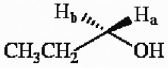
(Multiple Choice)
4.8/5 (85)
(85) 
Filters
- Essay(0)
- Multiple Choice(0)
- Short Answer(0)
- True False(0)
- Matching(0)