



 Chat with AI
Exam 13: Nuclear Magnetic Resonance Spectroscopy

Exam 1: Structure and Bonding127 Questions
Exam 2: Acids and Bases; Functional Groups136 Questions
Exam 3: Structure and Stereochemistry of Alkanes134 Questions
Exam 4: The Study of Chemical Reactions128 Questions
Exam 5: Stereochemistry132 Questions
Exam 6: Alkyl Halides; Nucleophilic Substitution137 Questions
Exam 7: Structure and Synthesis of Alkenes; Elimination131 Questions
Exam 8: Reactions of Alkenes134 Questions
Exam 10: Structure and Synthesis of Alcohols136 Questions
Exam 11: Reactions of Alcohols125 Questions
Exam 12: Infrared Spectroscopy and Mass Spectrometry121 Questions
Exam 13: Nuclear Magnetic Resonance Spectroscopy130 Questions
Exam 14: Ethers, Epoxides, and Thioethers127 Questions
Exam 15: Conjugated Systems, Orbital Symmetry, and Ultraviolet Spectroscopy130 Questions
Exam 16: Aromatic Compounds128 Questions
Exam 17: Reactions of Aromatic Compounds129 Questions
Exam 18: Ketones and Aldehydes131 Questions
Exam 19: Amines127 Questions
Exam 20: Carboxylic Acids125 Questions
Exam 21: Carboxylic Acid Derivatives130 Questions
Exam 22: Condensations and Alpha Substitutions of Carboxyl Compounds127 Questions
Exam 23: Carbohydrates and Nucleic Acids126 Questions
Exam 24: Amino Acids, Peptides, and Proteins127 Questions
Exam 25: Lipids127 Questions
Exam 26: Synthetic Polymers128 Questions
Select questions type


Draw a splitting tree to show the complex splitting pattern for the Hb proton. (Jcis = 10 Hz, trans = 15 Hz and Jgem = 2 Hz 
(Essay)
4.9/5  (77)
(77) Deduce the identity of the following compound from the 13C NMR data given.
C6H12O: δ 29.80 (quartet), 30.82 (singlet), 56.53 (triplet), 203.36 (doublet) (ppm)
(Essay)
4.9/5 (70)
(70) Provide a structure that is consistent with the data below.
C6H10
IR (cm-1): 2950, 2230
1H NMR ( d): 2.0 (1H, septet), 1.8 (3H, s), 0.9 (6H, d)
13C NMR (d ): 78 (s), 72 (s), 45 (d), 18 (q), 15 (q)
(Essay)
4.9/5 (71)
(71) Predict the number of signals expected in the proton spin decoupled 13C NMR spectrum of the compound shown below. 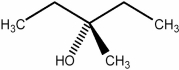
(Short Answer)
4.9/5 (77)
(77) Label the different 1H environments in the structure below a, b, c.... Then complete the table for each different type of proton. The first one is done for you as an example. (Note: there may be fewer than 7 different proton environments) 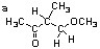 environments a b c d e f g
chemical shift
(+/- 0.5 ppm) 1.9
spin-spin splitting s
environments a b c d e f g
chemical shift
(+/- 0.5 ppm) 1.9
spin-spin splitting s (Essay)
4.9/5 (75)
(75) How many peaks appear in the proton spin decoupled 13C NMR spectrum of the compound below? 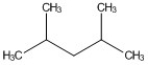
(Short Answer)
4.8/5 (96)
(96) Deduce the identity of the following compound from the 13C NMR data given.
C4H8O: δ 11.97 (triplet), 33.54 (triplet), 67.03 (doublet) (ppm)
(Short Answer)
4.7/5 (70)
(70) 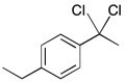
Which carbon signal shows up in the 0-50 ppm region of the proton spin decoupled 13C NMR spectrum? 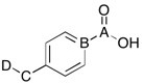
(Multiple Choice)
4.9/5 (80)
(80) Deduce the identity of the following compound from the NMR data given.
C4H6O2: 1H NMR, δ 2.28 (2H, multiplet), 2.50 (2H, triplet), 4.35 (2H, triplet);
13C NMR, δ 177.81 (singlet), 68.58 (triplet), 27.70 (triplet), 22.17 (triplet) (ppm)
(Short Answer)
4.9/5 (75)
(75) Using the scale below, draw the 1H NMR spectrum for isobutyl acetate, shown below. Present the peaks with correct splitting patterns and at the approximate chemical shift (+/- 0.5 ppm). Just above each peak, indicate the relative integration value of each type of hydrogen. 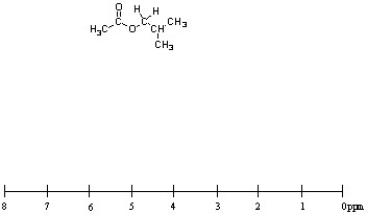
(Essay)
4.8/5 (65)
(65) Calculate the magnetic field that corresponds to the proton resonance frequency of 300.00 MHz. The gyromagnetic ratio of the 1H nucleus is 
(Short Answer)
4.8/5 (75)
(75) Deduce the identity of the following compound from the 1H NMR data given.
C8H10O: δ 3.4 (3H, singlet), 4.5 (2H, singlet), 7.2 (5H, apparent singlet) (ppm)
(Short Answer)
5.0/5 (71)
(71) What 1H NMR spectral data is expected for the compound shown? 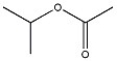
(Multiple Choice)
4.9/5 (86)
(86) How many peaks appear in the proton spin decoupled 13C NMR spectrum of the compound below? 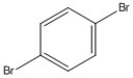
(Short Answer)
4.7/5 (88)
(88) 
Which of the structures shown below is consistent with the C-13 NMR (off resonance splitting for each peak is shown as a table within the figure) and H-NMR spectra? (formula = C9H11OBr) 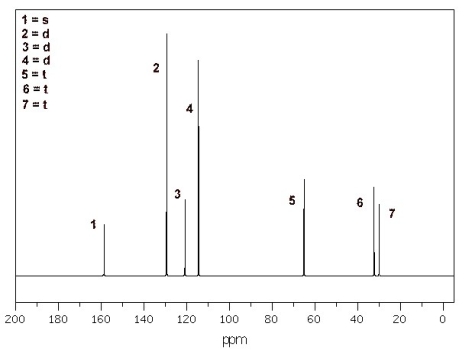
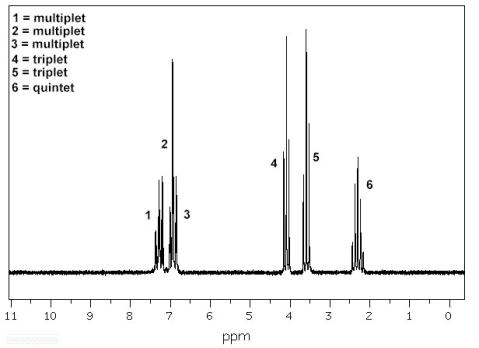
(Multiple Choice)
4.8/5 (89)
(89) Deduce the identity of the following compound from the 1H NMR data given.
C9H10O2: δ 2.2 (3H, singlet), 5.0 (2H, singlet), 7.2 (5H, singlet) (ppm)
(Essay)
4.8/5 (80)
(80) The protons marked Ha and Hb in the molecule below are ________. 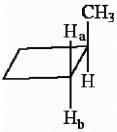
(Multiple Choice)
4.9/5 (80)
(80) How many peaks appear in the proton spin decoupled 13 C NMR spectrum of the compound below? 
(Multiple Choice)
4.8/5 (88)
(88) 
Filters
- Essay(0)
- Multiple Choice(0)
- Short Answer(0)
- True False(0)
- Matching(0)