



 Chat with AI
Exam 6: Alkyl Halides; Nucleophilic Substitution

Exam 1: Structure and Bonding127 Questions
Exam 2: Acids and Bases; Functional Groups136 Questions
Exam 3: Structure and Stereochemistry of Alkanes134 Questions
Exam 4: The Study of Chemical Reactions128 Questions
Exam 5: Stereochemistry132 Questions
Exam 6: Alkyl Halides; Nucleophilic Substitution137 Questions
Exam 7: Structure and Synthesis of Alkenes; Elimination131 Questions
Exam 8: Reactions of Alkenes134 Questions
Exam 10: Structure and Synthesis of Alcohols136 Questions
Exam 11: Reactions of Alcohols125 Questions
Exam 12: Infrared Spectroscopy and Mass Spectrometry121 Questions
Exam 13: Nuclear Magnetic Resonance Spectroscopy130 Questions
Exam 14: Ethers, Epoxides, and Thioethers127 Questions
Exam 15: Conjugated Systems, Orbital Symmetry, and Ultraviolet Spectroscopy130 Questions
Exam 16: Aromatic Compounds128 Questions
Exam 17: Reactions of Aromatic Compounds129 Questions
Exam 18: Ketones and Aldehydes131 Questions
Exam 19: Amines127 Questions
Exam 20: Carboxylic Acids125 Questions
Exam 21: Carboxylic Acid Derivatives130 Questions
Exam 22: Condensations and Alpha Substitutions of Carboxyl Compounds127 Questions
Exam 23: Carbohydrates and Nucleic Acids126 Questions
Exam 24: Amino Acids, Peptides, and Proteins127 Questions
Exam 25: Lipids127 Questions
Exam 26: Synthetic Polymers128 Questions
Select questions type


List the following bromides in order of their increasing reactivity as substrates in SN1 reactions: 1-iodo-1-ethylcyclopentane, chlorocyclopentane, and iodocyclopentane.
(Essay)
4.9/5  (80)
(80) Which of the following compounds is the most nucleophilic?
(Multiple Choice)
4.7/5 (74)
(74) Rank the species below in order of increasing nucleophilicity in hydroxylic solvents:
CH3CO2-, CH3S-, HO-, H2O.
(Essay)
4.9/5 (79)
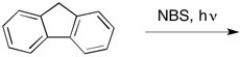
(79) 
Name the haloalkane shown. Be sure to include the appropriate R or S description if needed. 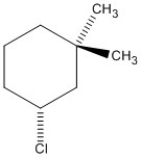
(Short Answer)
4.8/5 (92)
(92) Name the haloalkane shown. Be sure to include the appropriate R or S description if needed. 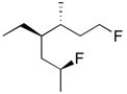
(Essay)
4.8/5 (81)
(81) Which of the following alkyl halides reacts most rapidly via an SN1 solvolysis reaction in hot methanol?
(Multiple Choice)
4.7/5 (80)
(80) Which diastereomer of 1-bromo-4-t-butylcyclohexane, the cis or the trans, undergoes elimination more rapidly when treated with sodium ethoxide? Explain your answer.
(Essay)
5.0/5 (83)
(83) When (cis)-1-bromo-2 methylcyclohexane is treated with methanol and heat, four different products are formed - two by substitution and two by elimination. 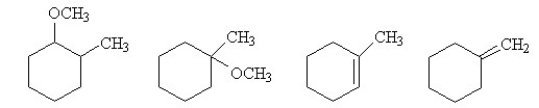 Which of the following conditions would change the outcome of this reaction by promoting the production of 3-methylhexene as the major product?
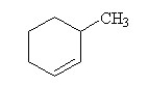
Which of the following conditions would change the outcome of this reaction by promoting the production of 3-methylhexene as the major product? (Multiple Choice)
4.9/5 (85)
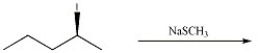
(85) Predict the two most likely mechanisms for the reaction of 2-iodohexane with potassium hydroxide.
(Multiple Choice)
4.9/5 (85)
(85) 
Which of the following alkyl halides has the smallest molecular dipole moment?
(Multiple Choice)
4.8/5 (65)
(65) Provide the structure of the major organic product in the reaction below. 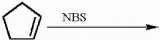
(Essay)
4.8/5 (75)
(75) 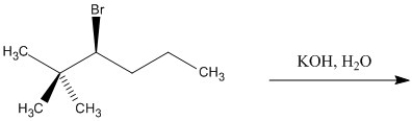
Predict the most likely mechanism for the reaction shown below. 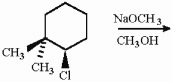
(Multiple Choice)
4.7/5 (83)
(83) Provide two circumstances under which solvolysis of a chiral alkyl halide would not result in the generation of a mixture of enantiomeric products.
(Essay)
4.9/5 (86)
(86) When 3-iodo-3-ethylpentane is heated in methanol, the major organic product is an ________ that is generated through an ________ mechanism.
(Multiple Choice)
4.7/5 (94)
(94) 
Filters
- Essay(0)
- Multiple Choice(0)
- Short Answer(0)
- True False(0)
- Matching(0)