



 Chat with AI
Exam 6: Alkyl Halides; Nucleophilic Substitution

Exam 1: Structure and Bonding127 Questions
Exam 2: Acids and Bases; Functional Groups136 Questions
Exam 3: Structure and Stereochemistry of Alkanes134 Questions
Exam 4: The Study of Chemical Reactions128 Questions
Exam 5: Stereochemistry132 Questions
Exam 6: Alkyl Halides; Nucleophilic Substitution137 Questions
Exam 7: Structure and Synthesis of Alkenes; Elimination131 Questions
Exam 8: Reactions of Alkenes134 Questions
Exam 10: Structure and Synthesis of Alcohols136 Questions
Exam 11: Reactions of Alcohols125 Questions
Exam 12: Infrared Spectroscopy and Mass Spectrometry121 Questions
Exam 13: Nuclear Magnetic Resonance Spectroscopy130 Questions
Exam 14: Ethers, Epoxides, and Thioethers127 Questions
Exam 15: Conjugated Systems, Orbital Symmetry, and Ultraviolet Spectroscopy130 Questions
Exam 16: Aromatic Compounds128 Questions
Exam 17: Reactions of Aromatic Compounds129 Questions
Exam 18: Ketones and Aldehydes131 Questions
Exam 19: Amines127 Questions
Exam 20: Carboxylic Acids125 Questions
Exam 21: Carboxylic Acid Derivatives130 Questions
Exam 22: Condensations and Alpha Substitutions of Carboxyl Compounds127 Questions
Exam 23: Carbohydrates and Nucleic Acids126 Questions
Exam 24: Amino Acids, Peptides, and Proteins127 Questions
Exam 25: Lipids127 Questions
Exam 26: Synthetic Polymers128 Questions
Select questions type


Why does CH2
 CHCHBrCH3 undergo solvolysis much more rapidly than 2-bromobutane?
 (Essay)
4.9/5  (87)
(87) 
Which of the following alkyl halides reacts most rapidly via an SN2 reaction with NaCN?
(Multiple Choice)
4.9/5 (87)
(87) Arrange the following compounds in order of increasing reactivity toward ethanol solvolysis:
t-butyl bromide, t-butyl iodide, isopropyl chloride, methyl iodide.
(Essay)
4.9/5 (88)
(88) Provide a structure for the major substitution and elimination product of the following reaction. 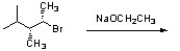
(Essay)
4.8/5 (74)
(74) When 3-iodo-3-ethylpentane is treated with sodium methoxide in methanol, the major organic product is an ________ that is generated through an ________ mechanism.
(Multiple Choice)
4.8/5 (83)
(83) Draw the highest energy transition state in the solvolysis of (CH3)3CI in CH3OH.
(Essay)
4.8/5 (80)
(80) 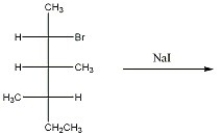
Which of the following mechanisms (SN1, SN2, E1, E2) feature(s) a carbocation intermediate?
(Multiple Choice)
4.9/5 (88)
(88) Draw the structures of the two major products formed in the following reaction. Indicate which of the two structures would be predicted to predominate under thermodynamic condition and explain why. 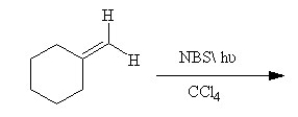
(Essay)
4.8/5 (79)
(79) Which of the cations below would be subject to a structural rearrangement? 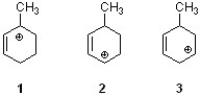
(Multiple Choice)
4.9/5 (89)
(89) Provide the structure of the major organic product which results in the following reaction. 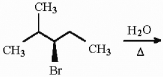
(Essay)
4.9/5 (79)
(79) Do all primary alkyl iodides undergo SN2 reactions with sodium cyanide in DMSO at identical rates? Explain.
(Essay)
4.8/5 (85)
(85) What type of intermediate is present in the SN2 reaction of cyanide with bromoethane?
(Multiple Choice)
4.7/5 (87)
(87) Show how the following reaction might be constructed using an SN2 reaction by drawing structures for the starting materials. 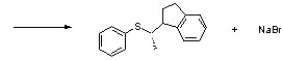
(Essay)
4.7/5 (84)
(84) Provide the structure of the major organic product in the following reaction. 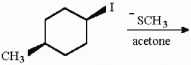
(Essay)
4.8/5 (80)
(80) When a SN1 reaction of R-2-iodobutane takes place in hot methanol, the product ________.
(Multiple Choice)
4.9/5 (70)
(70) The following structure is a proteasome inhibitor that may find application in treating cervical cancer (J. Med. Chem. 2011, 449). The halides in this structure may be classified as ________ and ________. 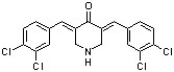
(Multiple Choice)
4.9/5 (79)
(79) 

Filters
- Essay(0)
- Multiple Choice(0)
- Short Answer(0)
- True False(0)
- Matching(0)