



 Chat with AI
Exam 6: Alkyl Halides; Nucleophilic Substitution

Exam 1: Structure and Bonding127 Questions
Exam 2: Acids and Bases; Functional Groups136 Questions
Exam 3: Structure and Stereochemistry of Alkanes134 Questions
Exam 4: The Study of Chemical Reactions128 Questions
Exam 5: Stereochemistry132 Questions
Exam 6: Alkyl Halides; Nucleophilic Substitution137 Questions
Exam 7: Structure and Synthesis of Alkenes; Elimination131 Questions
Exam 8: Reactions of Alkenes134 Questions
Exam 10: Structure and Synthesis of Alcohols136 Questions
Exam 11: Reactions of Alcohols125 Questions
Exam 12: Infrared Spectroscopy and Mass Spectrometry121 Questions
Exam 13: Nuclear Magnetic Resonance Spectroscopy130 Questions
Exam 14: Ethers, Epoxides, and Thioethers127 Questions
Exam 15: Conjugated Systems, Orbital Symmetry, and Ultraviolet Spectroscopy130 Questions
Exam 16: Aromatic Compounds128 Questions
Exam 17: Reactions of Aromatic Compounds129 Questions
Exam 18: Ketones and Aldehydes131 Questions
Exam 19: Amines127 Questions
Exam 20: Carboxylic Acids125 Questions
Exam 21: Carboxylic Acid Derivatives130 Questions
Exam 22: Condensations and Alpha Substitutions of Carboxyl Compounds127 Questions
Exam 23: Carbohydrates and Nucleic Acids126 Questions
Exam 24: Amino Acids, Peptides, and Proteins127 Questions
Exam 25: Lipids127 Questions
Exam 26: Synthetic Polymers128 Questions
Select questions type



Consider the substitution reaction shown below. By what mechanism will the reaction proceed? 
(Multiple Choice)
4.9/5  (87)
(87) Consider the substitution reaction shown below. By what mechanism will the reaction proceed? 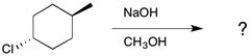
(Multiple Choice)
4.8/5 (90)
(90) Predict the most likely mechanism for the reaction shown below. 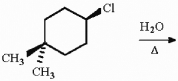
(Multiple Choice)
5.0/5 (83)
(83) Provide the structure of the major organic product in the following reaction. 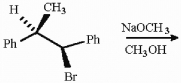
(Essay)
4.8/5 (84)
(84) When water is shaken with dichloromethane, a two-phase system results. Which compound forms the upper phase? Explain.
(Essay)
4.9/5 (69)
(69) 
Propose a mechanism with a hydride shift for the solvolysis reaction below. 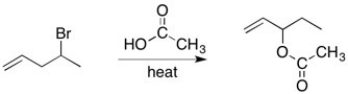
(Essay)
4.8/5 (68)
(68) What type of solvent is best for SN2 reactions which employ anionic nucleophiles: polar, protic solvents; polar, aprotic solvents; or nonpolar solvents? Explain.
(Essay)
4.7/5 (80)
(80) Which of the following statements correctly describe(s) E1 reactions of alkyl halides (RX)?
I. Rate = k[base]
II. Rate = k[base][RX]
III. Rate = k[RX]
IV. The reactions occur in two or more distinct steps.
V. Rearrangements are sometimes seen.
(Multiple Choice)
4.9/5 (86)
(86) Which of the following alkyl chlorides would undergo substitution most rapidly when treated with 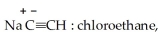
 or
 Provide the structure of the substitution product.
or
Provide the structure of the substitution product. (Essay)
4.8/5 (85)
(85) Although F is more electronegative than Cl, the C-Cl bond has a larger dipole moment than the  Explain.
 (Essay)
4.7/5 (75)
(75) Name one factor that is favorable for nucleophilicity but not for basicity.
(Short Answer)
4.8/5 (93)
(93) Complete the following SN2 reaction by providing structures for the necessary starting materials. 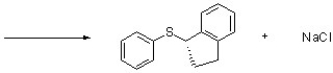
(Essay)
4.8/5 (92)
(92) When 1-bromo-2, 2-dimethylcyclopentane is heated in ethanol, one of the products which results is shown below. Provide a detailed, stepwise mechanism for the production of this compound, and give the name of the mechanism by which it is produced. 
(Essay)
4.7/5 (86)
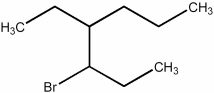
(86) How many distinct alkene products are possible, including stereoisomers, when the alkyl iodide below undergoes E2 elimination? 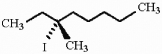
(Multiple Choice)
4.8/5 (76)
(76) 
Filters
- Essay(0)
- Multiple Choice(0)
- Short Answer(0)
- True False(0)
- Matching(0)