Multiple Choice
Passage
The lac operon encodes the proteins that metabolize lactose and is a key biochemical feature that differentiates between members of the Enterobacteriaceae family. For example, the severely virulent Salmonella typhimurium can be distinguished from its less virulent relative Escherichia coli by the absence of a lac operon. Researchers propose that the evolutionary loss of the lac operon may contribute to S. typhimurium's ability to invade epithelial cells.To test the hypothesis, wild-type (WT) S. typhimurium cells were transformed with plasmids encoding components of the lac operon (Figure 1) : β-galactosidase (lacZ+) , lactose permease (lacY+) , transacetylase (lacA+) , or all three (lac+) . Each plasmid also contained genes for the lac repressor (lacI) , which can inhibit lac operon transcription in the absence of lactose; the cAMP receptor protein (crp) , which induces lac expression in low glucose; and a chloramphenicol resistance gene (cat) .
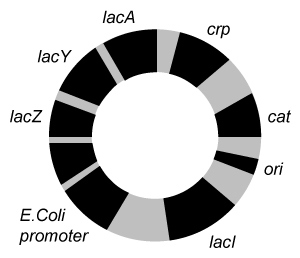 Figure 1 Plasmid PYM-LACZYA (lac+) , used to transform WT S. typhimurium. Similar plasmids containing only one of the three lacZ, lacY, or lacA genes were also used.Virulence assays were performed in mice by inoculating with WT or lac+ S. typhimurium. The assays confirmed that lac+ bacteria were less virulent than their WT counterparts, and that both WT and lac+ bacteria were more virulent in the presence of glucose. Subsequently, several genes related to invasion were analyzed for their expression levels in the presence or absence of lac plasmids (Table 1; Figure 2) .Table 1 Transcription Levels of Invasion-Associated Genes in lac+ S. typhimurium Relative to WT
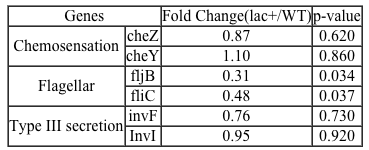
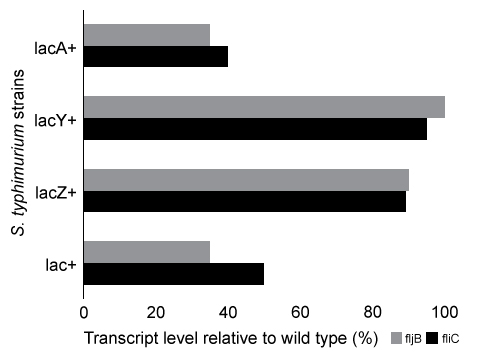 Figure 2 Transcript concentrations of two S. typhimurium flagellar genes, fljB and fliC, in bacteria transformed with lacZ+, lacY+, lacA+, or lac+ plasmids. Concentrations are expressed as a percentage of WT levels.
Adapted from Jiang L, Ni Z, Wang L, Feng L, Liu B. Loss of the lac operon contributes to Salmonella invasion of epithelial cells through derepression of flagellar synthesis. Curr Microbiol. 2015;70(3) :315-23.
-Based on Figure 2, which of the following would most likely reestablish the virulence of S. typhimurium transformed with lac+?
A) Excising the lacA sequence from the plasmid
B) Stimulating transcription of the lac operon
C) Removing the mRNA that encodes β-galactosidase
D) Increasing expression of lactose permease
Correct Answer:

Verified
Correct Answer:
Verified
Q171: Several techniques have been developed to treat
Q172: Passage<br>Hematological anomalies have been observed in patients
Q173: Following intron splicing in the nucleus, a
Q174: A drug that blocks the release of
Q175: <img src="https://d2lvgg3v3hfg70.cloudfront.net/MD0008/.jpg" alt=" A skeletal muscle
Q177: Passage<br>Beta-thalassemia is a blood disorder caused by
Q178: A specific recessive X-linked mutation prevents the
Q179: Passage<br>Osteoarthritis (OA) is a disorder marked by
Q180: Passage<br>The nicotinic acetylcholine receptor (nAChR) is a
Q181: Passage<br>Hematological anomalies have been observed in patients