Multiple Choice
Passage
Osteoarthritis (OA) is a disorder marked by the deterioration of articular (hyaline) cartilage, the connective tissue lining the ends of bones at most movable joints. The progressive erosion of articular cartilage in OA is thought to be caused by an inflammatory response induced by years of biomechanical stress due to excessive compression and friction. This response involves the release of proteolytic enzymes that break down cartilaginous proteins. The progressive breakdown of articular cartilage ultimately results in complete exposure of the cortical portion of the underlying subchondral bone with narrowing of the joint space. Repeated and abnormal joint stress can also cause the development of osteophytes, or bony growths, that form on the subchondral bone. These degenerative processes cause pain and restrict joint movement.Stem cell therapy, in which injected or grafted stem cells are induced to differentiate into chondrocytes (cartilage cells) , is a potential new treatment for OA. To further understand chondrogenesis, researchers have been studying the molecules that regulate the expression and activity of the transcription factor Sox9, which has been shown to promote chondrocyte differentiation. For example, researchers have found that binding of the growth factor TGF-β to its receptor results in Sox9 activation.MicroRNAs (miRNAs) , which are known to alter gene expression by acting at the translational level, are also potential regulators of Sox9. In particular, miRNA-145 is thought to regulate Sox9 expression by binding to the 3′-UTR of the Sox9 mRNA transcript. After chondrocyte differentiation was induced using TGF-β, researchers used Western blotting to generate an expression profile of Sox9 and β-actin (a protein not regulated by miRNA-145) in mouse stem cells transfected with miRNA-145, anti-miRNA-145, or neither (Figure 1) .
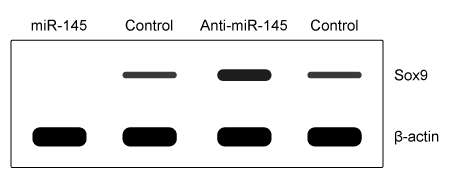 Figure 1 Expression of Sox9 in the presence and absence of miRNA-145 or anti-miRNA-145 following induction of chondrocyte differentiation
Adapted from Yang B, Guo H, Zhang Y, Chen L, Ying D, Dong S. MicroRNA-145 regulates chondrogenic differentiation of mesenchymal stem cells by targeting Sox9. PLoS ONE. 2011;6(7) :e21679.
-Which of the following statements is NOT true about hyaline cartilage?
A) It lacks innervation.
B) It gives rise to bone through endochondral ossification.
C) It serves as an attachment that holds bones to muscle.
D) It is avascular and receives nutrients from surrounding fluids.
Correct Answer:

Verified
Correct Answer:
Verified
Q174: A drug that blocks the release of
Q175: <img src="https://d2lvgg3v3hfg70.cloudfront.net/MD0008/.jpg" alt=" A skeletal muscle
Q176: Passage<br>The lac operon encodes the proteins that
Q177: Passage<br>Beta-thalassemia is a blood disorder caused by
Q178: A specific recessive X-linked mutation prevents the
Q180: Passage<br>The nicotinic acetylcholine receptor (nAChR) is a
Q181: Passage<br>Hematological anomalies have been observed in patients
Q182: Passage<br>Skin grafting is a procedure in which
Q183: Passage<br>Autosomal dominant polycystic kidney disease (ADPKD) is
Q184: Passage<br>Each time a eukaryotic cell replicates its