Multiple Choice
Passage
Quantitative fluorescence recovery after photobleaching (FRAP) is used to study the movement of molecules in live cells. During FRAP, the fluorescence of a green fluorescent protein (GFP) -tagged molecule is first measured and then photodestroyed in targeted cell regions. Researchers then assess the time course for fluorescence recovery, which is an indicator of molecular mobility of the GFP-tagged protein into the photodestroyed region. The average time required to recover 80% of the pre-bleach fluorescence of protein histone 1 (H1) fused to GFP (H1-GFP) in the photodestroyed region is given as t80.FRAP was used to analyze the mobility of the architectural H1 alone and in the presence of high-mobility group (HMG) proteins. HMG proteins are dynamic modifiers that have been shown to have opposite effects but similar binding sites on chromatin structure.
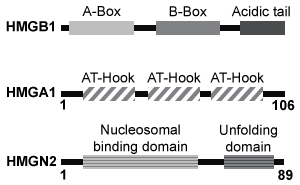 Figure 1 Unique chromatin binding motifs of HMG proteinsDuring analysis, HMGA1 and HMGB1 were microinjected into the cytoplasm of mouse embryonic fibroblast cells expressing H1-GFP. FRAP was performed on euchromatin and heterochromatin. Euchromatin and heterochromatin domains were identified as regions weakly and strongly stained by H1-GFP, respectively. The relative intensity of H1-GFP fluorescence in euchromatin and heterochromatin of uninjected and injected cells was assessed, and t80 results are shown in Table 1.Table 1 Effect of HMGB1 and HMGA1 on H1-GFP Mobility
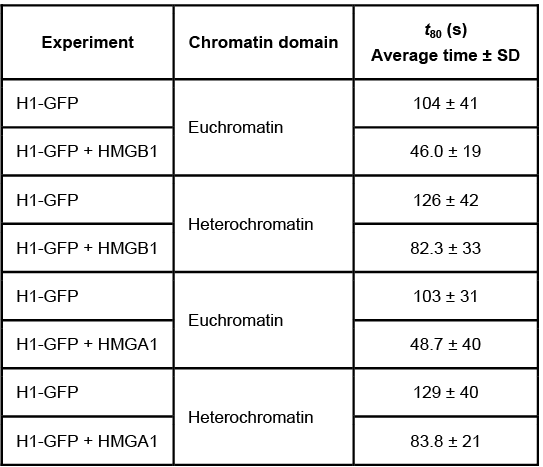 Adapted from Catez F, Yang H, Tracey KJ, Reeves R, Misteli T, Bustin M. Network of dynamic interactions between histone H1 and high-mobility-group proteins in chromatin. Mol Cell Biol. 2004;24(10) :4321-8.
-The experimental design described in the passage allowed researchers to do which of the following?Assess whether structural chromatin organization influences H1 mobilityAssess H1 and GFP competition at different levels of DNA compactionEvaluate if HMG proteins compete with H1 for chromatin-binding sites
A) I and III only
B) I and II only
C) II and III only
D) I, II, and III
Correct Answer:

Verified
Correct Answer:
Verified
Q136: Passage<br>Lipopolysaccharides (LPS) found in gram-negative bacterial cells
Q137: Passage<br>Mitochondria are thought to have been independent
Q138: Passage<br>Spinal muscular atrophy (SMA) is an autosomal
Q139: Passage<br>Alzheimer disease (AD) is a progressive condition
Q140: Excess post-exercise oxygen consumption is the extra
Q142: One function of catecholamines released by the
Q143: Passage<br>The adrenal glands are divided into two
Q144: Passage<br>Eukaryotic organelles such as mitochondria and chloroplasts
Q145: Passage<br>In the central nervous system, myelin produced
Q146: Passage<br>Obesity is a condition that affects over