Passage Lipopolysaccharides (LPS) Found in Gram-Negative Bacterial Cells Can Elicit a a Lethal
Multiple Choice
Passage
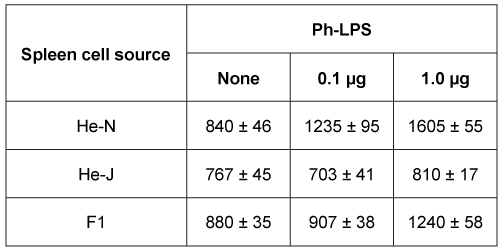
Lipopolysaccharides (LPS) found in gram-negative bacterial cells can elicit a lethal degree of adjuvanticity, or immune activation, in LPS-responsive host organisms. In mice, responses may be modulated by abnormalities in the toll-like receptor (TLR) encoded by the Tlr4 gene closely linked to coat color on Chromosome 4. To investigate the effect of a particular Tlr4 mutation on LPS response, three experiments were performed following a cross between fully responsive He-N mice [tlr4(+) /tlr4(+) ] and He-J mice homozygous for the mutation [tlr4(d) /tlr4(d) ].Experiment 1Researchers isolated spleen cells for analysis of protein expression and LPS response. In cells isolated from F1 mice, both wild-type and mutant TLRs were distinguishable by protein electrophoresis. Following this first analysis, spleen cells from each cohort were exposed to 2 × 10⁵ SRC, an antigen formed by sheep erythrocytes. Cultures were then incubated in the presence or absence of Ph-LPS, with LPS extracted from Escherichia coli K345 cells using a phenol-water mixture. Titers of anti-SRC antibody were recorded on incubation day 5, with the results shown in Table 1.Table 1 Mean anti-SRC titers with standard error
 Experiment 2Serum samples were assayed for interferon production 2 hours post LPS injection. Interferon was quantified using a plaque reduction assay on mouse cells challenged with vesicular stomatitis virus.
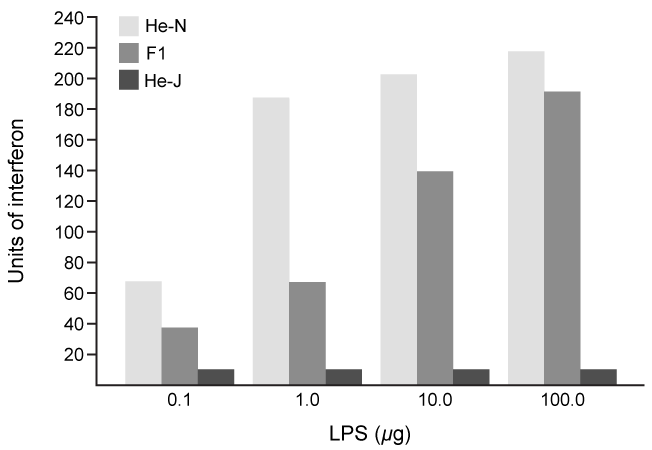 Figure 1 Average serum interferon levels in mice cohortsExperiment 3Mice were injected with varying doses of Ph-LPS and monitored for 4 days. The lethal dose (LD50) was defined as the minimum dose causing death in 50% of injected mice. Compared to He-N mice, results reflected a 10-fold increase in LD50 for F1 mice and a 100-fold increase in LD50 for He-J mice.
-In mice, a brown coat color is a dominant trait. Assuming that the He-N mice in the experiments were homozygous for the white allele and the He-J mice were homozygous for the brown allele, which of the following is true with regard to coat color and LPS response in F1 and F2 mice?
A) F1 mice will produce gametes with equal haplotype frequencies.
B) A large fraction of F2 mice exhibiting full response to LPS will be white.
C) A large fraction of F1 mice exhibiting full response to LPS will be white.
D) Half of F1 mice exhibiting full response to LPS will be brown and the other half will be white.
Correct Answer:

Verified
Correct Answer:
Verified
Q131: Passage<br>Proteins known as cancer/testis antigens (CTAs) are
Q132: Passage<br>Alzheimer disease (AD) is a progressive condition
Q133: Passage<br>Mitochondria are thought to have been independent
Q134: In an assay, researchers assessed activity levels
Q135: Passage<br>Parathyroid hormone (PTH) is an important regulator
Q137: Passage<br>Mitochondria are thought to have been independent
Q138: Passage<br>Spinal muscular atrophy (SMA) is an autosomal
Q139: Passage<br>Alzheimer disease (AD) is a progressive condition
Q140: Excess post-exercise oxygen consumption is the extra
Q141: Passage<br>Quantitative fluorescence recovery after photobleaching (FRAP) is