Multiple Choice
Passage
The bacterium Clostridium difficile secretes protein toxins TcdA and TcdB, two homologues associated with C. difficile-related colitis. Tcd proteins enter host intestinal cells via endocytosis induced by interactions between the Tcd C-terminal domain and cell surface receptors. Endocytosis is followed by translocation of the N-terminal glucosyltransferase domain (GTD) across the endosomal membrane. The GTD remains anchored to endosomes by the central region of the protein, a transmembrane domain believed to form membrane pores and facilitate translocation. Inositol hexakisphosphate (IP6) binds Tcd proteins, an interaction that is stabilized by salt bridges in the binding pocket (Figure 1) .
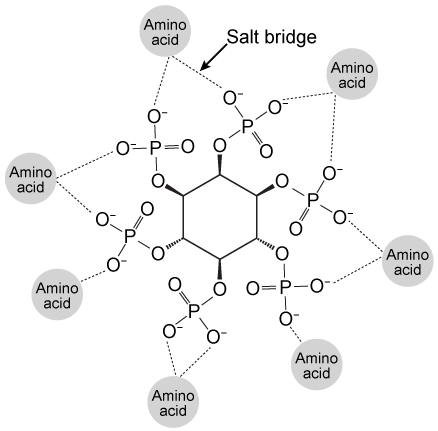 Figure 1 Salt bridges formed between IP6 and the amino acids in the binding pocketThis interaction induces a conformational change that causes a molecular flap to move away from the catalytic site. The catalytic site then mediates intramolecular cleavage in a reaction known as autoprocessing. This reaction results in the release of GTD into the cytosol, where it becomes active.To better understand the relationship between IP6 binding and catalytic activity, autoprocessing assays were performed. Researchers mutated histidine to alanine at positions 759 and 757 in the flap regions of TcdA and TcdB, respectively. They then compared the autoprocessing activities of H759A and H757A mutants to those of wild-type TcdA and TcdB at varying concentrations of IP6 (Figure 2) .
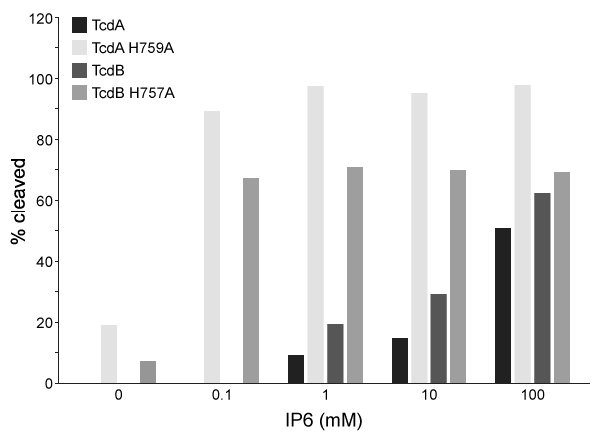 Figure 2 Percent cleavage of wild-type and mutant Tcd by autoprocessing
Adapted from Chumbler NM, Rutherford SA, Zhang Z, et al. Crystal structure of Clostridium difficile toxin A. Nat Microbiol. 2016;1:15002.
-Based on information given in the passage, stabilizing interactions are most likely to occur between phosphate groups on IP6 and which of the following amino acids lining the Tcd binding pocket?
A) Lys704 via electrostatic interactions
B) Gly705 via hydrophobic interactions
C) Cys707 via covalent bonding
D) Asp709 via ionic interactions
Correct Answer:

Verified
Correct Answer:
Verified
Q196: Passage<br>Dystroglycan (Dg) is a transmembrane protein that
Q197: Passage<br>The tumor suppressor p53 is a homotetrameric
Q198: Passage<br>Human gamma-glutamyl transpeptidase (hGGT) is an enzyme
Q199: Passage<br>The ABO blood groups are determined by
Q200: Passage<br>The ABO blood groups are determined by
Q202: Passage<br>Porphyrin biosynthesis is a multistep process that
Q203: Passage<br>Spinocerebellar ataxia 3 (SCA3) is a neurodegenerative
Q204: Passage<br>The innate immune system relies heavily on
Q205: Thermolysin is a protease that can cleave
Q206: A certain enzyme uses Mn<sup>2+</sup> as a