Multiple Choice
Passage
The ABO blood groups are determined by the polysaccharide antigens linked to sphingolipids on red blood cell membranes. The polysaccharide known as the H-antigen (O-type blood) consists of a polysaccharide (R-group) glycosidically linked to D-galactose, which is connected to L-fucose in an α-1,2 linkage. Type A and type B blood express the A- and B-antigens, respectively (Figure 1) . These antigens are modified forms of the H-antigen, in which D-galactose (B-antigen) or a derivative of D-galactose called GalNAc (A-antigen) is added in an α-1,3 linkage to the D-galactose moiety of the H-antigen.
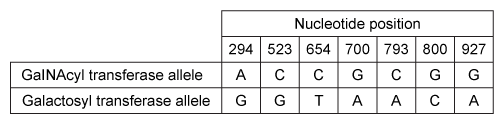
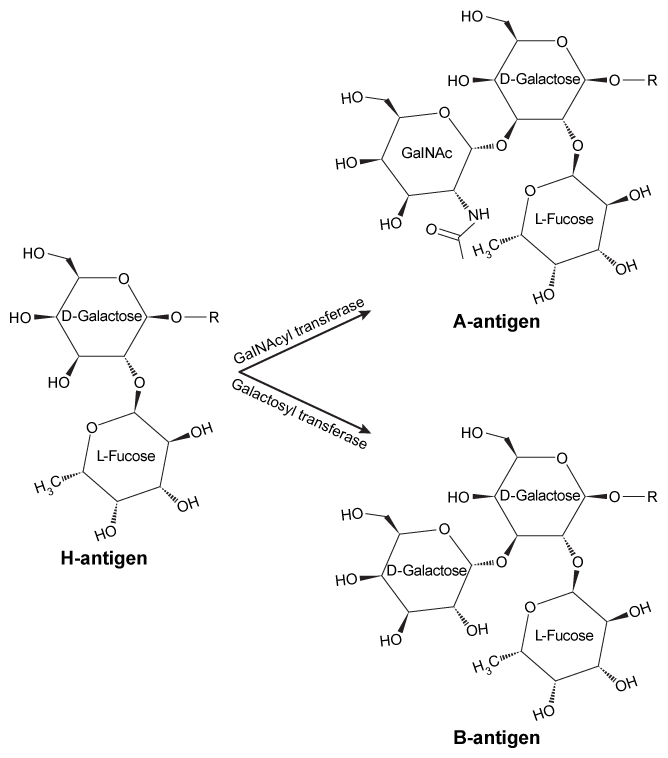 Figure 1 Structures of the H-, A-, and B-antigens. The R-group represents additional carbohydrates.The addition of GalNAc or galactose to the H-antigen is catalyzed by an enzyme encoded by the ABO gene. One allele of the gene encodes GalNAcyl transferase and produces the A-antigen, while another allele encodes galactosyl-transferase and yields the B-antigen (Figure 1) . The two alleles differ at seven nucleotide positions, summarized in Table 1.Table 1 Nucleotide Positions Where the Alleles Encoding GalNAcyl Transferase and Galactosyl Transferase Differ
 Individuals with both alleles express both antigens and have type AB blood. Those with type O blood have a third allele that encodes an inactive form of the enzyme. A study of blood type abundance was conducted, and the number of participants with each type is shown in Table 2. Table 3 shows several fatty-acyl chains found in the sphingolipids to which the antigens were attached.Table 2 Number of Participants That Express Each Blood Type in a Study of 10,000 Individuals
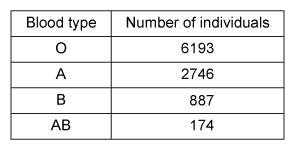 Table 3 Types of Sphingolipids to Which Polysaccharide Antigens Were Bound, as Determined by Mass Spectrometry (Note: For fatty acid chains, the numbers on the left and right of the colon indicate number of carbons and number of C=C double bonds, respectively)
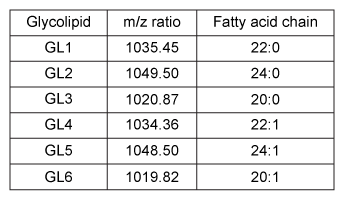
-Which of the following statements accurately describes the sphingolipids in Table 3?They provide structure to biological membranesThey are primarily used for energy storageThey can be hydrolyzed to produce two fatty acids
A) I only
B) III only
C) I and II only
D) II and III only
Correct Answer:

Verified
Correct Answer:
Verified
Q195: Escherichia coli bacteria containing only <sup>15</sup>N-labeled DNA
Q196: Passage<br>Dystroglycan (Dg) is a transmembrane protein that
Q197: Passage<br>The tumor suppressor p53 is a homotetrameric
Q198: Passage<br>Human gamma-glutamyl transpeptidase (hGGT) is an enzyme
Q199: Passage<br>The ABO blood groups are determined by
Q201: Passage<br>The bacterium Clostridium difficile secretes protein toxins
Q202: Passage<br>Porphyrin biosynthesis is a multistep process that
Q203: Passage<br>Spinocerebellar ataxia 3 (SCA3) is a neurodegenerative
Q204: Passage<br>The innate immune system relies heavily on
Q205: Thermolysin is a protease that can cleave