Multiple Choice
Passage
Human gamma-glutamyl transpeptidase (hGGT) is an enzyme involved in cysteine homeostasis, and its overexpression has been linked to asthma, cancer, and other diseases. It catalyzes the addition of water across a bond to cleave extracellular glutathione (GSH) into glutamate and a dipeptide composed of cysteine and glycine. It is believed to function by the mechanism shown in Figure 1.
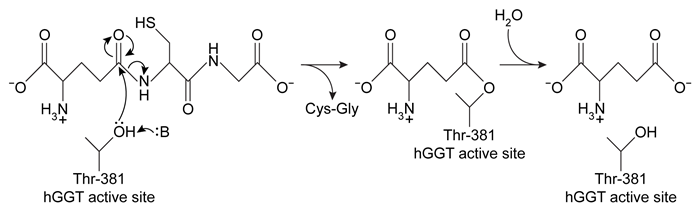 Figure 1 Proposed mechanism of hGGT-mediated GSH cleavageResearchers interested in investigating hGGT inhibitors as a treatment for pathologies related to excess hGGT activity performed the following experiments, each containing the same concentration of hGGT.Experiment 1hGGT was incubated with various concentrations of GSH in the presence or absence of 250-μM candidate compound acivicin or Compound 1. However, both candidates were found to be unsuitable as acivicin showed significant neurotoxicity and Compound 1 acted as an activator instead of an inhibitor.
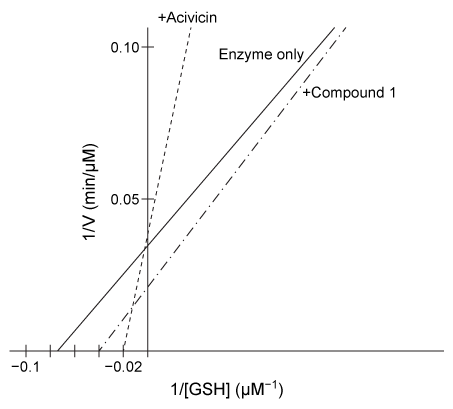 Figure 2 Lineweaver-Burk plot of hGGT activity with respect to GSH in the presence or absence of 250-μM candidate inhibitorsExperiment 2Researchers hypothesized that slight variations in the structure of Compound 1 could result in hGGT inhibition and tested several derivatives, shown in Table 1.Table 1 Kinetic Parameters of hGGT in the Presence or Absence of Several Candidate Inhibitors at 250 μM
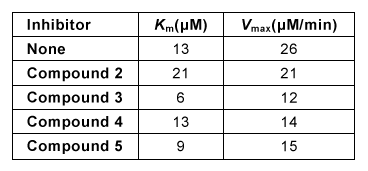 Experiment 3To better understand the physiological conditions under which hGGT operates, researchers exposed a cultured cell line expressing hGGT on the cell surface to a solution that mimicked the composition of extracellular fluid, including levels of GSH. They found that in this setup, uninhibited hGGT results in a reaction rate that is approximately ½Vmax.
Adapted from Wickham S, Regan N, West MB, et al. Inhibition of human ?-glutamyl transpeptidase: development of more potent, physiologically relevant, uncompetitive inhibitors. Biochem J. 2013;450(3) :547-57.
-Mutating residue 381 to which of the following amino acids would most likely result in the smallest change in hGGT activity?
A) Glycine
B) Lysine
C) Serine
D) Cysteine
Correct Answer:

Verified
Correct Answer:
Verified
Q193: Passage<br>Many lysosomal proteins are transported to the
Q194: Passage<br>The innate immune system relies heavily on
Q195: Escherichia coli bacteria containing only <sup>15</sup>N-labeled DNA
Q196: Passage<br>Dystroglycan (Dg) is a transmembrane protein that
Q197: Passage<br>The tumor suppressor p53 is a homotetrameric
Q199: Passage<br>The ABO blood groups are determined by
Q200: Passage<br>The ABO blood groups are determined by
Q201: Passage<br>The bacterium Clostridium difficile secretes protein toxins
Q202: Passage<br>Porphyrin biosynthesis is a multistep process that
Q203: Passage<br>Spinocerebellar ataxia 3 (SCA3) is a neurodegenerative