



 Chat with AI
Exam 9: Business Income, Deductions, and Accounting Methods

Exam 1: An Introduction to Tax113 Questions
Exam 2: Tax Compliance, the IRS, and Tax Authorities112 Questions
Exam 3: Tax Planning Strategies and Related Limitations115 Questions
Exam 4: Individual Income Tax Overview, Dependents, and Filing Status125 Questions
Exam 5: Gross Income and Exclusions130 Questions
Exam 6: Individual Deductions98 Questions
Exam 7: Investments74 Questions
Exam 8: Individual Income Tax Computation and Tax Credits154 Questions
Exam 9: Business Income, Deductions, and Accounting Methods99 Questions
Exam 10: Property Acquisition and Cost Recovery109 Questions
Exam 11: Property Dispositions110 Questions
Exam 12: Compensation101 Questions
Exam 13: Retirement Savings and Deferred Compensation115 Questions
Exam 14: Tax Consequences of Home Ownership108 Questions
Exam 15: Entities Overview80 Questions
Exam 16: Corporate Operations109 Questions
Exam 17: Accounting for Income Taxes100 Questions
Exam 18: Corporate Taxation: Nonliquidating Distributions100 Questions
Exam 19: Corporate Formation, Reorganization, and Liquidation100 Questions
Exam 20: Forming and Operating Partnerships106 Questions
Exam 21: Dispositions of Partnership Interests and Partnership Distributions100 Questions
Exam 22: S Corporations134 Questions
Exam 23: State and Local Taxes117 Questions
Exam 24: The Us Taxation of Multinational Transactions89 Questions
Exam 25: Transfer Taxes and Wealth Planning123 Questions
Select questions type


Danny owns an electronics outlet in Dallas. This year he paid $600 to register for a four-day course in management in Chicago. Danny paid $800 in airfare and $1,000 for five nights lodging. After the course, Danny spent the last day sightseeing. During the trip, Danny also paid $140 a day for meals, and $80 a day for a rental car. What amount of these travel expenditures may Danny deduct as business expenses?
(Essay)
4.8/5  (82)
(82) Alvin is a self-employed sound technician who reports on the cash method and calendar year. Alvin has a shop in Austin, Texas, but he spends much of his time away from his shop traveling to and from various concerts around the country. Alvin leases a truck to move his equipment around the country and this year he spent $12,000 in lease payments and paid $18,000 for gas, oil, and repairs. Alvin keeps records of his personal use of the truck and he estimates that 6,000 of the total 36,000 miles put on the truck this year were for personal trips. What amount of these expenses may Alvin deduct as business expenses?
(Essay)
4.8/5 (80)
(80) Uniform capitalization of indirect inventory costs is required for most very large taxpayers.
(True/False)
5.0/5 (77)
(77) Which of the following is a true statement about the limitation on business interest deductions?
(Multiple Choice)
4.9/5 (76)
(76) Joe is a self-employed electrician who operates his business on the accrual method. This year Joe purchased a shop for his business, and for the first time at year-end he received a bill for $4,500 of property taxes on his shop. Joe didn't pay the taxes until after year-end but prior to filing his tax return. Which of the following is a true statement?
(Multiple Choice)
4.9/5 (68)
(68) Sam operates a small chain of pizza outlets in Fort Collins, Colorado. In November of this year Sam decided to attend a two-day management training course. Sam could choose to attend the course in Denver or Los Angeles. Sam decided to attend the course in Los Angeles and take an eight-day vacation immediately after the course. Sam reported the following expenditures from the trip:
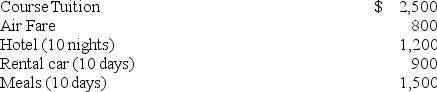 What amount of travel expenditures can Sam deduct?
 (Essay)
4.9/5 (80)
(80) Colbert operates a catering service on the accrual method. In November of year 1 Colbert received a payment of $9,000 for 18 months of catering services to be rendered from December 1st of year 1 through May 31st year 3. When must Colbert recognize the income if his accounting methods are selected to minimize income recognition?
(Multiple Choice)
4.9/5 (82)
(82) Which of the following is a true statement about impermissible accounting methods?
(Multiple Choice)
4.8/5 (88)
(88) The full-inclusion method requires cash basis taxpayers to include prepayments for goods or services into realized income.
(True/False)
4.8/5 (75)
(75) Bob operates a clothing business using the accrual method over a calendar year. In October of last year, Bob contracted with his father, Tim, for consulting advice. Tim is a cash basis calendar year taxpayer and he billed Bob for $6,000 of consulting fees. This amount was comparable to amounts charged by other consultants (a reasonable amount). Bob paid $2,500 of the consulting fee by December 31st of last year, but the remaining $3,500 was not paid until January of this year. When can Bob deduct the consulting fee?
(Essay)
4.8/5 (86)
(86) Reasonable in amount means that expenditures can be exorbitant as long as the activity is motivated by profit.
(True/False)
4.8/5 (84)
(84) Business activities are distinguished from personal activities in that business activities are motivated by the pursuit of profits.
(True/False)
4.8/5 (66)
(66) Which of the following is an explanation for why insurance premiums on a key employee are not deductible?
(Multiple Choice)
4.8/5 (85)
(85) Smith operates a roof repair business. This year Smith's business generated cash receipts of $32,000 and Smith made the following expenditures associated with his business:
 The education expense was for a two-week, night time course in business management. Smith believes the expenditure should qualify as an ordinary and necessary business expense. What net income should Smith report from his business? Smith is on the cash method and calendar year.
 (Essay)
4.9/5 (94)
(94) Which of the following types of transactions may not typically be accounted for using the cash method for small proprietorships?
(Multiple Choice)
4.7/5 (73)
(73) Dick pays insurance premiums for his employees. What type of insurance premium is not deductible as compensation paid to the employee?
(Multiple Choice)
5.0/5 (64)
(64) Adjusted taxable income for calculating the business interest limitation is defined as taxable income of the taxpayer computed without regard to any item of income, gain, deduction, or loss which is not properly allocable to a trade or business.
(True/False)
4.9/5 (75)
(75) Which of the following is a true statement about travel that has both business and personal aspects?
(Multiple Choice)
4.9/5 (80)
(80) 
Filters
- Essay(0)
- Multiple Choice(0)
- Short Answer(0)
- True False(0)
- Matching(0)