



 Chat with AI
Exam 19: Information for Decisions: Relevant Costs and Benefits

Exam 1: Management Accounting: Information for Creating Value and Managing Resources52 Questions
Exam 2: Management Accounting: Cost Terms and Concepts73 Questions
Exam 3: Cost Behaviour, Cost Drivers and Cost Estimation78 Questions
Exam 4: Product Costing Systems74 Questions
Exam 5: Process Costing and Operation Costing73 Questions
Exam 6: Service Costing78 Questions
Exam 7: A Closer Look at Overhead Costs85 Questions
Exam 8: Activity-Based Costing78 Questions
Exam 9: Budgeting Systems78 Questions
Exam 10: Standard Costs for Control: Direct Material and Direct Labour91 Questions
Exam 11: Standard Costs for Control: Flexible Budgets and Manufacturing Overhead97 Questions
Exam 12: Managing and Reporting Performance88 Questions
Exam 13: Financial Performance Measures and Incentive Schemes80 Questions
Exam 14: Strategic Performance Measurement Systems73 Questions
Exam 15: Managing Suppliers and Customers76 Questions
Exam 16: Managing Costs and Quality78 Questions
Exam 17: Sustainability and Management Accounting71 Questions
Exam 18: Cost Volume Profit Analysis97 Questions
Exam 19: Information for Decisions: Relevant Costs and Benefits95 Questions
Exam 20: Pricing and Product Mix Decisions95 Questions
Exam 21: Information for Capital Expenditure Decisions108 Questions
Select questions type


Lido Products produces two products (A and B)from a joint process.The joint cost of production is $80 000.Five thousand units of Product A can be sold at split-off for $20 per unit or processed further at an additional cost of $20 000 and sold for $25 per unit.Ten thousand units of Product B can be sold at split-off for $15 per unit or processed further at an additional cost of $20 000 and sold for $16 per unit.What is the difference in profit if Lido decides to process further Product B,instead of selling it at split-off?

Free
(Multiple Choice)
5.0/5  (68)
(68) Correct Answer: Verified
C
When a department or a product is showing a loss after all costs have been traced and allocated,a company has no option but to make the decision to either close the department or drop the product.
Free
(True/False)
4.9/5 (74)
(74) Correct Answer:Verified
VerifiedFalse
An appropriate way to account for by-products is to:
Free
(Multiple Choice)
4.9/5 (81)
(81) Correct Answer:Verified
VerifiedD
The joint cost allocation method that recognises the revenues at split-off but does not consider any further processing costs is the:
(Multiple Choice)
4.7/5 (68)
(68) Which of these statements about joint cost allocation is false?
(Multiple Choice)
4.8/5 (88)
(88) Rapid Growth Pty Ltd is presently operating at full capacity.They received a special order that,if accepted,would require refusing some sales to regular customers.Which of the following factors should management consider when making their decision?
Variable costs of special order
Fixed costs of equipment
Opportunity costs
(Multiple Choice)
4.9/5 (85)
(85) Decision problems involving accounting data are specified in:
(Multiple Choice)
4.7/5 (91)
(91) North Central Publishing is considering outsourcing its printing process.Which of the following are relevant for this outsourcing decision?
I The rent associated with the free-up space when the printing equipment is sold
Ii supplier's financial stability
Iii the carrying amount of the printing equipment
(Multiple Choice)
4.8/5 (75)
(75) Kragle Ltd manufacturers a number of specialised electronic components,including the advanced X1000.Kragle Ltd has the capacity to produce 10 000 units of X1000 per year.Currently it is operating at 80 per cent capacity.The selling price for X1000 is $100 per unit.The variable cost per unit is $30.Fixed cost allocated to producing X1000 is $200 000 per year.Kragle Ltd receives a special order for 3000 units of X1000.The opportunity cost associated with taking this special order is:
(Multiple Choice)
5.0/5 (78)
(78) Consider the situation where an activity-based costing system is in use rather than a conventional volume-based costing system.Which of the following statements is/are true?
(Multiple Choice)
4.9/5 (87)
(87) Generally,joint costs are not relevant in decision making after split-off because:
(Multiple Choice)
4.9/5 (69)
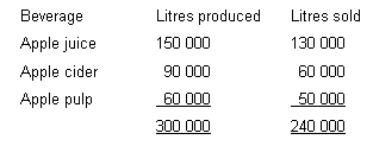
(69) A firm incurs manufacturing costs totalling $240 000 in process 1 to produce the following three beverages emerging from that process at the split-off point.Apple juice: sold immediately it emerges from Process 1 without further processing for $0.70 litre
Apple cider: processed further in Process 2 at an additional cost of $0.66667 litre,then sold for $1.50 litre
Apple pulp: processed further in Process 3 at an additional cost of $1.50 litre,then sold for $3.50 litre
The following data relates to the period in which the joint costs were incurred.What is the amount of joint cost that would be allocated to apple juice if the relative sales value method had been used?
(Multiple Choice)
4.8/5 (79)
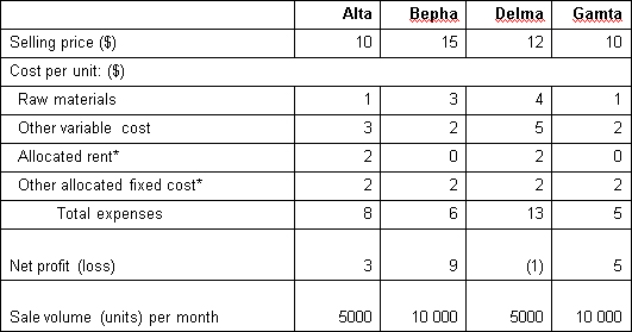
(79) Zoota Ltd makes four products: Alta,Bepha,Delma and Gamta.The selling price and per unit costs are show below.*Alta and Delma share the same factory;therefore,monthly rent is allocated equally between the two products.Other allocated monthly fixed costs include administrative costs,which are allocated based on a $2/unit charge.Zoota Ltd decides to drop Delma because it is unprofitable.Christina Bobo,the management accountant of Zoota Ltd,suggests that by dropping Delma the company can save $1 x 5000 = $5000 a month.Your assessment of Christina's suggestion is:
(Multiple Choice)
4.9/5 (80)
(80) The joint cost allocation method that is not based on the economic characteristics of the joint products is the:
(Multiple Choice)
4.9/5 (85)
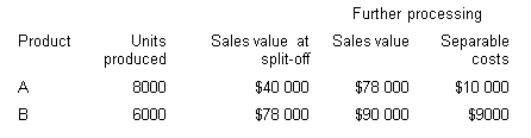
(85) C Limited produces two products (A and B)from a particular joint process.Each product may be sold at split-off or may be further processed.Joint production costs for the year amounted to $60 000.Sales values and costs are as follows.If the joint production costs were assigned using the net realisable value method,the joint costs allocated to B would be:
(Multiple Choice)
4.8/5 (80)
(80) A firm currently makes a component,and requires 30 000 for the coming year's production.Another supplier has offered the part at a delivered price of $3 per unit.It would cost $3000 to check purchased units for quality.Product costs per unit for the past year were $2.35 variable,and $1 fixed based on 30 000 units.If the component was bought,fixed overhead would be reduced by $6000,the cost of leasing specialised equipment.The space vacated by the equipment can be rented for $4000 for the year.Which of the following statements is the correct quantitative analysis of the make or buy decision?
(Multiple Choice)
4.7/5 (86)
(86) What term is used to describe factors in a decision problem that cannot be expressed effectively in numerical terms?
(Multiple Choice)
4.8/5 (75)
(75) For which of the following should joint costs and joint cost allocations not be used?
(Multiple Choice)
4.8/5 (81)
(81) 
Filters
- Essay(0)
- Multiple Choice(0)
- Short Answer(0)
- True False(0)
- Matching(0)