



 Chat with AI
Exam 16: Nutrition and Aging: the Adult Years

Exam 1: Nutrition: Food for Health80 Questions
Exam 2: Nutrition Guidelines: Applying the Science of Nutrition109 Questions
Exam 3: Digestion, Absorption, and Metabolism104 Questions
Exam 4: Carbohydrates: Sugars, Starches, and Fibre89 Questions
Exam 5: Lipids99 Questions
Exam 6: Proteins and Amino Acids76 Questions
Exam 7: Energy Balance and Weight Management89 Questions
Exam 8: A: the Water-Soluble Vitamins95 Questions
Exam 9: The Fat-Soluble Vitamins82 Questions
Exam 10: Water and the Electrolytes66 Questions
Exam 11: Major Minerals and Bone Health97 Questions
Exam 12: The Trace Elements129 Questions
Exam 13: Nutrition and Physical Activity106 Questions
Exam 14: Nutrition During Pregnancy and Lactation104 Questions
Exam 15: Nutrition From Infancy to Adolescence93 Questions
Exam 16: Nutrition and Aging: the Adult Years94 Questions
Exam 17: Food Safety98 Questions
Exam 18: World Hunger and Malnutrition89 Questions
Exam 19: Focus 1: Focus on Beyond the Basics12 Questions
Exam 20: Focus 2: Focus on Alcohol42 Questions
Exam 21: Focus 3: Focus on Obesity, Metabolism, and Disease Risk31 Questions
Exam 22: Focus 4: Focus on Phytochemicals30 Questions
Exam 23: Focus5:focus on Natural Health Products47 Questions
Exam 24: Focus 6: Focus on Integrating Nutrient Function in the Body38 Questions
Exam 25: Focus 7: Focus on Eating Disorders32 Questions
Exam 26: Focus 8: Focus on Biotechnology45 Questions
Select questions type


What social and economic factors MOST increase the risk of malnutrition?
(Multiple Choice)
4.8/5  (79)
(79) Sam and Marge are both in their 80s and live on a limited income in a medium-sized city.They usually eat at home and have almost the same diet every day of the week.They are finding that shopping and preparing three meals a day takes a lot of their energy.Marge especially has lost interest in cooking and sometimes only has tea and toast for dinner.Because neither Sam nor Marge drives,shopping means a bus trip to the store and back,along with walking several blocks.What type of assistance programs could Sam and Marge take advantage of to help them get adequate nutrition while relieving them of some of the shopping,cooking,and cleaning chores?
(Essay)
4.9/5 (88)
(88) Which statement accurately describes the recommendations for fat intake in older adults?
(Multiple Choice)
4.8/5 (80)
(80) 
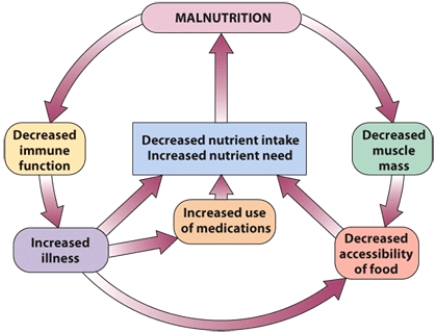
Describe the social and economic status of the elderly population most at risk for nutrition-related problems.
(Essay)
4.8/5 (74)
(74) A diet with adequate fiber can help prevent and manage all of the following EXCEPT one.Which one?
(Multiple Choice)
4.9/5 (84)
(84) Which of the following physical changes is NOT common in the elderly?
(Multiple Choice)
4.8/5 (77)
(77) Which dietary supplements is LEAST beneficial to a sedentary elderly woman with a relatively low EER?
(Multiple Choice)
4.9/5 (83)
(83) To maximize nutrient density when using Canada's Food Guide what foods should be selected?
(Multiple Choice)
4.8/5 (79)
(79) Which statement best describes the relationship between carbohydrates and energy intake in older adults?
(Multiple Choice)
4.8/5 (58)
(58) The programmed cell death hypothesis is supported by which observation?
(Multiple Choice)
4.8/5 (82)
(82) Why is the RDA for vitamin B6 is increased in older adults?
(Multiple Choice)
4.8/5 (79)
(79) What factor(s)is/are believed to contribute to the longevity of the Japanese of Okinawa?
(Multiple Choice)
4.9/5 (97)
(97) Basal metabolic rate (BMR)decreases by 2 to 3% every decade after about age 20.What causes this decline?
(Multiple Choice)
4.8/5 (77)
(77) Why might getting enough vitamin D be a problem for older adults?
(Multiple Choice)
4.7/5 (77)
(77) A hypothesis that has emerged to explain aging is termed "programmed cell death." What does this theory propose?
(Multiple Choice)
4.8/5 (68)
(68) 
Filters
- Essay(0)
- Multiple Choice(0)
- Short Answer(0)
- True False(0)
- Matching(0)