



 Chat with AI
Exam 35: Interference 1

Exam 1: Measurement37 Questions
Exam 2: Motion Along a Straight Line90 Questions
Exam 3: Vectors43 Questions
Exam 4: Motion in Two and Three Dimensions56 Questions
Exam 5: Force and Motion73 Questions
Exam 6: Force and Motion74 Questions
Exam 7: Kinetic Energy and Work73 Questions
Exam 8: Potential Energy and Conservation of Energy65 Questions
Exam 9: Center of Mass and Linear Momentum99 Questions
Exam 10: Rotation102 Questions
Exam 11: Rolling, Torque, and Angular Momentum67 Questions
Exam 12: Equilibrium and Elasticity57 Questions
Exam 13: Gravitation61 Questions
Exam 14: Fluids91 Questions
Exam 15: Oscillations80 Questions
Exam 16: Waves83 Questions
Exam 17: Waves72 Questions
Exam 18: Temperature, Heat, and the First Law of Thermodynamics96 Questions
Exam 19: The Kinetic Theory of Gases114 Questions
Exam 20: Entropy and the Second Law of Thermodynamics61 Questions
Exam 21: Coulombs Law52 Questions
Exam 22: Electric Fields55 Questions
Exam 23: Gauss Law44 Questions
Exam 24: Electric Potential55 Questions
Exam 25: Capacitance61 Questions
Exam 26: Current and Resistance55 Questions
Exam 27: Circuits75 Questions
Exam 28: Magnetic Fields53 Questions
Exam 29: Magnetic Fields Due to Currents49 Questions
Exam 30: Induction and Inductance90 Questions
Exam 31: Electromagnetic Oscillations and Alternating Current89 Questions
Exam 32: Maxwells Equations; Magnetism of Matter87 Questions
Exam 33: Electromagnetic Waves83 Questions
Exam 34: Images79 Questions
Exam 35: Interference 147 Questions
Exam 36: Diffraction77 Questions
Exam 37: Relativity69 Questions
Exam 38: Photons and Matter Waves59 Questions
Exam 39: More About Matter Waves45 Questions
Exam 40: All About Atoms79 Questions
Exam 41: Conduction of Electricity in Solids51 Questions
Exam 42: Energy From the Nucleus50 Questions
Exam 43: Quarks, Leptons, and the Big Bang59 Questions
Select questions type


Three experiments involving a thin film (in air)are shown.If t denotes the film thickness and denotes the wavelength of the light in the film, which experiments will produce constructive interference as seen by the observer? 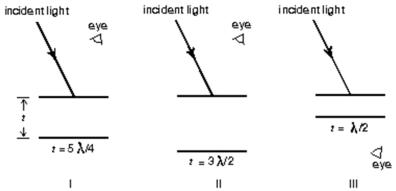
(Multiple Choice)
4.8/5  (76)
(76) Consider (I)the law of reflection and (II)the law of refraction.Huygens' principle can be used to derive:
(Multiple Choice)
4.9/5 (72)
(72) Monochromatic light, at normal incidence, strikes a thin film in air.If denotes the wavelength in the film, what is the thinnest film in which the reflected light will be a maximum?
(Multiple Choice)
4.8/5 (88)
(88) Light from a small region of an ordinary incandescent bulb is passed through a yellow filter and then serves as the source for a Young's double-slit experiment.Which of the following changes would cause the interference pattern to be more closely spaced?
(Multiple Choice)
4.9/5 (75)
(75) The three factors that determine the interference of reflected waves from a thin film are:
(Multiple Choice)
4.9/5 (85)
(85) In a Young's experiment, it is essential that the two beams:
(Multiple Choice)
4.7/5 (86)
(86) Yellow light is viewed by reflection from a thin vertical soap film.Let be the wavelength of the light within the film.Why is there a large dark space at the top of the film? 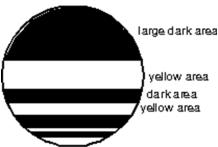
(Multiple Choice)
4.7/5 (78)
(78) 
Filters
- Essay(0)
- Multiple Choice(0)
- Short Answer(0)
- True False(0)
- Matching(0)