



 Chat with AI
Exam 33: Electromagnetic Waves

Exam 1: Measurement37 Questions
Exam 2: Motion Along a Straight Line90 Questions
Exam 3: Vectors43 Questions
Exam 4: Motion in Two and Three Dimensions56 Questions
Exam 5: Force and Motion73 Questions
Exam 6: Force and Motion74 Questions
Exam 7: Kinetic Energy and Work73 Questions
Exam 8: Potential Energy and Conservation of Energy65 Questions
Exam 9: Center of Mass and Linear Momentum99 Questions
Exam 10: Rotation102 Questions
Exam 11: Rolling, Torque, and Angular Momentum67 Questions
Exam 12: Equilibrium and Elasticity57 Questions
Exam 13: Gravitation61 Questions
Exam 14: Fluids91 Questions
Exam 15: Oscillations80 Questions
Exam 16: Waves83 Questions
Exam 17: Waves72 Questions
Exam 18: Temperature, Heat, and the First Law of Thermodynamics96 Questions
Exam 19: The Kinetic Theory of Gases114 Questions
Exam 20: Entropy and the Second Law of Thermodynamics61 Questions
Exam 21: Coulombs Law52 Questions
Exam 22: Electric Fields55 Questions
Exam 23: Gauss Law44 Questions
Exam 24: Electric Potential55 Questions
Exam 25: Capacitance61 Questions
Exam 26: Current and Resistance55 Questions
Exam 27: Circuits75 Questions
Exam 28: Magnetic Fields53 Questions
Exam 29: Magnetic Fields Due to Currents49 Questions
Exam 30: Induction and Inductance90 Questions
Exam 31: Electromagnetic Oscillations and Alternating Current89 Questions
Exam 32: Maxwells Equations; Magnetism of Matter87 Questions
Exam 33: Electromagnetic Waves83 Questions
Exam 34: Images79 Questions
Exam 35: Interference 147 Questions
Exam 36: Diffraction77 Questions
Exam 37: Relativity69 Questions
Exam 38: Photons and Matter Waves59 Questions
Exam 39: More About Matter Waves45 Questions
Exam 40: All About Atoms79 Questions
Exam 41: Conduction of Electricity in Solids51 Questions
Exam 42: Energy From the Nucleus50 Questions
Exam 43: Quarks, Leptons, and the Big Bang59 Questions
Select questions type


A clear sheet of polarizing material is placed on top of a second, similar sheet so that their polarizing axes make an angle of 30° with each other.The ratio of the intensity of emerging light to incident unpolarized light is:

Free
(Multiple Choice)
4.8/5  (66)
(66) Correct Answer: Verified
E
For a beam of light in air (n = 1)reflecting off glass (n = 1.5), what is Brewster's angle?
Free
(Multiple Choice)
4.8/5 (63)
(63) Correct Answer:Verified
VerifiedE
The separation of white light into colors by a prism is associated with:
Free
(Multiple Choice)
4.9/5 (76)
(76) Correct Answer:Verified
VerifiedC
When an electromagnetic wave meets a reflecting surface, the direction taken by the reflected wave is determined by:
(Multiple Choice)
4.7/5 (81)
(81) If nwater = 1.33, what is the angle of refraction for the ray shown? 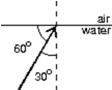
(Multiple Choice)
4.8/5 (79)
(79) The order of increasing wavelength for blue (b), green (g), red (r), and yellow (y)light is:
(Multiple Choice)
5.0/5 (87)
(87) The index of refraction for diamond is 2.5.Which of the following is correct for the situation shown? 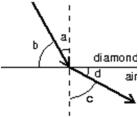
(Multiple Choice)
4.9/5 (72)
(72) Radio waves differ from visible light waves in that radio waves:
(Multiple Choice)
4.9/5 (85)
(85) The sun is about 1.5* 1011 m away.The time for light to travel this distance is about:
(Multiple Choice)
4.9/5 (84)
(84) The relation n1sin 1 = n2 sin 2 which applies as a ray of light strikes an interface between two media, is known as:
(Multiple Choice)
5.0/5 (85)
(85) A sinusoidal electromagnetic wave has an electric field whose rms value is 100 V/m.What is the instantaneous rate S of energy flow for this wave?
(Multiple Choice)
4.9/5 (81)
(81) A point source emits electromagnetic energy at a rate of 100 W.The intensity 10 m from the source is:
(Multiple Choice)
4.8/5 (71)
(71) The critical angle for total internal reflection at a diamond-air interface is 25°.Suppose light is incident at an angle of with the normal.Total internal reflection will occur if the incident medium is:
(Multiple Choice)
4.8/5 (84)
(84) A ray of light passes through three media as shown.The speeds of light in these media obey: 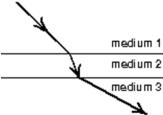
(Multiple Choice)
4.8/5 (75)
(75) The time averaged energy in a sinusoidal electromagnetic wave is:
(Multiple Choice)
4.9/5 (90)
(90) A ray of light in water (index n1)is incident on its surface (with air)at the critical angle.Some oil (index n2)is now floated on the water.The angle between the ray in the oil and the normal is:
(Multiple Choice)
4.9/5 (84)
(84) The time for a radar signal to travel to the Moon and back, a one-way distance of about 3.8*108 m, is:
(Multiple Choice)
4.8/5 (86)
(86) 
Filters
- Essay(0)
- Multiple Choice(0)
- Short Answer(0)
- True False(0)
- Matching(0)