



 Chat with AI
Exam 38: Photons and Matter Waves

Exam 1: Measurement37 Questions
Exam 2: Motion Along a Straight Line90 Questions
Exam 3: Vectors43 Questions
Exam 4: Motion in Two and Three Dimensions56 Questions
Exam 5: Force and Motion73 Questions
Exam 6: Force and Motion74 Questions
Exam 7: Kinetic Energy and Work73 Questions
Exam 8: Potential Energy and Conservation of Energy65 Questions
Exam 9: Center of Mass and Linear Momentum99 Questions
Exam 10: Rotation102 Questions
Exam 11: Rolling, Torque, and Angular Momentum67 Questions
Exam 12: Equilibrium and Elasticity57 Questions
Exam 13: Gravitation61 Questions
Exam 14: Fluids91 Questions
Exam 15: Oscillations80 Questions
Exam 16: Waves83 Questions
Exam 17: Waves72 Questions
Exam 18: Temperature, Heat, and the First Law of Thermodynamics96 Questions
Exam 19: The Kinetic Theory of Gases114 Questions
Exam 20: Entropy and the Second Law of Thermodynamics61 Questions
Exam 21: Coulombs Law52 Questions
Exam 22: Electric Fields55 Questions
Exam 23: Gauss Law44 Questions
Exam 24: Electric Potential55 Questions
Exam 25: Capacitance61 Questions
Exam 26: Current and Resistance55 Questions
Exam 27: Circuits75 Questions
Exam 28: Magnetic Fields53 Questions
Exam 29: Magnetic Fields Due to Currents49 Questions
Exam 30: Induction and Inductance90 Questions
Exam 31: Electromagnetic Oscillations and Alternating Current89 Questions
Exam 32: Maxwells Equations; Magnetism of Matter87 Questions
Exam 33: Electromagnetic Waves83 Questions
Exam 34: Images79 Questions
Exam 35: Interference 147 Questions
Exam 36: Diffraction77 Questions
Exam 37: Relativity69 Questions
Exam 38: Photons and Matter Waves59 Questions
Exam 39: More About Matter Waves45 Questions
Exam 40: All About Atoms79 Questions
Exam 41: Conduction of Electricity in Solids51 Questions
Exam 42: Energy From the Nucleus50 Questions
Exam 43: Quarks, Leptons, and the Big Bang59 Questions
Select questions type


A free electron and a free proton have the same speed.This means that, compared to the matter wave associated with the proton, the matter wave associated with the electron has:

Free
(Multiple Choice)
4.9/5  (84)
(84) Correct Answer: Verified
E
Identical particles, each with energy E, are incident on the following four potential energy barriers: 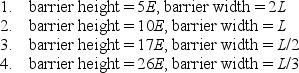 Rank the barriers in terms of the probability that the particles tunnel through them, from least probability to greatest probability.
Free
(Multiple Choice)
4.8/5 (78)
(78) Correct Answer:Verified
VerifiedA
In a photoelectric effect experiment at a frequency above cut off, the stopping potential is proportional to:
Free
(Multiple Choice)
4.8/5 (76)
(76) Correct Answer:Verified
VerifiedD
A photon in light beam A has twice the energy of a photon in light beam B.The ratio pA/pB of their momenta is:
(Multiple Choice)
4.9/5 (77)
(77) A free electron in motion along the x axis has a localized wave function.If it enters a region of space where its potential energy increases,
(Multiple Choice)
4.9/5 (87)
(87) In Compton scattering from stationary electrons the largest change in wavelength occurs when the photon is scattered through:
(Multiple Choice)
4.9/5 (100)
(100) Separate Compton effect experiments are carried out using visible light and x rays.The scattered radiation is observed at the same scattering angle.For these experiments:
(Multiple Choice)
4.8/5 (89)
(89) Consider the following three particles:  Rank them according to the wavelengths of their waves, least to greatest.
 (Multiple Choice)
4.8/5 (68)
(68) Which of the following electromagnetic radiations has photons with the greatest energy?
(Multiple Choice)
4.8/5 (65)
(65) A free electron and a free proton have the same momentum.This means that, compared to the matter wave associated with the proton, the matter wave associated with the electron has:
(Multiple Choice)
4.9/5 (75)
(75) Electromagnetic radiation with a wavelength of 3.5 *10-12 m is scattered from stationary electrons and photons that have been scattered through 50° are detected.An electron from which one of these photons was scattered receives an energy of:
(Multiple Choice)
4.8/5 (74)
(74) A non-relativistic free electron has kinetic energy K.If its wavelength doubles, its kinetic energy is:
(Multiple Choice)
4.9/5 (76)
(76) Maxwell's equations are to electric and magnetic fields as __________ equation is to the wave function of the particle.
(Multiple Choice)
4.7/5 (85)
(85) The probability that a particle is in a given small region of space is proportional to:
(Multiple Choice)
4.9/5 (81)
(81) A free electron in motion along the x axis has a localized wave function.The uncertainty in its momentum is decreased if:
(Multiple Choice)
4.8/5 (86)
(86) The frequency of light beam A is twice that of light beam B.The ratio EA/EB of photon energies is:
(Multiple Choice)
4.9/5 (83)
(83) Of the following which is the best evidence for the wave nature of matter?
(Multiple Choice)
4.7/5 (84)
(84)  | 2 is:
In a photoelectric effect experiment the stopping potential is:
(Multiple Choice)
5.0/5 (84)
(84) A free electron has a momentum of 5.0*10-24 kg . m/s.Its wavelength, as given by its wave function, is:
(Multiple Choice)
4.8/5 (81)
(81) 
Filters
- Essay(0)
- Multiple Choice(0)
- Short Answer(0)
- True False(0)
- Matching(0)