



 Chat with AI
Exam 38: Photons and Matter Waves

Exam 1: Measurement37 Questions
Exam 2: Motion Along a Straight Line90 Questions
Exam 3: Vectors43 Questions
Exam 4: Motion in Two and Three Dimensions56 Questions
Exam 5: Force and Motion73 Questions
Exam 6: Force and Motion74 Questions
Exam 7: Kinetic Energy and Work73 Questions
Exam 8: Potential Energy and Conservation of Energy65 Questions
Exam 9: Center of Mass and Linear Momentum99 Questions
Exam 10: Rotation102 Questions
Exam 11: Rolling, Torque, and Angular Momentum67 Questions
Exam 12: Equilibrium and Elasticity57 Questions
Exam 13: Gravitation61 Questions
Exam 14: Fluids91 Questions
Exam 15: Oscillations80 Questions
Exam 16: Waves83 Questions
Exam 17: Waves72 Questions
Exam 18: Temperature, Heat, and the First Law of Thermodynamics96 Questions
Exam 19: The Kinetic Theory of Gases114 Questions
Exam 20: Entropy and the Second Law of Thermodynamics61 Questions
Exam 21: Coulombs Law52 Questions
Exam 22: Electric Fields55 Questions
Exam 23: Gauss Law44 Questions
Exam 24: Electric Potential55 Questions
Exam 25: Capacitance61 Questions
Exam 26: Current and Resistance55 Questions
Exam 27: Circuits75 Questions
Exam 28: Magnetic Fields53 Questions
Exam 29: Magnetic Fields Due to Currents49 Questions
Exam 30: Induction and Inductance90 Questions
Exam 31: Electromagnetic Oscillations and Alternating Current89 Questions
Exam 32: Maxwells Equations; Magnetism of Matter87 Questions
Exam 33: Electromagnetic Waves83 Questions
Exam 34: Images79 Questions
Exam 35: Interference 147 Questions
Exam 36: Diffraction77 Questions
Exam 37: Relativity69 Questions
Exam 38: Photons and Matter Waves59 Questions
Exam 39: More About Matter Waves45 Questions
Exam 40: All About Atoms79 Questions
Exam 41: Conduction of Electricity in Solids51 Questions
Exam 42: Energy From the Nucleus50 Questions
Exam 43: Quarks, Leptons, and the Big Bang59 Questions
Select questions type


 (x)is the wave function for a particle moving along the x axis.The probability that the particle is in the interval from x = a to x = b is given by:
 (Multiple Choice)
4.8/5  (79)
(79) In Compton scattering from stationary electrons the largest change in wavelength that can occur is:
(Multiple Choice)
4.8/5 (75)
(75) In order to tunnel through a potential barrier a particle must:
(Multiple Choice)
4.9/5 (75)
(75) The intensity of a light beam with a wavelength of 500 nm is 2000 W/m2.The photon flux is about:
(Multiple Choice)
4.8/5 (78)
(78) An electron with energy E is incident on a potential energy barrier of height Epot and thickness L.The probability of tunneling increases if:
(Multiple Choice)
4.9/5 (69)
(69) In a photoelectric effect experiment no electrons are ejected if the frequency of the incident light is less than A/h, where h is the Planck constant and A is:
(Multiple Choice)
4.7/5 (91)
(91) Of the following, Compton scattering from electrons is most easily observed for:
(Multiple Choice)
4.9/5 (67)
(67) The diagram shows the graphs of the stopping potential as a function of the frequency of the incident light for photoelectric experiments performed on three different materials.Rank the materials according to the values of their work functions, from least to greatest. 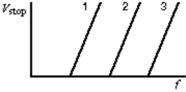
(Multiple Choice)
4.9/5 (77)
(77) The quantization of energy, E = nhf, is not important for an ordinary pendulum because:
(Multiple Choice)
4.9/5 (83)
(83) Monoenergetic electrons are incident on a single slit barrier.If the energy of each incident electron is increased the central maximum of the diffraction pattern:
(Multiple Choice)
4.8/5 (82)
(82) If the kinetic energy of a non-relativistic free electron doubles, the frequency of its wave function changes by the factor:
(Multiple Choice)
4.7/5 (78)
(78) An electron with energy E is incident upon a potential energy barrier of height Epot < E and thickness L.The reflection coefficient R:
(Multiple Choice)
4.9/5 (71)
(71) The surface of the Sun is at a temperature of approximately 5800 K, and radiates a peak wavelength of 500 nm.According to the Planck radiation law, what is its emitted intensity per unit wavelength at the peak?
(Multiple Choice)
4.9/5 (80)
(80) Electromagnetic radiation with a wavelength of 3.5 * 10-12 m is scattered from stationary electrons, and photons that have been scattered through 50° are detected.After a scattering event the magnitude of the photon's momentum is:
(Multiple Choice)
4.8/5 (93)
(93) Rank following electromagnetic radiations according to the energies of their photons, from least to greatest. 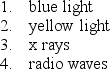
(Multiple Choice)
4.8/5 (76)
(76) The reflection coefficient R for a certain barrier tunneling problem is 0.80.The corresponding transmission coefficient T is:
(Multiple Choice)
4.7/5 (93)
(93) Consider the following: I.A photoelectric process in which all emitted electrons have energy less than hf, where f is the frequency of the incident light.
II.A photoelectric process in which some emitted electrons have kinetic energy greater than hf.
III.Compton scattering from stationary electrons for which the emitted light has a frequency that is greater than that of the incident light.
IV.Compton scattering from stationary electrons for which the emitted light has a frequency that is less than that of the incident light.
The only possible processes are:
(Multiple Choice)
4.9/5 (72)
(72) Consider the following three particles: 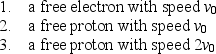 Rank them according to the wavelengths of their matter waves, least to greatest.
 (Multiple Choice)
4.7/5 (67)
(67) The wavelength of light beam B is twice the wavelength of light beam B.The energy of a photon in beam A is:
(Multiple Choice)
4.9/5 (81)
(81) 
Filters
- Essay(0)
- Multiple Choice(0)
- Short Answer(0)
- True False(0)
- Matching(0)