



 Chat with AI
Exam 35: Interference 1

Exam 1: Measurement37 Questions
Exam 2: Motion Along a Straight Line90 Questions
Exam 3: Vectors43 Questions
Exam 4: Motion in Two and Three Dimensions56 Questions
Exam 5: Force and Motion73 Questions
Exam 6: Force and Motion74 Questions
Exam 7: Kinetic Energy and Work73 Questions
Exam 8: Potential Energy and Conservation of Energy65 Questions
Exam 9: Center of Mass and Linear Momentum99 Questions
Exam 10: Rotation102 Questions
Exam 11: Rolling, Torque, and Angular Momentum67 Questions
Exam 12: Equilibrium and Elasticity57 Questions
Exam 13: Gravitation61 Questions
Exam 14: Fluids91 Questions
Exam 15: Oscillations80 Questions
Exam 16: Waves83 Questions
Exam 17: Waves72 Questions
Exam 18: Temperature, Heat, and the First Law of Thermodynamics96 Questions
Exam 19: The Kinetic Theory of Gases114 Questions
Exam 20: Entropy and the Second Law of Thermodynamics61 Questions
Exam 21: Coulombs Law52 Questions
Exam 22: Electric Fields55 Questions
Exam 23: Gauss Law44 Questions
Exam 24: Electric Potential55 Questions
Exam 25: Capacitance61 Questions
Exam 26: Current and Resistance55 Questions
Exam 27: Circuits75 Questions
Exam 28: Magnetic Fields53 Questions
Exam 29: Magnetic Fields Due to Currents49 Questions
Exam 30: Induction and Inductance90 Questions
Exam 31: Electromagnetic Oscillations and Alternating Current89 Questions
Exam 32: Maxwells Equations; Magnetism of Matter87 Questions
Exam 33: Electromagnetic Waves83 Questions
Exam 34: Images79 Questions
Exam 35: Interference 147 Questions
Exam 36: Diffraction77 Questions
Exam 37: Relativity69 Questions
Exam 38: Photons and Matter Waves59 Questions
Exam 39: More About Matter Waves45 Questions
Exam 40: All About Atoms79 Questions
Exam 41: Conduction of Electricity in Solids51 Questions
Exam 42: Energy From the Nucleus50 Questions
Exam 43: Quarks, Leptons, and the Big Bang59 Questions
Select questions type


In a Young's double-slit experiment the center of a bright fringe occurs wherever waves from the slits differ in the distance they travel by a multiple of:
(Multiple Choice)
5.0/5  (81)
(81) A soap film is illuminated by white light normal to its surface.The index of refraction of the film is 1.50.Wavelengths of 480 nm and 800 nm and no wavelengths between are intensified in the reflected beam.The thickness of the film is:
(Multiple Choice)
4.8/5 (83)
(83) Light from a point source X contains only blue and red components.After passing through a mysterious box, the light falls on a screen.Red and blue hands are observed as shown.The box must contain: 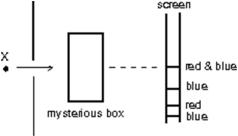
(Multiple Choice)
4.8/5 (79)
(79) An air wedge is formed using two glass plates that are in contact along their left edge.When viewed by highly monochromatic light, there are exactly 4001 dark bands in the reflected light.The air is now evacuated (with the glass plates remaining rigidly fixed)and the number of dark bands decreases to exactly 4000.The index of refraction of the air is:
(Multiple Choice)
4.7/5 (75)
(75) If the speed of light is c, and the index of refraction of a material is n, what is the speed of light in the material?
(Multiple Choice)
4.8/5 (81)
(81) Two light waves are initially in phase and have the same wavelength, 470 nm.They enter two different media of identical lengths of 2.50 µm.If n1 = 1.2 and n2 = 1.5, what is the effective phase difference of the waves when they exit the media? 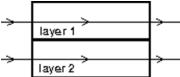
(Multiple Choice)
4.8/5 (73)
(73) The light waves represented by the three rays shown in the diagram all have the same frequency.4.7 wavelengths fit into layer 1, 3.2 wavelengths fit into layer 2, and 5.3 wavelengths fit into layer 3.Rank the layers according to the speeds of the waves, least to greatest. 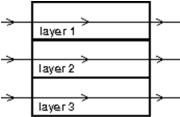
(Multiple Choice)
4.7/5 (78)
(78) In a Young's double-slit experiment, the separation between slits is d and the screen is a distance D from the slits.D is much greater than d and is the wavelength of the light.The number of bright fringes per unit length on the screen is:
(Multiple Choice)
4.9/5 (82)
(82) In a Young's double-slit experiment, light of wavelength 500 nm illuminates two slits which are separated by 1 mm.The separation between adjacent bright fringes on a screen 5 m from the slits is:
(Multiple Choice)
4.8/5 (80)
(80) A thin film with an index of refraction of 1.60 is placed in one of the beams of a Michelson interferometer.If this causes a shift of 8 bright fringes in the pattern produced by light of wavelength 580 nm, what is the thickness of the film?
(Multiple Choice)
4.8/5 (70)
(70) If the wavelength of a particular beam of light in vacuum is λ, and the index of refraction of a material is n, what is the wavelength of the light in the material?
(Multiple Choice)
4.9/5 (79)
(79) In a Young's double-slit experiment, a thin sheet of mica is placed over one of the two slits.As a result, the center of the fringe pattern (on the screen)shifts so that the center is now occupied by what was the 30th dark band.The wavelength of the light in this experiment is 480 nm and the index of the mica is 1.60.The mica thickness is:
(Multiple Choice)
4.8/5 (87)
(87) In a Young's double-slit experiment, the slit separation is doubled.To maintain the same fringe spacing on the screen, the screen-to-slit distance D must be changed to:
(Multiple Choice)
4.9/5 (71)
(71) A lens with a refractive index of 1.5 is coated with a material of refractive index 1.2 in order to minimize reflection.If denotes the wavelength of the incident light in air, what is the thinnest possible such coating? 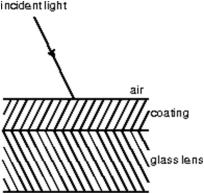
(Multiple Choice)
4.9/5 (87)
(87) When light travels from one medium into a different medium with a different index of refraction,
(Multiple Choice)
4.8/5 (78)
(78) Waves from two slits are in phase at the slits and travel to a distant screen to produce the second minimum of the interference pattern.The difference in the distance traveled by the wave is:
(Multiple Choice)
4.9/5 (68)
(68) Red light is viewed through a thin vertical soap film.At the third dark area shown, the thickness of the film, in terms of the wavelength within the film, is: 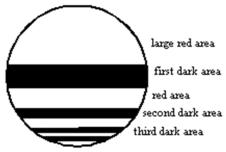
(Multiple Choice)
4.7/5 (78)
(78) 
Filters
- Essay(0)
- Multiple Choice(0)
- Short Answer(0)
- True False(0)
- Matching(0)