



 Chat with AI
Exam 34: Images

Exam 1: Measurement37 Questions
Exam 2: Motion Along a Straight Line90 Questions
Exam 3: Vectors43 Questions
Exam 4: Motion in Two and Three Dimensions56 Questions
Exam 5: Force and Motion73 Questions
Exam 6: Force and Motion74 Questions
Exam 7: Kinetic Energy and Work73 Questions
Exam 8: Potential Energy and Conservation of Energy65 Questions
Exam 9: Center of Mass and Linear Momentum99 Questions
Exam 10: Rotation102 Questions
Exam 11: Rolling, Torque, and Angular Momentum67 Questions
Exam 12: Equilibrium and Elasticity57 Questions
Exam 13: Gravitation61 Questions
Exam 14: Fluids91 Questions
Exam 15: Oscillations80 Questions
Exam 16: Waves83 Questions
Exam 17: Waves72 Questions
Exam 18: Temperature, Heat, and the First Law of Thermodynamics96 Questions
Exam 19: The Kinetic Theory of Gases114 Questions
Exam 20: Entropy and the Second Law of Thermodynamics61 Questions
Exam 21: Coulombs Law52 Questions
Exam 22: Electric Fields55 Questions
Exam 23: Gauss Law44 Questions
Exam 24: Electric Potential55 Questions
Exam 25: Capacitance61 Questions
Exam 26: Current and Resistance55 Questions
Exam 27: Circuits75 Questions
Exam 28: Magnetic Fields53 Questions
Exam 29: Magnetic Fields Due to Currents49 Questions
Exam 30: Induction and Inductance90 Questions
Exam 31: Electromagnetic Oscillations and Alternating Current89 Questions
Exam 32: Maxwells Equations; Magnetism of Matter87 Questions
Exam 33: Electromagnetic Waves83 Questions
Exam 34: Images79 Questions
Exam 35: Interference 147 Questions
Exam 36: Diffraction77 Questions
Exam 37: Relativity69 Questions
Exam 38: Photons and Matter Waves59 Questions
Exam 39: More About Matter Waves45 Questions
Exam 40: All About Atoms79 Questions
Exam 41: Conduction of Electricity in Solids51 Questions
Exam 42: Energy From the Nucleus50 Questions
Exam 43: Quarks, Leptons, and the Big Bang59 Questions
Select questions type


A convex refracting surface has a radius of 12 cm.Light is incident in air (n = 1)and refracted into a medium with an index of refraction of 2.To obtain light with rays parallel to the central axis after refraction a point source should be placed on the axis:
(Multiple Choice)
4.9/5  (84)
(84) Which of the following five glass lenses is a diverging lens? 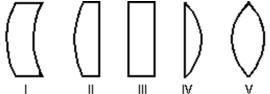
(Multiple Choice)
5.0/5 (73)
(73) An erect object is 2f in front of a convex lens of focal length f.The image is:
(Multiple Choice)
4.8/5 (79)
(79) The Sun subtends 0.5° as seen from the Earth.Its image, using a 1.0-m focal length lens, is about:
(Multiple Choice)
4.8/5 (72)
(72) An erect object is placed on the central axis of a thin lens, further from the lens than the magnitude of its focal length.The magnification is +0.4.This means:
(Multiple Choice)
4.9/5 (63)
(63) A converging lens is symmetric; its curved sides have radii of 50 cm.If the focal length is to be 80 cm, what should the index of refraction be?
(Multiple Choice)
5.0/5 (80)
(80) A concave spherical mirror has a focal length of 12 cm.If an object is placed 6 cm in front of it the image position is:
(Multiple Choice)
4.9/5 (78)
(78) A card marked IAHIO8 is standing upright in front of a plane mirror.Which of the following is NOT true?
(Multiple Choice)
4.9/5 (77)
(77) Let p denote the object-lens distance and i the image-lens distance.The image produced by a lens of focal length f has a height that can be obtained from the object height by multiplying it by:
(Multiple Choice)
4.8/5 (72)
(72) A concave refracting surface of a medium with index of refraction n produces a real image no matter where an object is placed outside:
(Multiple Choice)
4.8/5 (74)
(74) A plano-convex glass (n = 1.5)lens has a curved side whose radius is 50 cm.If the image size is to be the same as the object size, the object should be placed at a distance from the lens of:
(Multiple Choice)
4.8/5 (85)
(85) A concave spherical mirror has a focal length of 12 cm.If an object is placed 18 cm in front of it the image position is:
(Multiple Choice)
4.9/5 (81)
(81) A camera with a lens of focal length 6.0 cm takes a picture of a 1.4-m man standing 11 m away.The height of the image is about:
(Multiple Choice)
4.8/5 (80)
(80) An object faces a spherical refracting surface.If r is negative,
(Multiple Choice)
4.8/5 (79)
(79) An erect object placed outside the focal point of a converging lens will produce an image that is:
(Multiple Choice)
4.9/5 (80)
(80) Which of the following is NOT correct for a simple magnifying glass?
(Multiple Choice)
4.9/5 (82)
(82) 
Filters
- Essay(0)
- Multiple Choice(0)
- Short Answer(0)
- True False(0)
- Matching(0)