



 Chat with AI
Exam 34: Images

Exam 1: Measurement37 Questions
Exam 2: Motion Along a Straight Line90 Questions
Exam 3: Vectors43 Questions
Exam 4: Motion in Two and Three Dimensions56 Questions
Exam 5: Force and Motion73 Questions
Exam 6: Force and Motion74 Questions
Exam 7: Kinetic Energy and Work73 Questions
Exam 8: Potential Energy and Conservation of Energy65 Questions
Exam 9: Center of Mass and Linear Momentum99 Questions
Exam 10: Rotation102 Questions
Exam 11: Rolling, Torque, and Angular Momentum67 Questions
Exam 12: Equilibrium and Elasticity57 Questions
Exam 13: Gravitation61 Questions
Exam 14: Fluids91 Questions
Exam 15: Oscillations80 Questions
Exam 16: Waves83 Questions
Exam 17: Waves72 Questions
Exam 18: Temperature, Heat, and the First Law of Thermodynamics96 Questions
Exam 19: The Kinetic Theory of Gases114 Questions
Exam 20: Entropy and the Second Law of Thermodynamics61 Questions
Exam 21: Coulombs Law52 Questions
Exam 22: Electric Fields55 Questions
Exam 23: Gauss Law44 Questions
Exam 24: Electric Potential55 Questions
Exam 25: Capacitance61 Questions
Exam 26: Current and Resistance55 Questions
Exam 27: Circuits75 Questions
Exam 28: Magnetic Fields53 Questions
Exam 29: Magnetic Fields Due to Currents49 Questions
Exam 30: Induction and Inductance90 Questions
Exam 31: Electromagnetic Oscillations and Alternating Current89 Questions
Exam 32: Maxwells Equations; Magnetism of Matter87 Questions
Exam 33: Electromagnetic Waves83 Questions
Exam 34: Images79 Questions
Exam 35: Interference 147 Questions
Exam 36: Diffraction77 Questions
Exam 37: Relativity69 Questions
Exam 38: Photons and Matter Waves59 Questions
Exam 39: More About Matter Waves45 Questions
Exam 40: All About Atoms79 Questions
Exam 41: Conduction of Electricity in Solids51 Questions
Exam 42: Energy From the Nucleus50 Questions
Exam 43: Quarks, Leptons, and the Big Bang59 Questions
Select questions type


The angle between a horizontal ruler and a vertical plane mirror is 30°.The angle between the ruler and its image is:
(Multiple Choice)
4.9/5  (73)
(73) The objective lens of the Yerkes telescope (the largest functioning refracting telescope in the world)has a focal length of 19.4 m.If its eyepiece has a focal length of 2.5 cm, what is the magnitude of its magnification?
(Multiple Choice)
4.7/5 (69)
(69) A converging lens of focal length 20 cm is placed in contact with, and to the left of, a diverging lens of focal length 30 cm.If an object is placed 40 cm to the left of the converging lens, the total magnification is:
(Multiple Choice)
4.7/5 (77)
(77) In a compound microscope, the objective has a focal length of 1.0 cm, the eyepiece has a focal length of 2.0 cm, and the tube length is 25 cm.What is the magnitude of the overall magnification of the microscope?
(Multiple Choice)
4.8/5 (67)
(67) The focal length of a spherical mirror is N times its radius of curvature where N is:
(Multiple Choice)
5.0/5 (87)
(87) A point source is to be used with a concave mirror to produce a beam of parallel light.The source should be placed:
(Multiple Choice)
4.8/5 (72)
(72) A man holds a rectangular card in front of and parallel to a plane mirror.In order for him to see the entire image of the card, the least mirror area needed is:
(Multiple Choice)
4.8/5 (66)
(66) A concave refracting surface is one with a center of curvature:
(Multiple Choice)
4.9/5 (82)
(82) A convex refracting surface has a radius of 12 cm.Light is incident in air (n = 1)and refracted into a medium with an index of refraction of 2.Light incident parallel to the central axis is focused at a point:
(Multiple Choice)
4.9/5 (83)
(83) A candle C sits between two parallel mirrors, a distance 0.2d from mirror 1.Here d is the distance between the mirrors.Multiple images of the candle appear in both mirrors.How far behind mirror 1 are the nearest three images of the candle in that mirror? 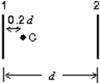
(Multiple Choice)
4.8/5 (82)
(82) A light bulb burns in front of the center of a 40-cm wide mirror that is hung vertically on a wall.A man walks in front of the mirror along a line that is parallel to the mirror and twice as far from it as the bulb.The greatest distance he can walk and see the image of the bulb at all times is:
(Multiple Choice)
4.9/5 (74)
(74) A concave mirror forms a real image which is twice the size of the object.If the object is 20 cm from the mirror, the radius of curvature of the mirror must be about:
(Multiple Choice)
4.7/5 (83)
(83) A man stands with his nose 8 cm from a concave shaving mirror of radius 32 cm.The distance from the mirror to the image of his nose is:
(Multiple Choice)
4.7/5 (81)
(81) The bellows of an adjustable camera can be extended so that the largest film to lens distance is one and one-half times the focal length.If the focal length is 12 cm, the nearest object which can be sharply focused on the film must be what distance from the lens?
(Multiple Choice)
4.7/5 (82)
(82) Which type(s)of lenses can produce both real and virtual images?
(Multiple Choice)
4.8/5 (85)
(85) Where must an object be placed in front of a converging lens in order to obtain a virtual image?
(Multiple Choice)
4.8/5 (86)
(86) A convex spherical refracting surface separates a medium with index of refraction 2 from air.The image of an object outside the surface is real:
(Multiple Choice)
4.9/5 (79)
(79) An erect object is located on the central axis of a spherical mirror.The magnification is -3.This means its image is:
(Multiple Choice)
4.8/5 (87)
(87) An erect object is in front of a convex mirror a distance greater than the focal length.The image is:
(Multiple Choice)
4.9/5 (83)
(83) A hollow lens is made of thin glass as shown.It can be filled with air, water (n = 1.3)or CS2 (carbon disulfide, n = 1.6).A beam of parallel light entering the lens will diverge if the lens is filled with: 
(Multiple Choice)
4.8/5 (74)
(74) 
Filters
- Essay(0)
- Multiple Choice(0)
- Short Answer(0)
- True False(0)
- Matching(0)