



 Chat with AI
Exam 27: Circuits

Exam 1: Measurement37 Questions
Exam 2: Motion Along a Straight Line90 Questions
Exam 3: Vectors43 Questions
Exam 4: Motion in Two and Three Dimensions56 Questions
Exam 5: Force and Motion73 Questions
Exam 6: Force and Motion74 Questions
Exam 7: Kinetic Energy and Work73 Questions
Exam 8: Potential Energy and Conservation of Energy65 Questions
Exam 9: Center of Mass and Linear Momentum99 Questions
Exam 10: Rotation102 Questions
Exam 11: Rolling, Torque, and Angular Momentum67 Questions
Exam 12: Equilibrium and Elasticity57 Questions
Exam 13: Gravitation61 Questions
Exam 14: Fluids91 Questions
Exam 15: Oscillations80 Questions
Exam 16: Waves83 Questions
Exam 17: Waves72 Questions
Exam 18: Temperature, Heat, and the First Law of Thermodynamics96 Questions
Exam 19: The Kinetic Theory of Gases114 Questions
Exam 20: Entropy and the Second Law of Thermodynamics61 Questions
Exam 21: Coulombs Law52 Questions
Exam 22: Electric Fields55 Questions
Exam 23: Gauss Law44 Questions
Exam 24: Electric Potential55 Questions
Exam 25: Capacitance61 Questions
Exam 26: Current and Resistance55 Questions
Exam 27: Circuits75 Questions
Exam 28: Magnetic Fields53 Questions
Exam 29: Magnetic Fields Due to Currents49 Questions
Exam 30: Induction and Inductance90 Questions
Exam 31: Electromagnetic Oscillations and Alternating Current89 Questions
Exam 32: Maxwells Equations; Magnetism of Matter87 Questions
Exam 33: Electromagnetic Waves83 Questions
Exam 34: Images79 Questions
Exam 35: Interference 147 Questions
Exam 36: Diffraction77 Questions
Exam 37: Relativity69 Questions
Exam 38: Photons and Matter Waves59 Questions
Exam 39: More About Matter Waves45 Questions
Exam 40: All About Atoms79 Questions
Exam 41: Conduction of Electricity in Solids51 Questions
Exam 42: Energy From the Nucleus50 Questions
Exam 43: Quarks, Leptons, and the Big Bang59 Questions
Select questions type


In the circuit shown, both resistors have the same value R.Suppose switch S is initially closed and capacitor C is charged.When switch S is then opened, the circuit has a time constant  a.Conversely, suppose S is initially open and capacitor C is uncharged.When switch S is then closed, the circuit has a time constant 11ef00bf_7880_91f1_bc85_1792c21a71f3_TB6585_11 b.The ratio 11ef00bf_7880_91f1_bc85_1792c21a71f3_TB6585_11 a/ 11ef00bf_7880_91f1_bc85_1792c21a71f3_TB6585_11 b is:
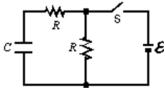
a.Conversely, suppose S is initially open and capacitor C is uncharged.When switch S is then closed, the circuit has a time constant 11ef00bf_7880_91f1_bc85_1792c21a71f3_TB6585_11 b.The ratio 11ef00bf_7880_91f1_bc85_1792c21a71f3_TB6585_11 a/ 11ef00bf_7880_91f1_bc85_1792c21a71f3_TB6585_11 b is: (Multiple Choice)
4.8/5  (85)
(85) Suppose the current charging a capacitor is kept constant.Which graph below correctly gives the potential difference V across the capacitor as a function of time? 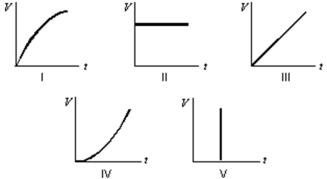
(Multiple Choice)
4.8/5 (85)
(85) 2. The circuit is completed by connecting the negative terminals.If each battery has an internal resistance of r, the rate in watts at which electrical energy is converted to chemical energy in the smaller battery is:
(Multiple Choice)
4.8/5 (82)
(82) A certain voltmeter has an internal resistance of 10,000 and a range from 0 to 100 V.To give it a range from 0 to 1000 V, one should connect:
(Multiple Choice)
5.0/5 (78)
(78) "The sum of the emf's and potential differences around a closed loop equals zero" is a consequence of:
(Multiple Choice)
4.7/5 (73)
(73) Four 20- resistors are connected in parallel and the combination is connected to a 20-V emf device.The current in any one of the resistors is:
(Multiple Choice)
4.8/5 (88)
(88) Resistor 1 has twice the resistance of resistor 2.They are connected in parallel to a battery.The ratio of the thermal energy dissipation by 1 to that by 2 is:
(Multiple Choice)
4.9/5 (72)
(72) By using only two resistors, R1 and R2 a student is able to obtain resistances of 3 , 4 , 12 , and 16 .The values of R1 and R2 are:
(Multiple Choice)
4.7/5 (87)
(87) A certain voltmeter has an internal resistance of 10,000 and a range from 0 to 12 V.To extend its range to 120 V, use a series resistance of:
(Multiple Choice)
4.8/5 (79)
(79) Two wires made of the same material have the same length but different diameters.They are connected in series to a battery.The quantity that is the same for the wires is:
(Multiple Choice)
4.8/5 (88)
(88) Four wires meet at a junction.The first carries 4 A into the junction, the second carries 5 A out of the junction, and the third carries 2 A out of the junction.The fourth carries:
(Multiple Choice)
4.9/5 (68)
(68) Two 110-V light bulbs, one labeled 25 W and the other 100 W, are connected in series to a 110 V source.Then:
(Multiple Choice)
4.8/5 (82)
(82) Resistor 1 has twice the resistance of resistor 2.The two are connected in series and a potential difference is maintained across the combination.The rate of thermal energy dissipation in 1 is:
(Multiple Choice)
4.9/5 (80)
(80) If a circuit has L closed loops, B branches, and J junctions the number of independent loop equations is:
(Multiple Choice)
4.7/5 (61)
(61) 
Filters
- Essay(0)
- Multiple Choice(0)
- Short Answer(0)
- True False(0)
- Matching(0)