



 Chat with AI
Exam 27: Circuits

Exam 1: Measurement37 Questions
Exam 2: Motion Along a Straight Line90 Questions
Exam 3: Vectors43 Questions
Exam 4: Motion in Two and Three Dimensions56 Questions
Exam 5: Force and Motion73 Questions
Exam 6: Force and Motion74 Questions
Exam 7: Kinetic Energy and Work73 Questions
Exam 8: Potential Energy and Conservation of Energy65 Questions
Exam 9: Center of Mass and Linear Momentum99 Questions
Exam 10: Rotation102 Questions
Exam 11: Rolling, Torque, and Angular Momentum67 Questions
Exam 12: Equilibrium and Elasticity57 Questions
Exam 13: Gravitation61 Questions
Exam 14: Fluids91 Questions
Exam 15: Oscillations80 Questions
Exam 16: Waves83 Questions
Exam 17: Waves72 Questions
Exam 18: Temperature, Heat, and the First Law of Thermodynamics96 Questions
Exam 19: The Kinetic Theory of Gases114 Questions
Exam 20: Entropy and the Second Law of Thermodynamics61 Questions
Exam 21: Coulombs Law52 Questions
Exam 22: Electric Fields55 Questions
Exam 23: Gauss Law44 Questions
Exam 24: Electric Potential55 Questions
Exam 25: Capacitance61 Questions
Exam 26: Current and Resistance55 Questions
Exam 27: Circuits75 Questions
Exam 28: Magnetic Fields53 Questions
Exam 29: Magnetic Fields Due to Currents49 Questions
Exam 30: Induction and Inductance90 Questions
Exam 31: Electromagnetic Oscillations and Alternating Current89 Questions
Exam 32: Maxwells Equations; Magnetism of Matter87 Questions
Exam 33: Electromagnetic Waves83 Questions
Exam 34: Images79 Questions
Exam 35: Interference 147 Questions
Exam 36: Diffraction77 Questions
Exam 37: Relativity69 Questions
Exam 38: Photons and Matter Waves59 Questions
Exam 39: More About Matter Waves45 Questions
Exam 40: All About Atoms79 Questions
Exam 41: Conduction of Electricity in Solids51 Questions
Exam 42: Energy From the Nucleus50 Questions
Exam 43: Quarks, Leptons, and the Big Bang59 Questions
Select questions type


In the diagram R1 > R2 > R3.Rank the three resistors according to the current in them, least to greatest. 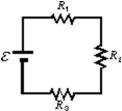
(Multiple Choice)
4.9/5  (71)
(71) A resistor with resistance R1 and a resistor with resistance R2 are connected in parallel to an ideal battery with emf  .The rate of thermal energy generation in the resistor with resistance R1 is:
 (Multiple Choice)
4.8/5 (74)
(74) An ideal battery has an emf of 12 V.If it is connected to a circuit and creates a current of 4.0 A, what is the power?
(Multiple Choice)
4.9/5 (62)
(62) For any circuit the number of independent equations containing emf's, resistances, and currents equals:
(Multiple Choice)
4.8/5 (76)
(76) The emf of a battery is equal to its terminal potential difference:
(Multiple Choice)
4.8/5 (74)
(74) Nine identical wires, each of diameter d and length L, are connected in series.The combination has the same resistance as a single similar wire of length L but whose diameter is:
(Multiple Choice)
4.8/5 (82)
(82) "The sum of the currents into a junction equals the sum of the currents out of the junction" is a consequence of:
(Multiple Choice)
4.9/5 (87)
(87) When switch S is open, the ammeter in the circuit shown reads 2.0 A.When S is closed, the ammeter reading: 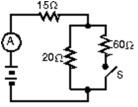
(Multiple Choice)
5.0/5 (83)
(83) Four circuits have the form shown in the diagram.The capacitor is initially uncharged and the switch S is open. 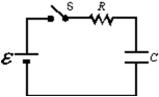
 Rank the circuits according to the current just after switch S is closed least to greatest.
 (Multiple Choice)
4.9/5 (74)
(74) In the diagrams, all light bulbs are identical and all emf devices are identical.In which circuit (I, II, III, IV, V)will the bulbs be dimmest? 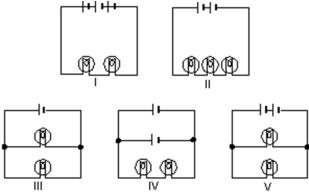
(Multiple Choice)
4.7/5 (86)
(86) In the diagram, the current in the 3- resistor is 4 A.The potential difference between points 1 and 2 is: 
(Multiple Choice)
5.0/5 (82)
(82) An initially uncharged capacitor C is connected in series with resistor R.This combination is then connected to a battery of emf V0.Sufficient time elapses so that a steady state is reached.Which of the following statements is NOT true?
(Multiple Choice)
4.9/5 (78)
(78) 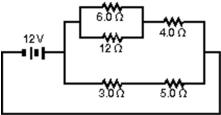
Two identical batteries, each with an emf of 18 V and an internal resistance of 1 , are wired in parallel by connecting their positive terminals together and connecting their negative terminals together.The combination is then wired across a 4- resistor.The potential difference across the 4- resistor is:
(Multiple Choice)
4.9/5 (71)
(71) A battery of emf 24 V is connected to a 6.0- resistor.As a result, current of 3.0 A exists in the resistor.The rate at which energy is being dissipated in the battery is:
(Multiple Choice)
4.9/5 (93)
(93) A portion of a circuit is shown, with the values of the currents given for some branches.What is the direction and value of the current i? 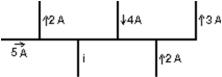
(Multiple Choice)
4.9/5 (77)
(77) A battery is connected across a series combination of two identical resistors.If the potential difference across the terminals is V and the current in the battery is i, then:
(Multiple Choice)
4.8/5 (76)
(76) Two identical batteries, each with an emf of 18 V and an internal resistance of 1 , are wired in parallel by connecting their positive terminals together and connecting their negative terminals together.The combination is then wired across a 4- resistor.The current in the 4- resistor is:
(Multiple Choice)
4.8/5 (74)
(74) Two wires are made of the same material and have the same length but different radii.They are joined end-to-end and a potential difference is maintained across the combination.Of the following the quantity that is the same for both wires is:
(Multiple Choice)
4.8/5 (88)
(88) A certain ammeter has an internal resistance of 1 and a range from 0 to 50 mA.To make its range from 0 to 5 A, use:
(Multiple Choice)
4.8/5 (81)
(81) 
Filters
- Essay(0)
- Multiple Choice(0)
- Short Answer(0)
- True False(0)
- Matching(0)