



 Chat with AI
Exam 8: Potential Energy and Conservation of Energy

Exam 1: Measurement37 Questions
Exam 2: Motion Along a Straight Line90 Questions
Exam 3: Vectors43 Questions
Exam 4: Motion in Two and Three Dimensions56 Questions
Exam 5: Force and Motion73 Questions
Exam 6: Force and Motion74 Questions
Exam 7: Kinetic Energy and Work73 Questions
Exam 8: Potential Energy and Conservation of Energy65 Questions
Exam 9: Center of Mass and Linear Momentum99 Questions
Exam 10: Rotation102 Questions
Exam 11: Rolling, Torque, and Angular Momentum67 Questions
Exam 12: Equilibrium and Elasticity57 Questions
Exam 13: Gravitation61 Questions
Exam 14: Fluids91 Questions
Exam 15: Oscillations80 Questions
Exam 16: Waves83 Questions
Exam 17: Waves72 Questions
Exam 18: Temperature, Heat, and the First Law of Thermodynamics96 Questions
Exam 19: The Kinetic Theory of Gases114 Questions
Exam 20: Entropy and the Second Law of Thermodynamics61 Questions
Exam 21: Coulombs Law52 Questions
Exam 22: Electric Fields55 Questions
Exam 23: Gauss Law44 Questions
Exam 24: Electric Potential55 Questions
Exam 25: Capacitance61 Questions
Exam 26: Current and Resistance55 Questions
Exam 27: Circuits75 Questions
Exam 28: Magnetic Fields53 Questions
Exam 29: Magnetic Fields Due to Currents49 Questions
Exam 30: Induction and Inductance90 Questions
Exam 31: Electromagnetic Oscillations and Alternating Current89 Questions
Exam 32: Maxwells Equations; Magnetism of Matter87 Questions
Exam 33: Electromagnetic Waves83 Questions
Exam 34: Images79 Questions
Exam 35: Interference 147 Questions
Exam 36: Diffraction77 Questions
Exam 37: Relativity69 Questions
Exam 38: Photons and Matter Waves59 Questions
Exam 39: More About Matter Waves45 Questions
Exam 40: All About Atoms79 Questions
Exam 41: Conduction of Electricity in Solids51 Questions
Exam 42: Energy From the Nucleus50 Questions
Exam 43: Quarks, Leptons, and the Big Bang59 Questions
Select questions type


A ball is held at a height H above a floor.It is then released and falls to the floor.If air resistance can be ignored, which of the five graphs below correctly gives the mechanical energy E of the Earth-ball system as a function of the altitude y of the ball? 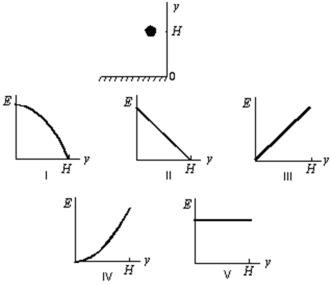
(Multiple Choice)
4.8/5  (83)
(83) The potential energy of a 0.20-kg particle moving along the x axis is given by U(x)= (8.0 J/m2)x2 − (2.0 J/m4)x4.When the particle is at x = 1.0 m the magnitude of its acceleration is:
(Multiple Choice)
4.9/5 (73)
(73) The graphs below show the magnitude of the force on a particle as the particle moves along the positive x axis from the origin to x = x1.The force is parallel to the x axis and is conservative.The maximum magnitude F1 has the same value for all graphs.Rank the situations according to the change in the potential energy associated with the force, least (or most negative)to greatest (or most positive). 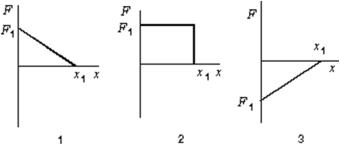
(Multiple Choice)
4.8/5 (81)
(81) The diagram shows a plot of the potential energy as a function of x for a particle moving along the x axis.The points of unstable equilibrium are: 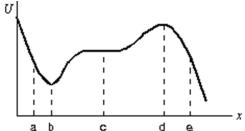
(Multiple Choice)
5.0/5 (74)
(74) A 2-kg block is thrown upward from a point 20 m above the Earth's surface.At what height above Earth's surface will the gravitational potential energy of the Earth-block system have increased by 500 J?
(Multiple Choice)
4.8/5 (86)
(86) The diagram shows a plot of the potential energy as a function of x for a particle moving along the x axis.The points of neutral equilibrium are: 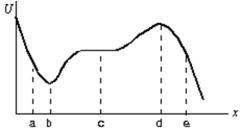
(Multiple Choice)
4.9/5 (79)
(79) A 6.0-kg block is released from rest 80 m above the ground.When it has fallen 60 m its kinetic energy is approximately:
(Multiple Choice)
4.8/5 (65)
(65) A small object of mass m, on the end of a light cord, is held horizontally at a distance r from a fixed support as shown.The object is then released.What is the tension in the cord when the object is at the lowest point of its swing? 
(Multiple Choice)
4.9/5 (78)
(78) A 0.50-kg block attached to an ideal spring with a spring constant of 80 N/m oscillates on a horizontal frictionless surface.The total mechanical energy is 0.12 J.The greatest extension of the spring from its equilibrium length is:
(Multiple Choice)
4.7/5 (73)
(73) A stationary mass m = 1.3 kg is hanging from a spring of spring constant k = 1200 N/m.You raise the mass a distance of 10 cm above its equilibrium position.How much has the potential energy of the mass-spring system changed?
(Multiple Choice)
4.9/5 (74)
(74) The sum of the kinetic and potential energies of a system of objects is conserved:
(Multiple Choice)
4.8/5 (86)
(86) The thermal energy of a system consisting of a thrown ball, Earth, and the air is most closely associated with:
(Multiple Choice)
4.9/5 (77)
(77) A stationary mass m = 1.3 kg is hanging from a spring of spring constant k = 1200 N/m.You raise the mass a distance of 10 cm above its equilibrium position in a time of 1.4 s.What was the average power expended?
(Multiple Choice)
4.9/5 (76)
(76) A block slides across a rough horizontal table top.The work done by friction changes:
(Multiple Choice)
4.8/5 (87)
(87) A 700-N man jumps out of a window into a fire net 10 m below.The net stretches 2 m before bringing the man to rest and tossing him back into the air.The maximum potential energy of the net, compared to its unstretched potential energy, is:
(Multiple Choice)
4.7/5 (72)
(72) A golf ball is struck by a golf club and falls on a green eight feet above the tee.The potential energy of the Earth-ball system is greatest:
(Multiple Choice)
4.8/5 (76)
(76) A 0.5-kg block slides along a horizontal frictionless surface at 2 m/s.It is brought to rest by compressing a very long spring of spring constant 800 N/m.The maximum spring compression is:
(Multiple Choice)
4.8/5 (84)
(84) 
Filters
- Essay(0)
- Multiple Choice(0)
- Short Answer(0)
- True False(0)
- Matching(0)