



 Chat with AI
Exam 8: Potential Energy and Conservation of Energy

Exam 1: Measurement37 Questions
Exam 2: Motion Along a Straight Line90 Questions
Exam 3: Vectors43 Questions
Exam 4: Motion in Two and Three Dimensions56 Questions
Exam 5: Force and Motion73 Questions
Exam 6: Force and Motion74 Questions
Exam 7: Kinetic Energy and Work73 Questions
Exam 8: Potential Energy and Conservation of Energy65 Questions
Exam 9: Center of Mass and Linear Momentum99 Questions
Exam 10: Rotation102 Questions
Exam 11: Rolling, Torque, and Angular Momentum67 Questions
Exam 12: Equilibrium and Elasticity57 Questions
Exam 13: Gravitation61 Questions
Exam 14: Fluids91 Questions
Exam 15: Oscillations80 Questions
Exam 16: Waves83 Questions
Exam 17: Waves72 Questions
Exam 18: Temperature, Heat, and the First Law of Thermodynamics96 Questions
Exam 19: The Kinetic Theory of Gases114 Questions
Exam 20: Entropy and the Second Law of Thermodynamics61 Questions
Exam 21: Coulombs Law52 Questions
Exam 22: Electric Fields55 Questions
Exam 23: Gauss Law44 Questions
Exam 24: Electric Potential55 Questions
Exam 25: Capacitance61 Questions
Exam 26: Current and Resistance55 Questions
Exam 27: Circuits75 Questions
Exam 28: Magnetic Fields53 Questions
Exam 29: Magnetic Fields Due to Currents49 Questions
Exam 30: Induction and Inductance90 Questions
Exam 31: Electromagnetic Oscillations and Alternating Current89 Questions
Exam 32: Maxwells Equations; Magnetism of Matter87 Questions
Exam 33: Electromagnetic Waves83 Questions
Exam 34: Images79 Questions
Exam 35: Interference 147 Questions
Exam 36: Diffraction77 Questions
Exam 37: Relativity69 Questions
Exam 38: Photons and Matter Waves59 Questions
Exam 39: More About Matter Waves45 Questions
Exam 40: All About Atoms79 Questions
Exam 41: Conduction of Electricity in Solids51 Questions
Exam 42: Energy From the Nucleus50 Questions
Exam 43: Quarks, Leptons, and the Big Bang59 Questions
Select questions type


A small object slides along the frictionless loop-the-loop with a diameter of 3 m.What minimum speed must it have at the top of the loop in order to remain in contact with the loop? 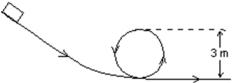
(Multiple Choice)
4.8/5  (82)
(82) Which one of the following five quantities CANNOT be used as a unit of potential energy?
(Multiple Choice)
4.8/5 (80)
(80) A 0.20-kg particle moves along the x axis under the influence of a conservative force.The potential energy is given by U(x)= (8.0 J/m2)x2 + (2.0 J/m4)x4,
Where x is in coordinate of the particle.If the particle has a speed of 5.0 m/s when it is at x = 1.0 m, its speed when it is at the origin is:
(Multiple Choice)
4.8/5 (68)
(68) As a particle moves along the x axis it is acted by a conservative force.The potential energy is shown below as a function of the coordinate x of the particle.Rank the labeled regions according to the magnitude of the force, least to greatest. 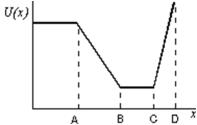
(Multiple Choice)
4.8/5 (94)
(94) A toy cork gun contains a spring whose spring constant is 10.0 N/m.The spring is compressed 5.00 cm and then used to propel a 6.00-g cork.The cork, however, sticks to the spring for 1.00 cm beyond its unstretched length before separation occurs.The muzzle velocity of this cork is: 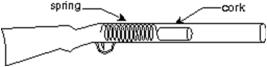
(Multiple Choice)
4.8/5 (72)
(72) A projectile of mass 0.50 kg is fired with an initial speed of 10 m/s at an angle of 60° above the horizontal.The potential energy of the projectile-Earth system when the projectile is at its highest point (relative to the potential energy when the projectile is at ground level)is:
(Multiple Choice)
4.9/5 (69)
(69) A simple pendulum consists of a 2.0 kg mass attached to a string.It is released from rest at X as shown.Its speed at the lowest point Y is: 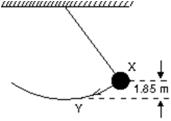
(Multiple Choice)
4.9/5 (83)
(83) A block of mass m is initially moving to the right on a horizontal frictionless surface at a speed v.It then compresses a spring of spring constant k.At the instant when the kinetic energy of the block is equal to the potential energy of the spring, the spring is compressed a distance of:
(Multiple Choice)
4.7/5 (71)
(71) A particle is released from rest at the point x = a and moves along the x axis subject to the potential energy function U(x)shown.The particle: 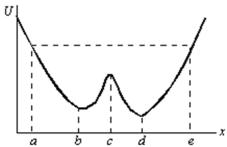
(Multiple Choice)
4.9/5 (67)
(67) The first graph shows the potential energy U(x)for a particle moving on the x axis.Which of the following five graphs correctly gives the force F exerted on the particle? 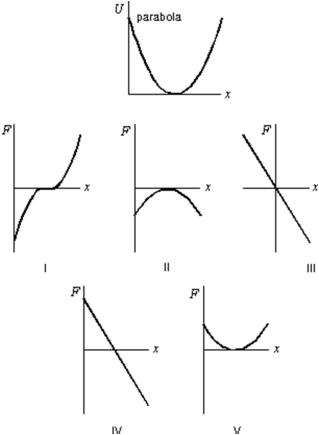
(Multiple Choice)
4.8/5 (78)
(78) Given a potential energy function U(x), the corresponding force  is in the positive x direction if:
 (Multiple Choice)
4.8/5 (84)
(84) A 5-kg projectile is fired over level ground with a velocity of 200 m/s at an angle of 25°above the horizontal.Just before it hits the ground its speed is 150 m/s.Over the entire trip the change in the thermal energy of the projectile and air is:
(Multiple Choice)
4.8/5 (69)
(69) The string in the figure is 50 cm long.When the ball is released from rest, it swings along the dotted arc.How fast is it going at the lowest point in its swing? 
(Multiple Choice)
4.9/5 (74)
(74) A particle moves along the x axis under the influence of a stationary object.The net force on the particle, which is conservative, is given by F = (8N/m3)x3.If the potential energy is taken to be zero for x = 0 then the potential energy is given by:
(Multiple Choice)
4.7/5 (75)
(75) Two particles interact by conservative forces.In addition, an external force acts on each particle.They complete round trips, ending at the points where they started.Which of the following must have the same values at the beginning and end of this trip?
(Multiple Choice)
5.0/5 (84)
(84) An elevator is rising at constant speed.Consider the following statements: I.the upward cable force is constant
II.the kinetic energy of the elevator is constant
III.the gravitational potential energy of the Earth-elevator system is constant
IV.the acceleration of the elevator is zero
V.the mechanical energy of the Earth-elevator system is constant
(Multiple Choice)
4.8/5 (82)
(82) The diagram shows a plot of the potential energy as a function of x for a particle moving along the x axis.The points of stable equilibrium are: 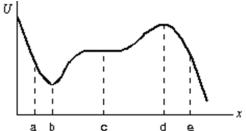
(Multiple Choice)
4.9/5 (72)
(72) The energy of a system increases at a rate of 3.5 t + 6.2 t2, in joules.What is the instantaneous power at t = 3.1 s?
(Multiple Choice)
4.9/5 (82)
(82) Objects A and B interact with each other via both conservative and nonconservative forces.Let KA and KB be the kinetic energies, U be the potential energy, and Eint be the internal energy.If no external agent does work on the objects then:
(Multiple Choice)
4.7/5 (88)
(88) 
Filters
- Essay(0)
- Multiple Choice(0)
- Short Answer(0)
- True False(0)
- Matching(0)