



 Chat with AI
Exam 9: Making Earth

Exam 1: Why Study Earth84 Questions
Exam 2: Minerals: Building Blocks of the Planet88 Questions
Exam 3: Rocks and Rock-Forming Processes90 Questions
Exam 4: Formation of Magma and Igneous Rocks88 Questions
Exam 5: Formation of Sediment and Sedimentary Rocks83 Questions
Exam 6: Formation of Metamorphic Rocks84 Questions
Exam 7: Earth Materials As Time Keepers91 Questions
Exam 8: Earth Materials As Time Keepers85 Questions
Exam 9: Making Earth74 Questions
Exam 10: Motion Inside Earth62 Questions
Exam 11: Deformation of Rocks88 Questions
Exam 12: Global Tectonics: Plates and Plumes80 Questions
Exam 13: Tectonics and Surface Relief85 Questions
Exam 14: Soil Formation and Landscape Stability79 Questions
Exam 15: Mass Movements: Landscapes in Motion85 Questions
Exam 16: Streams: Flowing Water Shapes the Landscape85 Questions
Exam 17: Water Flowing Underground85 Questions
Exam 18: Glaciers: Cold-Climate Sculptors of Continents83 Questions
Exam 19: Shorelines: Changing Landscapes Where Land Meets Sea84 Questions
Exam 20: Wind: a Global Geologic Process85 Questions
Exam 21: Global Warming: Real Time Change in the Earth System79 Questions
Select questions type


The disk-shaped cloud that formed our solar system is called the solar nebula because:
(Multiple Choice)
4.8/5  (82)
(82) Which of the following did not happen to Earth's original rocks?
(Multiple Choice)
4.8/5 (78)
(78) The most distinctive chemical and physical boundary within Earth is between the mantle and core.
(True/False)
4.8/5 (75)
(75) Although spectacular collisions like comet Shoemaker-Levy 9 impact with Jupiter in 1994 provide evidence that planetary accretion is still occurring, near all the mass of the solar nebula now resides in the sun and planets. When did Earth, for the most part, attain its current mass and volume?
(Multiple Choice)
4.8/5 (84)
(84) Why did the first planetesimals form at the outer edge of the nebular disk?
(Multiple Choice)
4.9/5 (85)
(85) After about 100,000 years, what is the internal temperature of a nebular disk?
(Multiple Choice)
4.8/5 (90)
(90) Figure 9.15 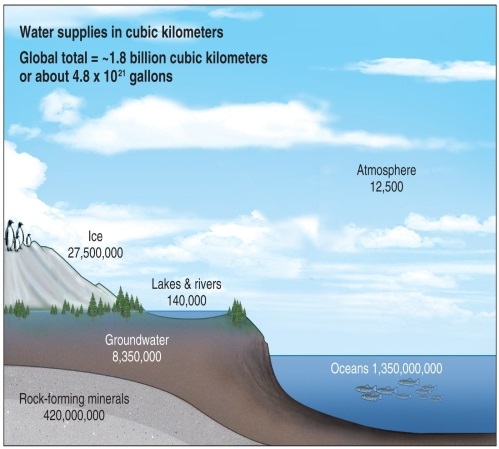 -Using Figure 9.15 in your textbook, what is the ratio of cubic kilometers of water in ice to water in rock-forming minerals?
 (Multiple Choice)
4.8/5 (74)
(74) Present day heat flow from within Earth is twice as high as could be expected from radioactivity's contribution. This suggests that
(Multiple Choice)
4.8/5 (85)
(85) What determines the chemical composition of the dust particles that form around a protostar?
(Multiple Choice)
4.8/5 (90)
(90) The oceanic crust has an average age of ________ and a maximum age of ________.
(Multiple Choice)
4.8/5 (61)
(61) What is defined here? "mixtures of ice and rock like dirty snowballs"
(Multiple Choice)
5.0/5 (84)
(84) 
Filters
- Essay(0)
- Multiple Choice(0)
- Short Answer(0)
- True False(0)
- Matching(0)