



 Chat with AI
Exam 9: Making Earth

Exam 1: Why Study Earth84 Questions
Exam 2: Minerals: Building Blocks of the Planet88 Questions
Exam 3: Rocks and Rock-Forming Processes90 Questions
Exam 4: Formation of Magma and Igneous Rocks88 Questions
Exam 5: Formation of Sediment and Sedimentary Rocks83 Questions
Exam 6: Formation of Metamorphic Rocks84 Questions
Exam 7: Earth Materials As Time Keepers91 Questions
Exam 8: Earth Materials As Time Keepers85 Questions
Exam 9: Making Earth74 Questions
Exam 10: Motion Inside Earth62 Questions
Exam 11: Deformation of Rocks88 Questions
Exam 12: Global Tectonics: Plates and Plumes80 Questions
Exam 13: Tectonics and Surface Relief85 Questions
Exam 14: Soil Formation and Landscape Stability79 Questions
Exam 15: Mass Movements: Landscapes in Motion85 Questions
Exam 16: Streams: Flowing Water Shapes the Landscape85 Questions
Exam 17: Water Flowing Underground85 Questions
Exam 18: Glaciers: Cold-Climate Sculptors of Continents83 Questions
Exam 19: Shorelines: Changing Landscapes Where Land Meets Sea84 Questions
Exam 20: Wind: a Global Geologic Process85 Questions
Exam 21: Global Warming: Real Time Change in the Earth System79 Questions
Select questions type


Planetary accretion is the process that gradually accumulates small particles into large different parts of the nebular disk, because of the different condensation temperatures of particles at various distances from the hot protosun.
(True/False)
4.9/5  (69)
(69) "The oceanic crust is older than the continental crust because it is deeper." Evaluate this statement.
(Multiple Choice)
4.8/5 (73)
(73) What does a comparison of meteorite abundances of metals with samples of Earth's mantle help geochemists understand?
(Multiple Choice)
4.8/5 (89)
(89) What happened to the "leftovers" from the formation of our solar system?
(Essay)
4.8/5 (87)
(87) The continental crust has an average age of ________ and a maximum age of ________.
(Multiple Choice)
5.0/5 (90)
(90) Which explanation best describes how oceanic crust is formed?
(Multiple Choice)
4.9/5 (82)
(82) Figure 9.9 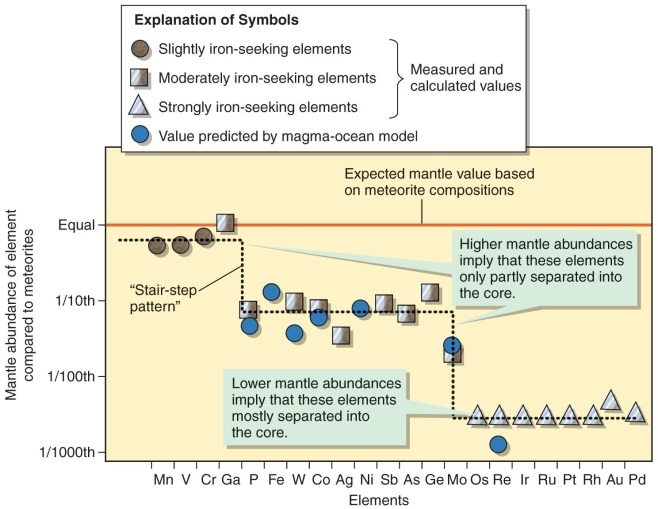 -Using Figure 9.9 in your textbook, which element is present in the mantle in the same quantity as it is present in meteorites?
 (Multiple Choice)
4.9/5 (71)
(71) The rocks that originated during or immediately after Earth's planetary formation are not preserved for study.
(True/False)
5.0/5 (81)
(81) Why did the first planetesimals form at the outer edge of the nebular disk?
(Multiple Choice)
4.7/5 (73)
(73) The final accretion of Earth is thought to have included giant embryo collisions.
(True/False)
4.8/5 (86)
(86) What scientific mistake do late-delivery hypothesis scientists claim that water-accretion hypothesis scientists made?
(Multiple Choice)
4.8/5 (87)
(87) The statement that certain meteorites resemble the composition of the early mantle is
(Multiple Choice)
4.8/5 (89)
(89) Oxygen most likely accumulated in the atmosphere very gradually after the appearance of photosynthetic organisms, which consume carbon dioxide while manufacturing oxygen.
(True/False)
4.7/5 (81)
(81) Which option was not an effect of gravitational push and pull on planetary embryos?
(Multiple Choice)
4.9/5 (73)
(73) How much material is accreted to Earth from outer space on a daily basis?
(Multiple Choice)
4.9/5 (84)
(84) The largest reservoir of water on, below or above Earth's surface is/are
(Multiple Choice)
4.8/5 (90)
(90) 
Filters
- Essay(0)
- Multiple Choice(0)
- Short Answer(0)
- True False(0)
- Matching(0)