



 Chat with AI
Exam 11: Deformation of Rocks

Exam 1: Why Study Earth84 Questions
Exam 2: Minerals: Building Blocks of the Planet88 Questions
Exam 3: Rocks and Rock-Forming Processes90 Questions
Exam 4: Formation of Magma and Igneous Rocks88 Questions
Exam 5: Formation of Sediment and Sedimentary Rocks83 Questions
Exam 6: Formation of Metamorphic Rocks84 Questions
Exam 7: Earth Materials As Time Keepers91 Questions
Exam 8: Earth Materials As Time Keepers85 Questions
Exam 9: Making Earth74 Questions
Exam 10: Motion Inside Earth62 Questions
Exam 11: Deformation of Rocks88 Questions
Exam 12: Global Tectonics: Plates and Plumes80 Questions
Exam 13: Tectonics and Surface Relief85 Questions
Exam 14: Soil Formation and Landscape Stability79 Questions
Exam 15: Mass Movements: Landscapes in Motion85 Questions
Exam 16: Streams: Flowing Water Shapes the Landscape85 Questions
Exam 17: Water Flowing Underground85 Questions
Exam 18: Glaciers: Cold-Climate Sculptors of Continents83 Questions
Exam 19: Shorelines: Changing Landscapes Where Land Meets Sea84 Questions
Exam 20: Wind: a Global Geologic Process85 Questions
Exam 21: Global Warming: Real Time Change in the Earth System79 Questions
Select questions type


Figure 11.13 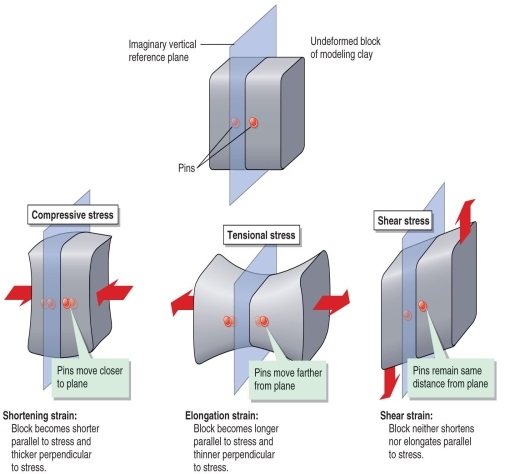 -According to Figure 11.13, which option correctly describes the movement of two pins on either side of a plane in a block of clay submitted to tensional stress?
 (Multiple Choice)
5.0/5  (95)
(95) A measure of earthquake size that corresponds to the energy released during the earthquake is called the
(Multiple Choice)
4.9/5 (79)
(79) A seismic station records an earthquake that has a maximum surface wave amplitude of 20 mm and the S-wave arrives 40 seconds after the P-wave. The Richter magnitude of this earthquake is
(Multiple Choice)
4.9/5 (90)
(90) Cracks where very little or no displacement of rock has occurred are called
(Multiple Choice)
4.8/5 (83)
(83) A seismic station records an earthquake that has a maximum surface wave amplitude of 1 mm and the S-wave arrives 2 seconds after the P-wave. The Richter magnitude of this earthquake is
(Multiple Choice)
5.0/5 (70)
(70) Strike-slip faults include right-lateral, left-lateral and thrust faults.
(True/False)
4.8/5 (88)
(88) Which of the following is not a factor that is considered when comparing the strength of the oceanic and continental lithosphere?
(Multiple Choice)
4.7/5 (80)
(80) All of the seismic hazards in the United States are located west of the Rocky Mountains.
(True/False)
4.8/5 (87)
(87) If a geologist creates a geologic map of an area and then draws a cross-section of that area, what type of scientific process is shown?
(Multiple Choice)
4.8/5 (65)
(65) What is the best construction method for a building situated in an earthquake prone area?
(Essay)
4.9/5 (69)
(69) Judge the following sentence according to the criteria given below. There is a link between mining and faults because minerals precipitate from water percolating along faults.
(Multiple Choice)
4.8/5 (78)
(78) What type of data to date is most useful for earthquake prediction?
(Multiple Choice)
4.9/5 (82)
(82) Oppositely dipping sides of the fold of a rock are called its limbs.
(True/False)
4.7/5 (87)
(87) You are asleep and are awakened to hear dishes rattling, and you feel a sensation that resembles a heavy truck striking your building. On the Modified Mercalli Intensity Scale, what intensity is the earthquake you've experienced?
(Multiple Choice)
4.8/5 (84)
(84) 
Filters
- Essay(0)
- Multiple Choice(0)
- Short Answer(0)
- True False(0)
- Matching(0)