



 Chat with AI
Exam 11: Deformation of Rocks

Exam 1: Why Study Earth84 Questions
Exam 2: Minerals: Building Blocks of the Planet88 Questions
Exam 3: Rocks and Rock-Forming Processes90 Questions
Exam 4: Formation of Magma and Igneous Rocks88 Questions
Exam 5: Formation of Sediment and Sedimentary Rocks83 Questions
Exam 6: Formation of Metamorphic Rocks84 Questions
Exam 7: Earth Materials As Time Keepers91 Questions
Exam 8: Earth Materials As Time Keepers85 Questions
Exam 9: Making Earth74 Questions
Exam 10: Motion Inside Earth62 Questions
Exam 11: Deformation of Rocks88 Questions
Exam 12: Global Tectonics: Plates and Plumes80 Questions
Exam 13: Tectonics and Surface Relief85 Questions
Exam 14: Soil Formation and Landscape Stability79 Questions
Exam 15: Mass Movements: Landscapes in Motion85 Questions
Exam 16: Streams: Flowing Water Shapes the Landscape85 Questions
Exam 17: Water Flowing Underground85 Questions
Exam 18: Glaciers: Cold-Climate Sculptors of Continents83 Questions
Exam 19: Shorelines: Changing Landscapes Where Land Meets Sea84 Questions
Exam 20: Wind: a Global Geologic Process85 Questions
Exam 21: Global Warming: Real Time Change in the Earth System79 Questions
Select questions type


A seismic station records an earthquake that has a maximum surface wave amplitude of 50 mm and the S-wave arrives 2 seconds after the P-wave. The Richter magnitude of this earthquake is
(Multiple Choice)
4.9/5  (77)
(77) Arched folds where limbs dip away from the hinge line are called
(Multiple Choice)
4.8/5 (73)
(73) The block of rock above an inclined fault plane is called the ________.
(Multiple Choice)
4.9/5 (76)
(76) What is the downside of using moment magnitude as an earthquake measurement?
(Essay)
4.8/5 (74)
(74) The elastic rebound theory explains earthquakes as sudden brittle failure following the buildup of elastic strain.
(True/False)
4.7/5 (77)
(77) Intensity measures the violence of ground shaking during an earthquake in terms of the extent to which people felt the earthquake.
(True/False)
4.8/5 (69)
(69) Put the steps in the correct order. 1. Stress exceeds rock yield strength. 2. Potential energy is released as motion energy. 3. Strong rocks absorb large stresses during elastic strain. 4. Rock breaks.
(Multiple Choice)
4.8/5 (70)
(70) Movement along a dip-slip fault causes an abrupt vertical displacement of the ground surface called a fault scarp.
(True/False)
4.9/5 (85)
(85) Figure 11.14 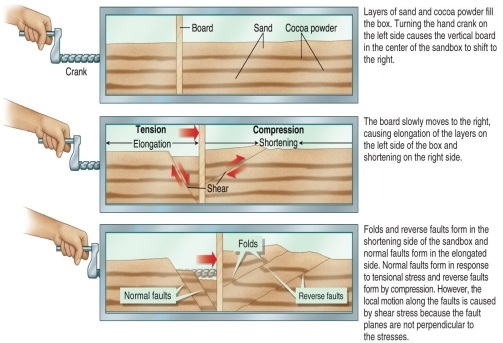 -In a sandbox with a crankable division, which of the following may be illustrated?
 (Multiple Choice)
4.8/5 (80)
(80) 
Filters
- Essay(0)
- Multiple Choice(0)
- Short Answer(0)
- True False(0)
- Matching(0)